In the Middle Ages the rabbit was linked with virgin conception
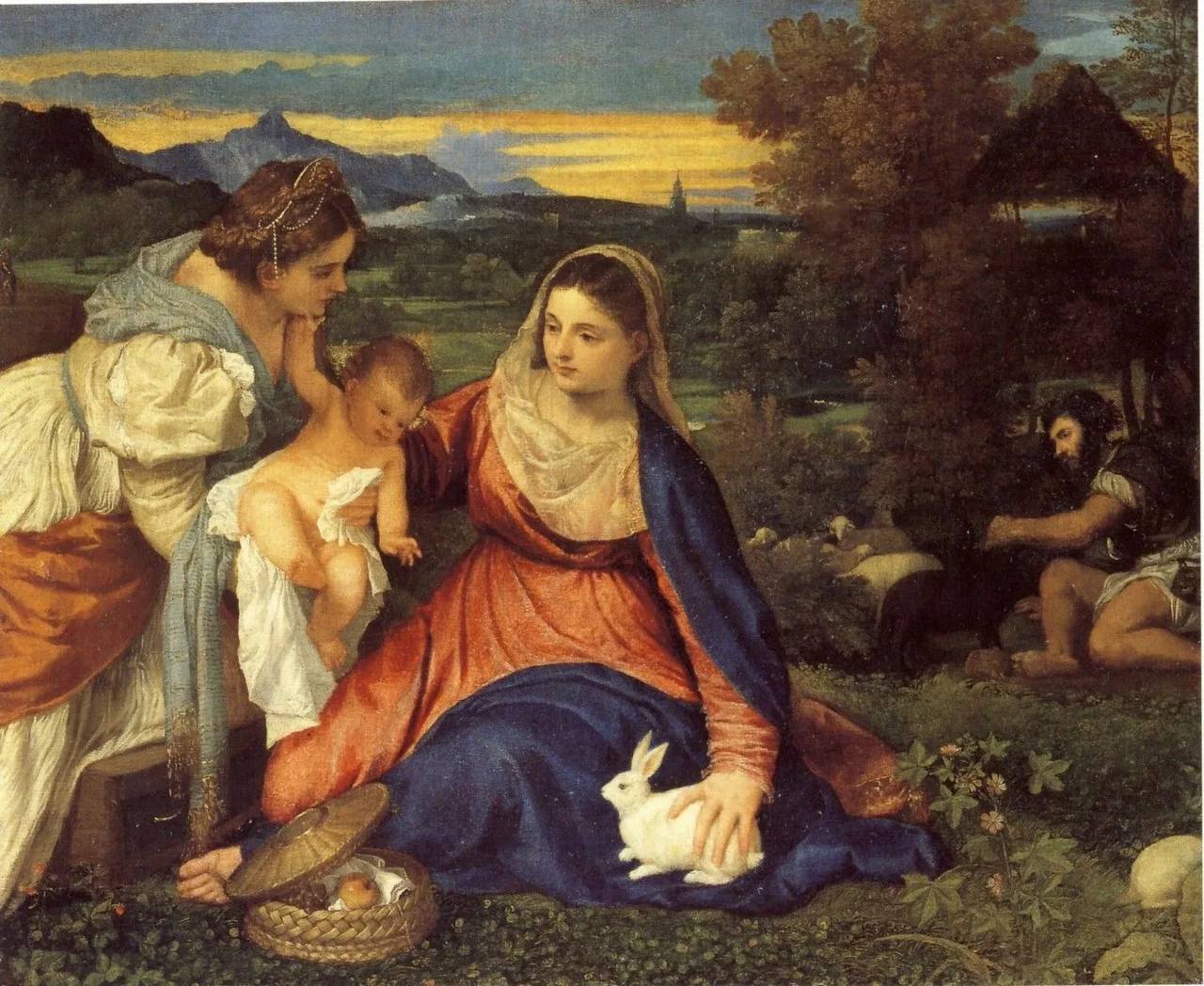
In the Middle Ages the rabbit was linked with virgin conception. It is no accident that the rabbit appears in the iconography of the Virgin, for instance beside Titian's Madonna.
It was believed that a doe rabbit could produce young without mating with a male; this notion in turn goes back to the view that female rabbits can bear two litters as the result of a single mating. An animal so unusual in its qualities was ranked alongside the marvellous and magical beasts.
Besides changing the colour of its coat for winter (the rabbit, or the hare, for medieval authors did not tell them apart), it was also supposed to change its sex when need arose. In principle, biology too can furnish descriptions of extremely rare cases of parthenogenesis (virgin conception) in rabbits.
Apart from its role in the many rites of Easter and in the Christian legendary, the rabbit also played its part in the scientific establishment of the mechanisms of heredity, and in a rather unexpected way. Darwin supposed that certain capsules carrying hereditary information were contained in the germ cells. In his view, these particles, the so-called gemmules, were conveyed through the blood from the tissues of the body, bearing the necessary information, into the cells of the reproductive organs.
That Darwin was mistaken was demonstrated with perfect clarity by his contemporary Francis Galton, by means of an experiment with rabbits: he took albino and black rabbits and transfused the blood of individuals of one colouring into animals of the other. Had Darwin's theory been correct, then together with the black rabbit's blood the information about black fur should have passed into the albino's germ cells, and the offspring of such a rabbit, after mating with another white rabbit, would still have turned out black. This did not happen in a single combination.
Galton, however, came to the conclusion that the germ cells already contain hereditary information, and of two kinds: one influencing the new organism, and another passed on in a dormant state to its descendants. This was, on the whole, the foundation for understanding the dual nature of heredity, which later discoveries would confirm.