September digest: archaeological finds, exhibitions, museums, theatre and the Church
In the finale of the Strugatskys' Roadside Picnic, the Golden Ball is told: "Happiness for everybody, free, and let nobody go away unsatisfied!" I do not promise to offend nobody, but the digest really does come free of charge. So, here is the main business of the channel for September.
Archaeology and the origins of man 🧑🏻🔬 In the Obi-Rakhmat cave in Uzbekistan arrowheads 80,000 years old were found, the oldest long-range weapon in Eurasia. The DNA of plague was detected in 18 of 46 hunters of the Baikal region who lived 5,500 years ago; it has become known that the early strains were not mild. In three caves in the south of Spain traces of cannibalism were found. Beneath the Hôtel-Dieu hospital on the Île de la Cité a wall of Lutetia more than two thousand years old was unearthed. In Staraya Russa an eleventh-century serpentine amulet was found, on which a warrior saint keeps company with the head of Medusa. The cultivated vine reached Iberia with the Phoenicians about three thousand years ago, long before the Romans. In Henan the first skeletal evidence of punishment by cutting off the nose, described in the Chinese chronicles, was found.
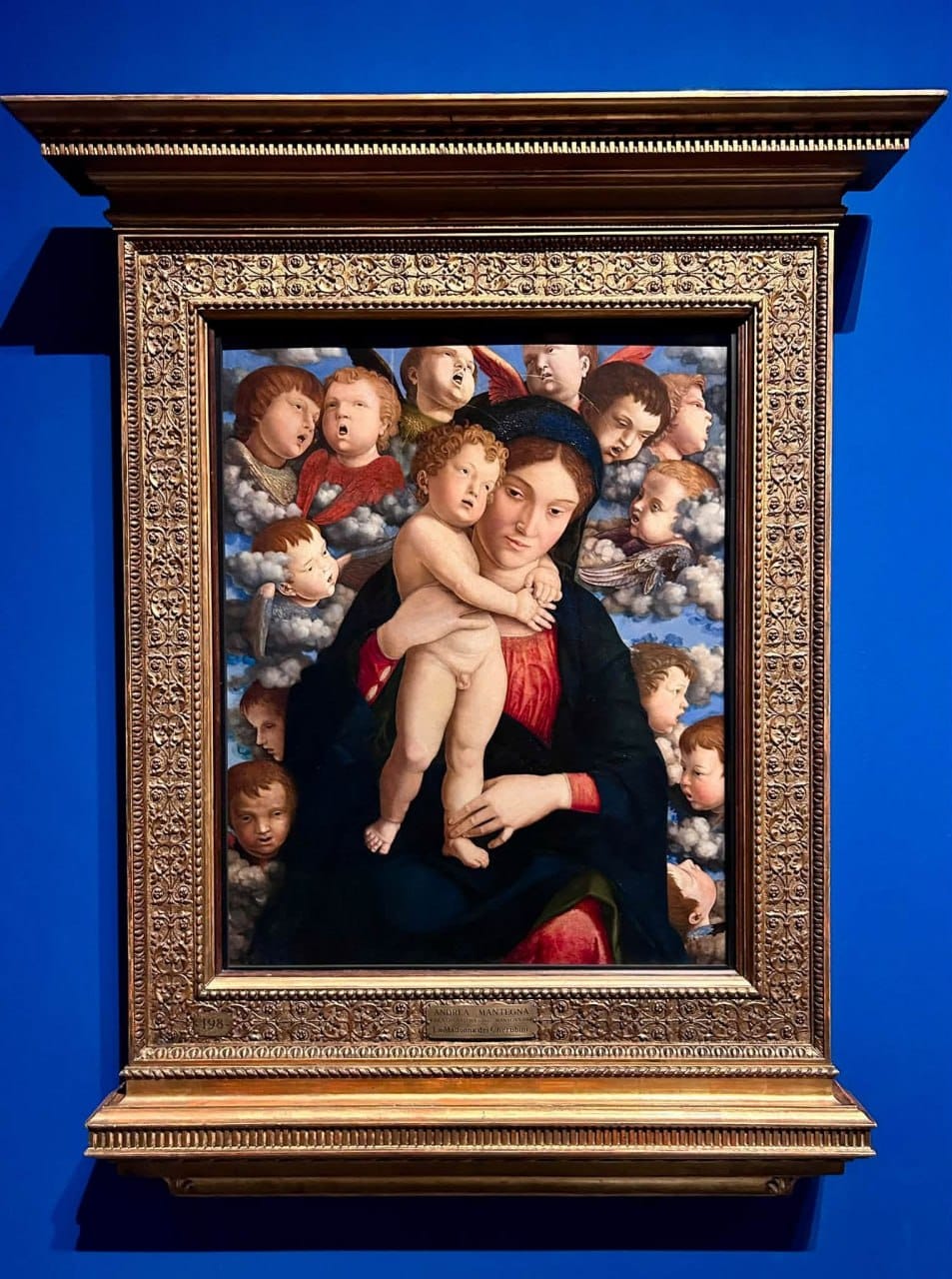
Exhibitions 🖼 The season was opened by Cosmoscow, but the chief museum event of the year in Moscow I consider to be the Ludwig gift at Zaryadye, shown in its entirety for the first time. At the All-Russian Museum of Decorative Art Vrubel is presented through ceramics. The Rublev Museum has assembled more than a hundred monuments of childhood sanctity. At the Museum of the East there is an exhibition of three generations of the Volkov-Rybnikovs, at the Galeev Gallery Pakhomov has been brought together for the first time, and at AZ/ART the sculptors of the Thaw, nonconformists, stand beside the academicians. The Ekaterina Foundation tells the history of the colour black after Pastoureau's book.
Market and museums 💰 The Getty has bought its first Velázquez, a portrait of Olivares of around 1626. The Picasso Museum will issue an edition of bronzes to pay for a new wing, while in Russia a trial is under way over forged casts of Neizvestny that had passed through the Tretyakov Gallery. For the first time a Hockney dachshund will come up at auction, estimated at £1.5 to 2.5 million. The Bayeux Tapestry has come to the British Museum for the first time in almost a thousand years, and photographing it is forbidden. Caravaggio's Bacchus was taken off the wall of the Uffizi after a leak, while two Germans glued their own paintings next to the "Mona Lisa".
Theatre and literature 📖 The Electrotheatre marked Yukhananov's birthday with the evening "Picnic. Requiem", and Anatoly Vasiliev sent a message for it. The Satyricon began its 88th season still without a stage of its own. Rushdie and his wife spoke about the film Knife about the attack of 2022. Evangelicals are outraged that the lion Aslan will be voiced by Meryl Streep. The Writers' Bookshop on Kuznetsky has opened again, which cannot be said of Akademkniga on Vavilov Street.
Church and power ⛪️ Leo XIV prayed at Lourdes, and Macron first boycotted his masses, then held the Pope by the elbow. The Synod of the Church of Greece two weeks later withdrew an honour from Metropolitan Ambrosios for his criticism. No one has ever seen Nikon's ban on tent roofs, while the men of Palekh built a tent-roofed bell tower in 1762-1774.
Empires and memory 🏰 Tsarevich George died in 1899 on the highway near Abastumani, having barely stepped down from a petrol tricycle. The Admiral Kuznetsov left Sevastopol for the North on the day of the Ukrainian referendum of 1991. By 1788 there were 2.22 million Aboriginal people in Australia, and 93% of them perished in under eighty years. The Tbilisi "underground city" turned out to be the engineering foundation of an apartment house of 1912-1915. In 1903 Kustodiev photographed Novgorod, and Stelletsky photographed Kustodiev himself.
Science and methods 🔬 A NASA method for satellite imagery helps to read faded rock paintings. Thousand-year-old seeds from the port of Wenzhou have proved that the melon came to China from South Asia. In fossilised dinosaur dung 66 million years old a feather was found