In an eighteenth-century alchemical manuscript, "The Wisdom of the Ancient Philosophers, or Their Teaching on the Supreme and Universal Medicine", once kept in the Capuchin library on the Rue Saint-Honoré and describing a universal medicine capable of pre
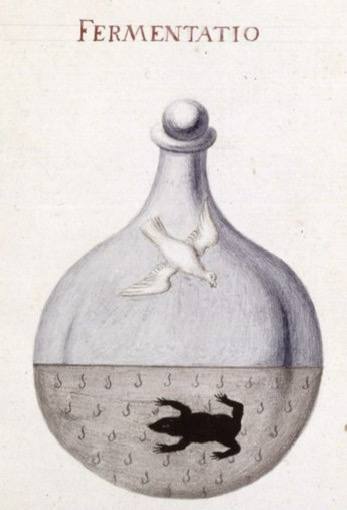
Let us take four from the many scenes: Fermentatio, Putrefactio, Solutio, Calcinatio. They show, first, the substance: a toad half-submerged in water and speckled with rising bubbles. This is the textbook visual representation of the "putrefaction of matter, often accompanied by the release of gas.
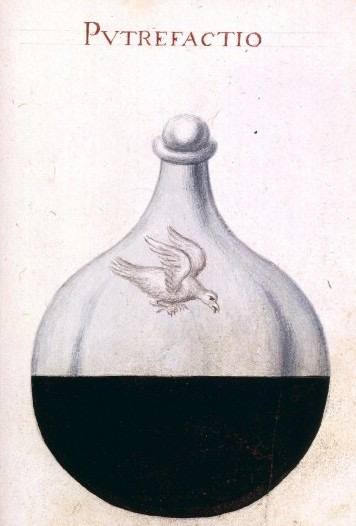
Putrefaction is followed by Putrefactio: the contents have turned black, becoming the nigredo, the necessary "death" that precedes rebirth. In alchemy the nigredo is the first stage in the making of the Philosophers' Stone. It is characterised by decomposition, putrefaction, death or calcination. The original elements must be wholly destroyed, purified and reduced to a uniform black mass, a mixed matter: a purification in which the imperfect material perishes in order to be born again in a new, perfect form. Jung borrows the notion of the nigredo and calls it the dark night of the soul, in which a person meets his Shadow, which represents the repressed and negative aspects of his personality; in this period he loses his bearings, falls into depression, feels bewildered and crushed, so that in the inner chaos he may realise the necessity of accepting the dark sides for the passage to the stage of whitening.
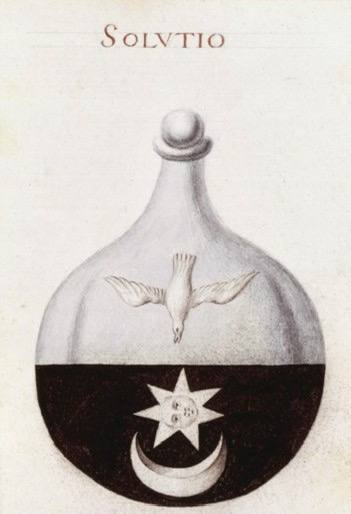
Further on in the manuscript we see a mass with heavenly luminaries, but these are not bodies that have arisen within it. The stage of Solutio, associated with purification and return to the cosmic ocean, describes the transformation of a solid body into a liquid: the material loses its former fixed form and returns to a more primary, scattered state, in order to prepare for transformation. No substance can be changed until it has been reduced to its "prima materia", that is, dissolved. Jung uses this as a metaphor for the dissolution of the rigid, frozen, inflexible aspects of the personality and the plunge into the unconscious, symbolised by water, which will help to wash away unresolved problems and complexities. The destruction of the old "I" releases the energy needed for the birth of a more integral form. The crisis of dissolution, which softens hardened structures, proves necessary for further spiritual growth.
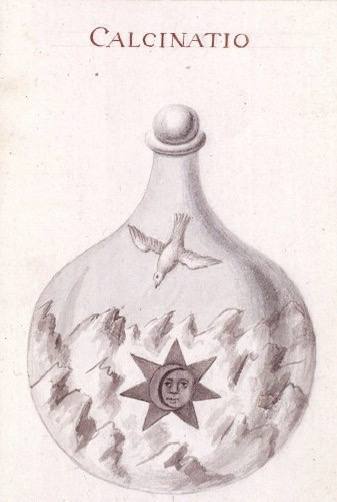
The operation of Calcinatio is connected with the element of fire. It subjects the remaining substance to intense heat, turning it into friable lime, that is, an oxide, or into dust.
In such burning it is not merely volatile impurities and moisture that are removed: the primary structure of the material is also destroyed, and what is left is only a dry, pure residue, white ash. In analytical psychology Calcinatio is introduced to denote an intense psychological transformation caused by an inner fire, that is, the psychic burning of powerful emotions, from anger and shame to frustration and desire. In this fire the ego, which clings to fixed attitudes and flares up on meeting an unyielding reality, is, in theory, consumed.
These are only some of the stages of the so-called Magnum Opus, the obtaining of the Philosophers' Stone, but, as the psychological retelling shows, they demand again and again the simplification of structures, liberation from illusions and false attachments, in order to obtain an inert, purer substance for the creation of a new personality.
I hope Nicolas Flamel has no complaints about my summary. In any case, necromancers and Hermeticists, do not take offence.