Vasilisa Kozhina and the Partisan War Against Napoleon in Smolensk Governorate
The elder of a certain village in the Sychyovka district led a party of prisoners, taken by the peasants, into town. In his absence the villagers caught several more Frenchmen and at once brought them to the elder's wife, Vasilisa, to be dispatched whither they ought to go. The latter, unwilling to distract the grown men from their chief occupation of beating and catching the villains, assembled a small escort of children and, mounting a horse, set off to conduct the Frenchmen herself in the capacity of commander… With this intent, riding round the prisoners, she cried to them in a tone of command: “Now then, French villains! Attention! Fall in! Forward, march!” One of the captive officers, vexed that a mere peasant woman should presume to give him orders, did not obey her. Vasilisa, seeing this, darted up to him in an instant and, striking him on the head with her sceptre, which was a scythe, laid him dead at her feet, exclaiming: “The same will be done to all of you, thieves and dogs, who so much as dare to stir! I have already cut off the heads of twenty-seven such rascals! March to the town!” And after this, who will doubt that the prisoners acknowledged the authority of the elder's wife Vasilisa?
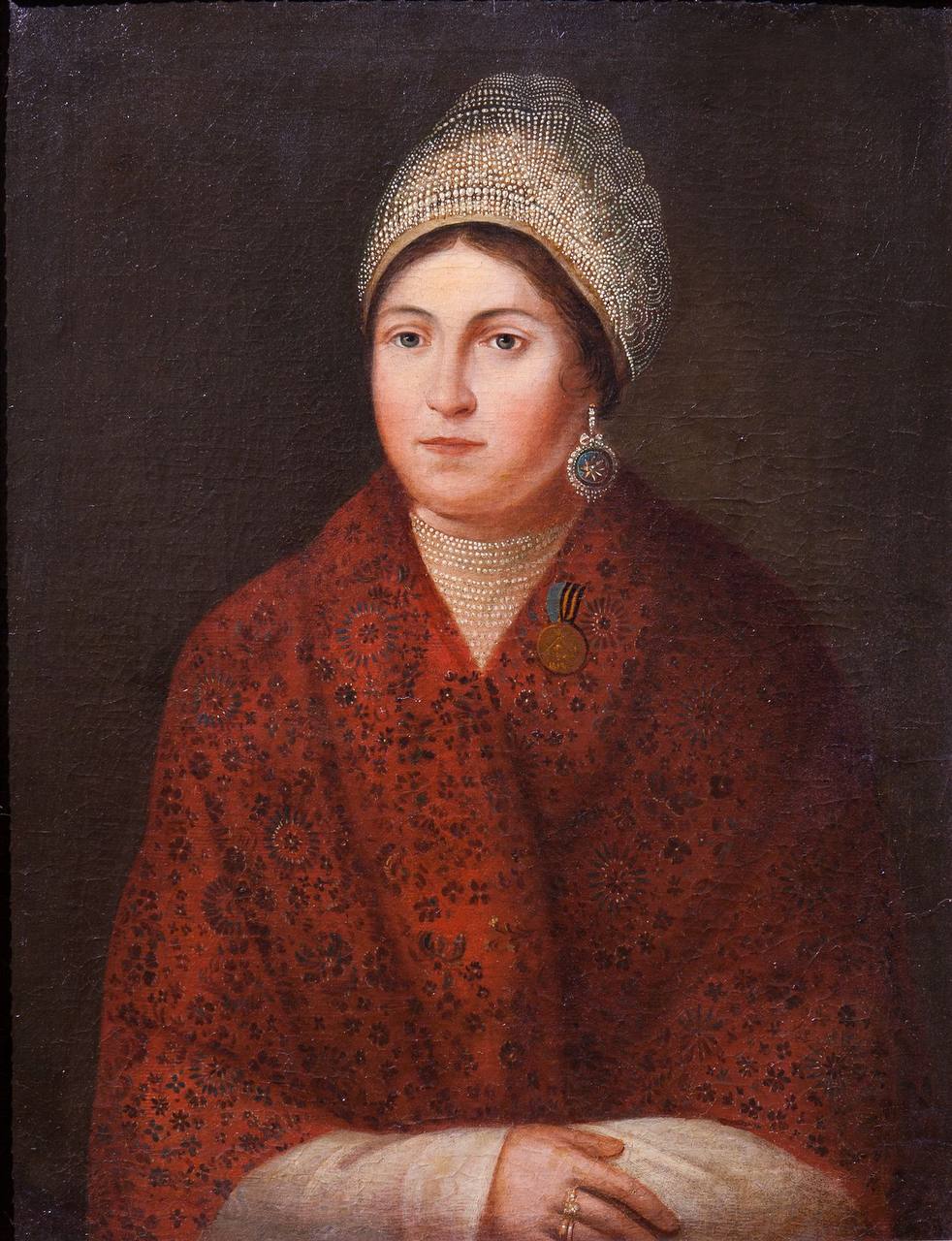
Portrait of the elder's wife Vasilisa Kozhina, Alexandr Smirnov, 1813.
Vasilisa Kozhina, a peasant woman from the hamlet of Gorshkovo in Smolensk Governorate, won fame as a vivid figure of the partisan war against Napoleon. She is believed to have killed several dozen Frenchmen and to have organised a partisan detachment of women and children that inflicted considerable losses on the French troops. For her services in the field Kozhina was awarded a medal and a monetary grant of 500 roubles. She became a celebrity while the war was still under way: her image appeared in tales, in literature and in folk art, and there are several well-known lubok prints featuring her. In present-day Russia streets, a railway station and a village bear Vasilisa Kozhina's name, and there is a monument to her.