Surrealists and the Dadaists Who Joined Them, from Tzara to Man Ray
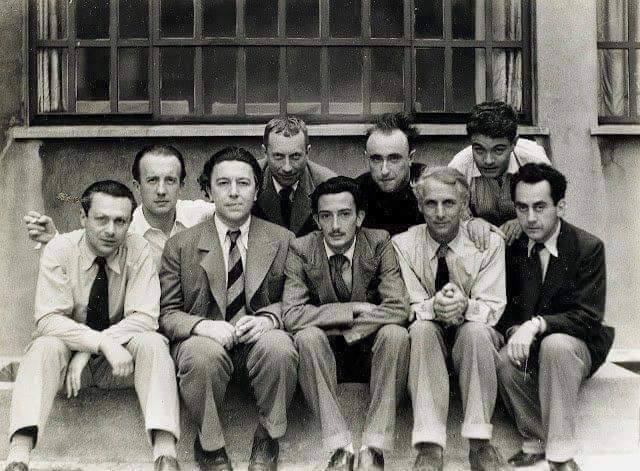
Surrealists in Paris in 1933: Tristan Tzara, Paul Éluard, André Breton, Jean Arp, Salvador Dalí, Yves Tanguy, Max Ernst, René Crevel and Man Ray.
Tristan Tzara was a poet and a founder of Dadaism. In early 1930, together with Francis Ponge and Paul Nougé, he supported the first issue of a new Surrealist journal, Le Surréalisme au service de la Révolution, which, on the whole, continued the political theme in the history of Surrealism's development. We remember how important the printed polemical word proved in the life of this movement, beginning with the Manifesto of Surrealism itself. And, of course, from the very outset art could not keep aloof from political statements: the journal Documents, which ran for two years from the spring of 1929 under the direction of the art theorist and philosopher Georges Bataille, became a hotbed of Surrealist dissent and, in effect, welcomed those who refused to side with the members of the movement who were rushing to pledge the political loyalty of creative people to the French Communist Party.
The poet Paul Éluard, who stood at the source of Surrealism alongside André Breton and Louis Aragon, had previously belonged to the Dadaists, but he felt the anarchic idea of destroying the old morality and trampling on bourgeois taste to be exhausted, and came to Surrealism with experiments in constructive creation in the realm of the superreal.
Not all scholars, however, call Éluard a co-founder of Surrealism; some hold that Surrealism was born in the reflections of André Breton, Philippe Soupault and Louis Aragon. Only later were the three poets joined by other writers, artists and film-makers who likewise sought to free themselves from rational control and to place the imagination at the foundation of their work.
Jean Arp was another active Dadaist who joined the Surrealists when he moved from Switzerland to Paris, where he exhibited at their first exhibition in 1925. Arp's works embody the spirit of automatism: he takes real figures and reduces them to abstract forms. He is the author of the idea of an analogy between the organic world and the creative process: art is a fruit that grows in a person, like a fruit on a plant or a child in its mother's womb.
Yves Tanguy joined the group in 1925, and the influence of Dalí is especially marked in his work. Earlier, like Arp, he had been carried away by automatism; Tanguy now began to paint pictures depicting fairy-tale worlds and vast landscapes populated by biomorphic forms.
The writer and former Dadaist René Crevel was the author of such Surrealist books as “My Body and I”, “Babylon” and “Difficult Death”, which, as it were, burst open the very conception of the novel as a genre.
The American Man Ray owes his greatest fame to Surrealist objects created even before the Surrealist movement took shape: for example, the cloth-wrapped object titled “The Enigma of Isidore Ducasse” and “Gift”, an iron with sharp nails jutting out of it.