Pushkin’s poem “The Death of Lucullus” and Uvarov’s designs on Sheremetev’s inheritance
Sergey Semyonovich Uvarov, who published works on archaeology and ancient Greek literature and rose to be President of the Imperial Academy of Sciences, was an exceedingly contradictory man. Who expects a scholar and thinker to be capable of foul deeds, spite, thieving and petty pilfering? Yet Solovyov recalls that there was not a single baseness that Uvarov was incapable of committing.
He interests us first of all as a man who, through his envious meanness and dirty, bilious gossip, did much to spoil Pushkin's life. It was precisely Uvarov's intrigues that placed Pushkin's Sovremennik under secondary censorship. But Alexander Sergeyevich did not leave the plots hatched against him unanswered, and in effect shamed Uvarov for ever with his talent.
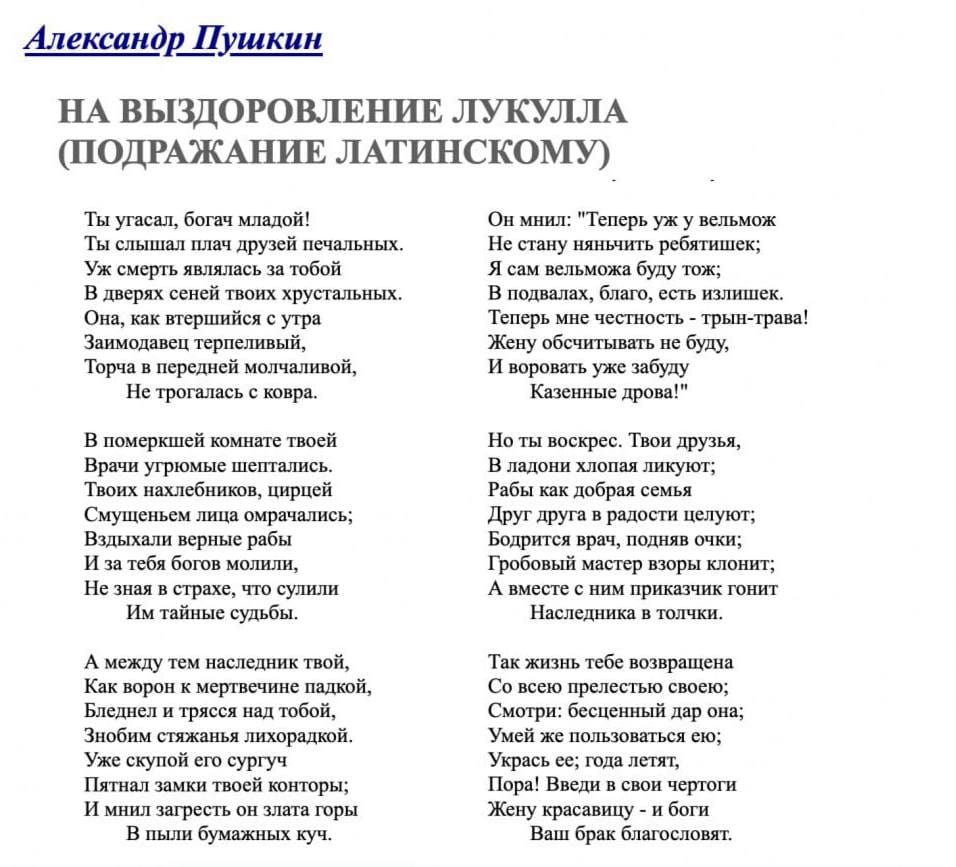
In the well-known poem "The Death of Lucullus" Pushkin describes the repellent scene of a greedy heir of a young rich man scrabbling about, who has set about dividing the fortune of a distant relative who has not yet died. And this really is a direct allusion to the disgraced Uvarov, who sealed up and greedily appropriated the property of the ailing Sheremetev. As is well known, the fabulously wealthy Sheremetev had no direct heirs, and Uvarov was the husband of his second cousin. When the dangerous illness miraculously passed and Sheremetev recovered, Uvarov found himself in a very awkward position.
The poem contains other unpleasant details from Uvarov's life: "I shall not cheat my wife, and I shall forget how to steal the government's firewood!" They point to the beginning of Uvarov's career, when he sold the firewood allotted for heating the Academy's buildings.
When all society recognised Uvarov in the worthless heir, Pushkin had to give explanations to Benckendorff. And the poet objected in astonishment: what could Uvarov possibly have in common with "a low miser, a scoundrel who steals government firewood, hands his wife false accounts, a toady who has become a nursemaid in the houses of noble grandees"?