The "Russian Incredible" exhibition has many paintings before which one stops with a lungful of air
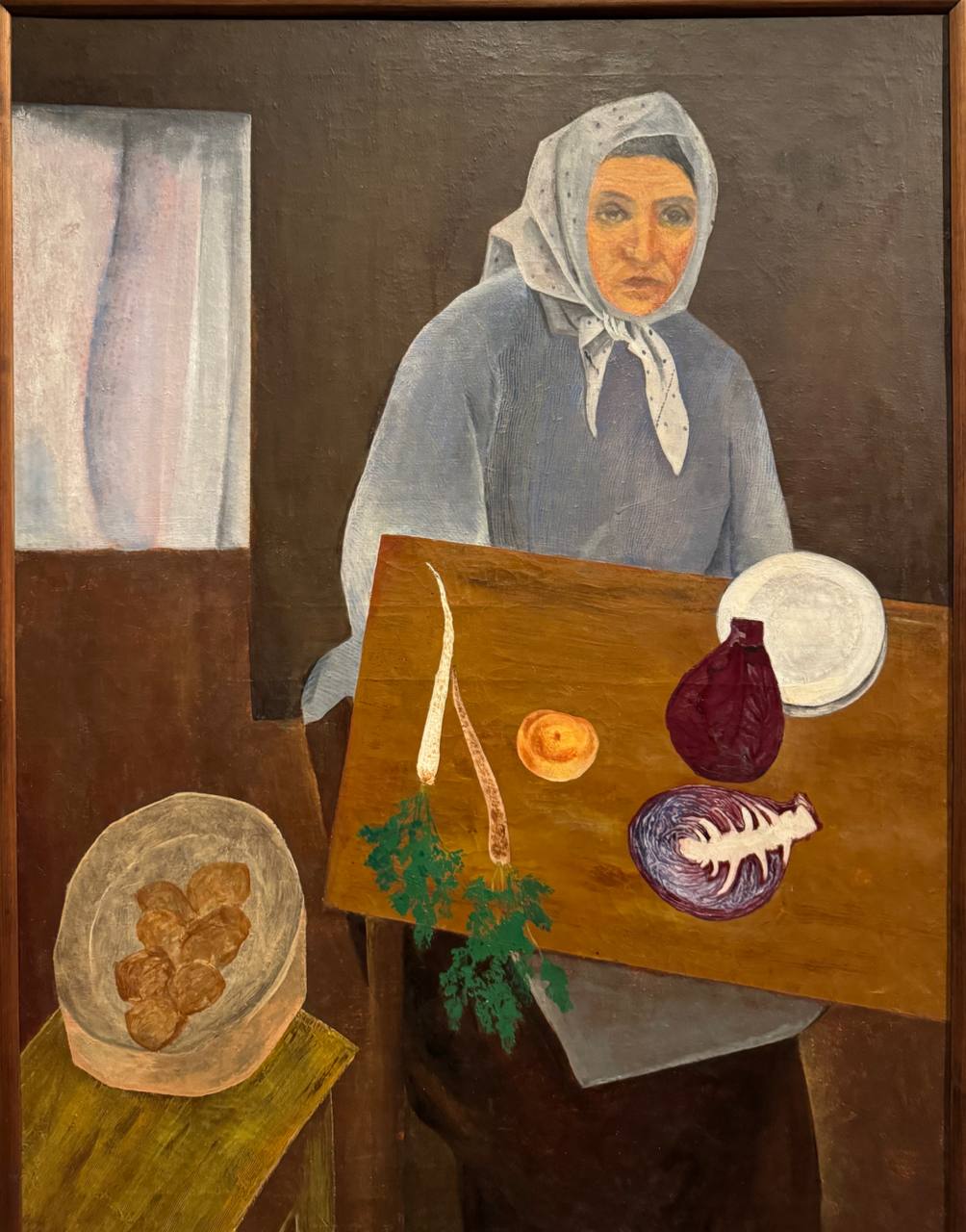
But the painting "Aunt Sasha" by David Petrovich Shterenberg simply will not let go. From the collection of the State Russian Museum.
1922-1923. The Civil War has only just ended. Before us sits a Russian village woman in a cornflower-blue headscarf and blouse. She is no longer young. She has seen the horrors of wars and revolutions, the arbitrariness of land surveyors, the dishonesty of officials and every sort of nastiness from the authorities, yet she still remembers well the happy life, her cow and a barn full of victuals. Aunt Sasha.
They write that the picture conveys the squalor, poverty and devastation of postwar life.
I do not agree. Poverty, why poverty? We see a whole bowl of potatoes, a couple of kilograms at least, two carrots from her own vegetable patch, a large turnip, a sturdy head of cabbage. A clean room, plates on the table, a tidy housewife. Not bent double by illness. A little pensive. But not from want: want has not yet come.
Anyone who knows the shortage of food, its scantiness, will agree: this is not hunger. Aunt Sasha (incidentally, why not Shura? Perhaps because she is not so close to the artist; naturally she is no aunt of his, the son of a shop clerk) could feed her family on these provisions for three days. The daughter-in-law will come with the children, or grandfather will return from his earnings, or a neighbour with her niece from town, and there will be three women in blue. She will set a lenten borscht before them, fry potatoes with thick cracklings in the Russian stove, steam the turnip, find a little grain, and an onion too, and a boiled egg, a bit of bread made with potato leaven, and salt for the table. Help yourselves to whatever God has sent.
But the picture is not really about provisions. In the doorway, on white tulle, daylight plays in pink and blue waves. The cottage is warm and dry. The housewife has something to put on the table and someone to cook for. True, the table is not laid for seven, but still. Aunt Sasha is alive, and someone from her family will dine with her.
There is no room for excess, and there never was any. Flowers? Who knows, there is weed growing beyond the fence, who would bother to pluck it. Tablecloths were never seen here. No one keeps spare crockery. The main thing is that everyone is clothed and fed. What is there to rejoice at, particularly? But it would be a sin to grieve, too. A woman of few words, yes, reserved, modest, Russian. Neat, in her own way handsomely dressed, hair put up, hands resting sedately on her knees.
This is not about emotions but about the everyday happiness of simple things, about blessed ordinariness. Come now, poets and critics: alive, and thank God; the day will bring its own bread. Cross yourselves before the icon and eat, eat