Guido Reni's Moses, painted between 1620 and 1625, and the influence of Caravaggio
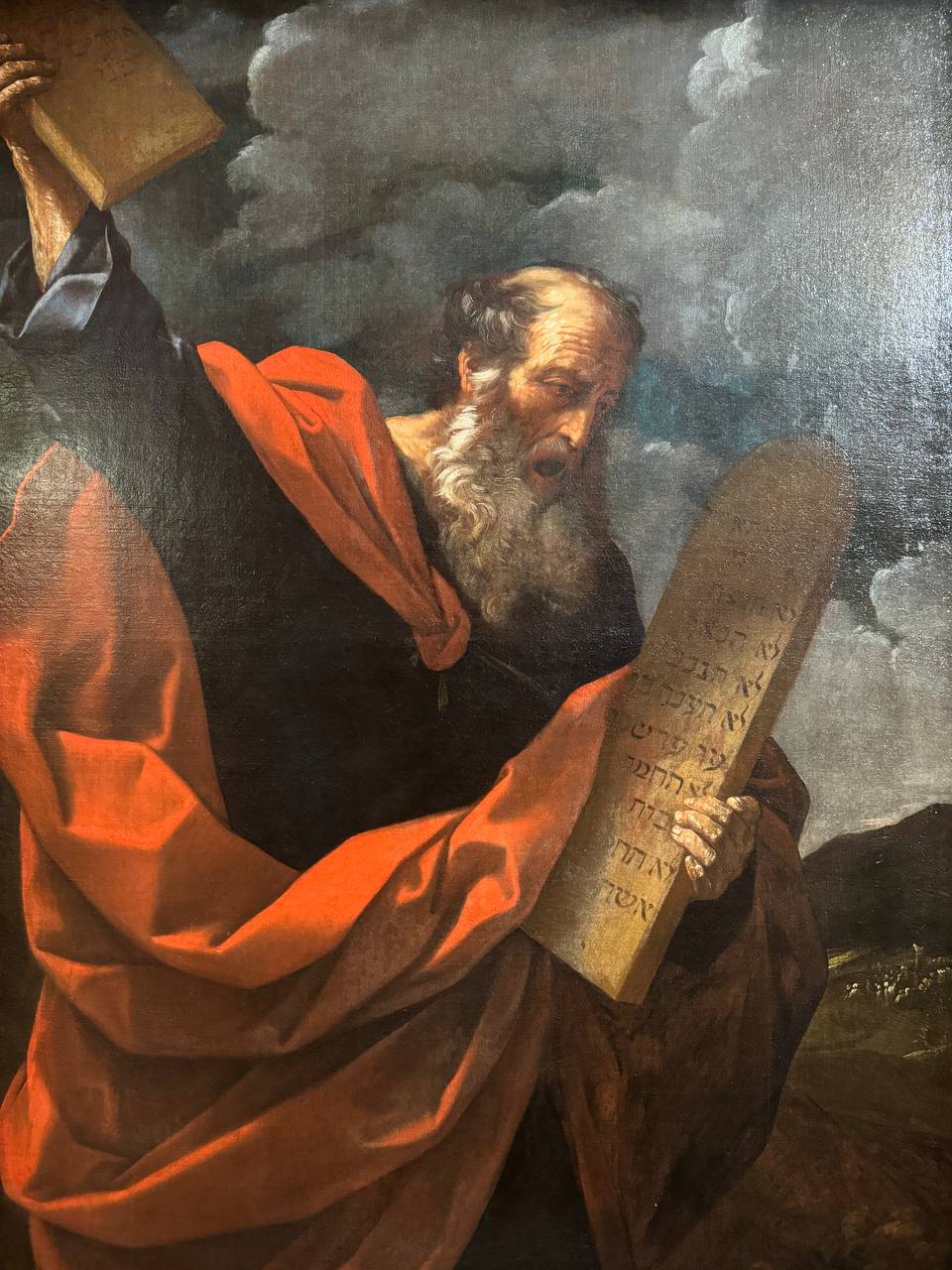
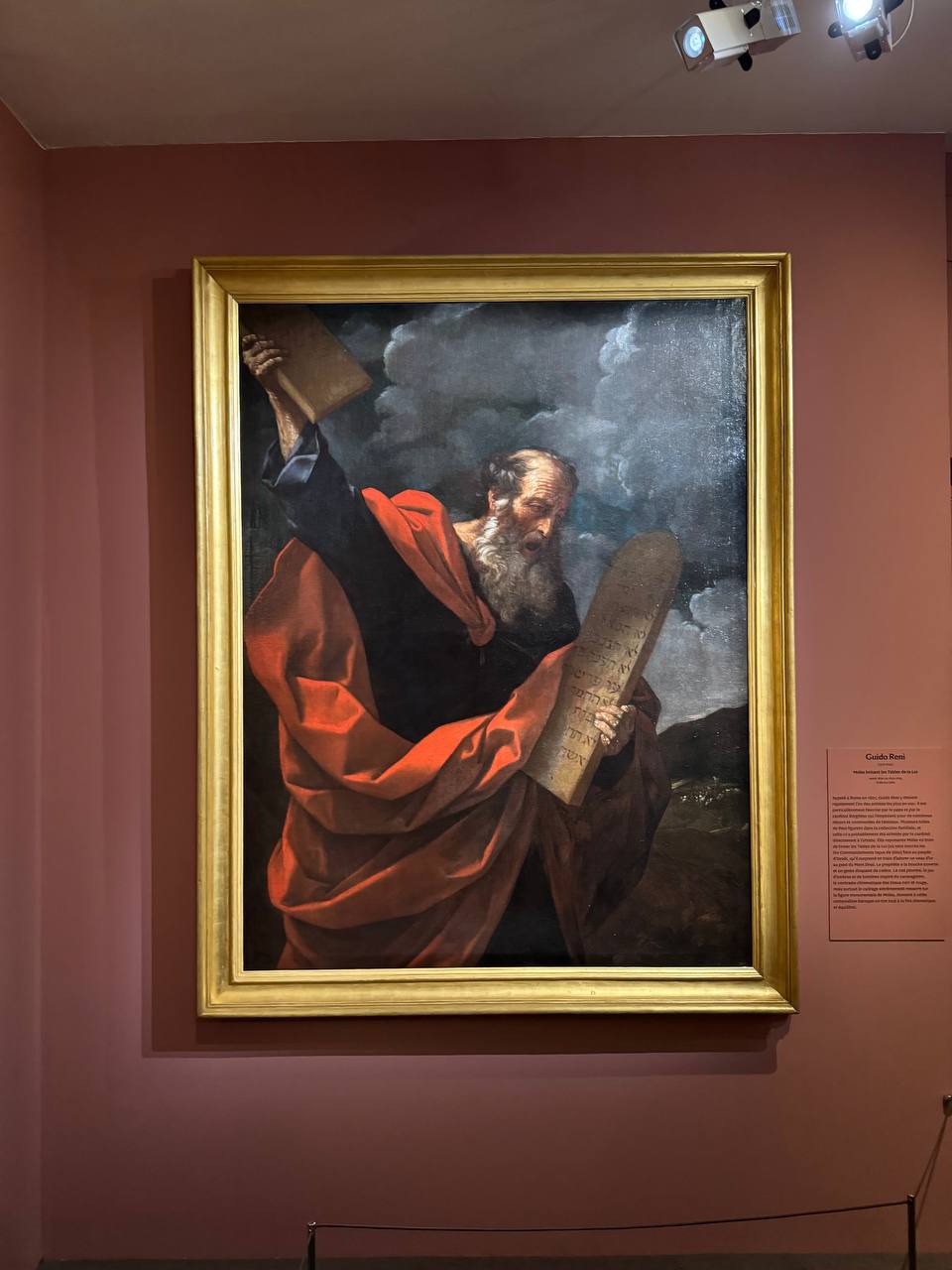
And although the song most apt to the occasion went "don't lose it and don't break it", the masterpiece by Guido Reni in the Galleria Borghese is called "Moses Breaking the Tablets of the Law"
The canvas dates from 1620-1625. By this time Reni was already head of the Bolognese academy.
Having arrived in Rome in 1601, Guido Reni soon won renown as one of the most outstanding painters through his diligence and talent, and found himself under the patronage of the Pope and Cardinal Borghese, who gave him numerous commissions. What more does an artist need than recognition and the chance to work?
Moses breaking the tablets of the Law, inscribed with the Ten Commandments received from God, before the people of Israel, whom the prophet has discovered worshipping the golden calf at the foot of Mount Sinai, is, like many biblical stories, one of the textbook subjects of classical painting.
Let us look at the prophet: his face is contorted with anger, and he is surely shouting. His expression is in harmony with the colouring of the forces of nature, for the backdrop of the picture is a heavy, dark sky. The hero's gesture leaves no doubt as to his intention.
The massive drapery with its characteristic shadows conveys Reni's impression of Caravaggio's methods. Tortured to death some ten years or so before the painting was made, Caravaggio still wields great power over the artistic tastes of his contemporaries. It is known that Guido Reni, almost his exact contemporary, became acquainted with Caravaggio's paintings precisely in Rome, in 1602, after which Reni's work shows traces of his fascination with the scandalous painter. On this canvas we see a Caravaggesque framing of the figure of Moses, set against a dark background, and a rich dramatic intensity. True, in passionate content it is no "David with the Head of Goliath", but the emotion of the prophet smashing the stone tablets is nonetheless very strong. And of course there is the beloved combination of black and red and the contrasting light. Though the contrasting illumination in Reni's pictures is not as warm as Caravaggio's.
Not all of Reni's paintings are so Caravaggesque, and that is what makes this Moses interesting. Guido Reni, as a great master of his time, naturally had his own recognisable style as well, even if at a certain period it took shape under the strong influence of Caravaggio.
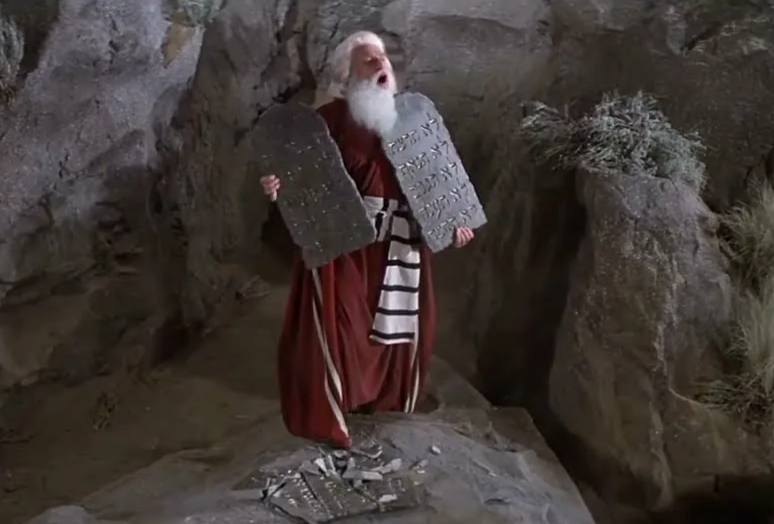
The epic shot with Moses from "Monty Python", to which I turn so often, appears here purely as an example of an artistic image that has influenced me, with the result that I cannot think of Moses and the tablets separately from this particular scene.