Norman Rockwell’s 1951 painting “Spirit of Kansas City” and the fortunes of the city
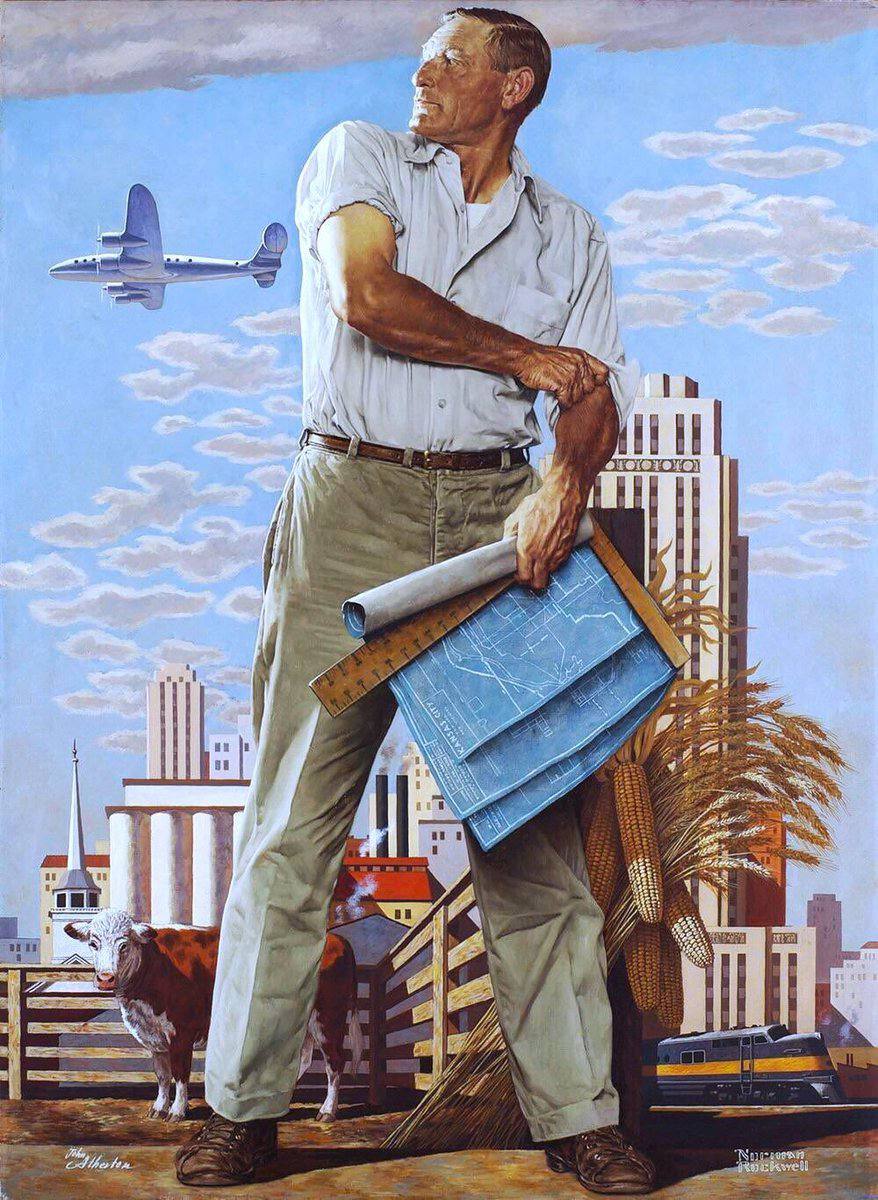
This painting by Norman Rockwell looks as though he were depicting a builder of communism as the builders saw themselves. But no: the work of 1951 is called “The Spirit of Kansas City”.
An aeroplane flies calmly through the sky, while a man stands confidently on the ground. Legs planted wide, taller than a skyscraper, this giant is literally rolling up his sleeves, preparing for new feats. Before us is an engineer or an architect, a true professional, with blueprints and a ruler in his hands. In the bold, forward-looking gaze of this not quite man but colossus there is assurance and audacity.
The ears of wheat and the maize in the background, like the plump pedigree cow: what could better convey the abundance of agricultural production? Before us is, as it were, the quintessence of the very notion of an “exhibition of the achievements of the national economy”.
The canvas has found room for the locomotive of a modern railway train, for public buildings, for a church modest in the American manner, for a modernist colonnade, for smoking factory chimneys. Admit it, you too would like to move into this picture?
The 1950s were upon the world. In the advanced countries the ideas of the grandeur of the human spirit, of great undertakings, of success in industry and construction held sway. Socialist competition on our side was easily replaced on theirs by capitalist competition. The in many ways naive pathos of the hard-working, educated Man with a capital M became common to both sides of the bipolar world.
The Paris of the Plains, as Kansas City had been called since the 1930s, reached the peak of its prosperity at the very time when Soviet industrial and economic centres shone with a special lustre against the backdrop of the headlong development of the first half of the century. But by the 1990s the city was no longer what it had been, and neither was its spirit: broken, weary, without hope for the future. The prosperous city on the banks of the Missouri lost not only its charm and former glory but hundreds of thousands of its inhabitants, who left behind them empty, beautiful Art Deco buildings, the vast halls of city banks and factory workshops. The aircraft plant was repurposed for who knows what, the economy was in decline, the hum of the factories fell silent. And so it remained for a third of a century. But now, suddenly, Kansas City is regaining its former appeal, people are returning, urban spaces are coming back to life, and business is beginning to bustle again. And it seems that the majestic spirit from Rockwell's canvas may yet awaken.
Between “us” and “them” there is much more in common than is usually supposed, don't you think?