Diomedes Wounds Aphrodite in the “Iliad” and Ingres’s Sketch in a Basel Museum
Дочь Зевсова! брось ты войну и кровавую битву;
Не довольно ли, если прельщаешь ты слабых супругов?
Страшно, ах, страшно опять возвращаться тебе на сраженья.
Или, быть может, захочешь еще — и содрогнешься при мысли:
Всякий раз, как пойдешь, увидишь то место, где рана
Тяжкая в длань проницала тебе от руки Диомеда!
Literal translation
Daughter of Zeus! Give up war and bloody battle;
Is it not enough that you beguile feeble husbands?
It is dreadful, ah, dreadful for you to return to the fighting again.
Or perhaps you will wish to, and shudder at the thought:
Every time you go, you will see the place where the grievous
Wound pierced your hand from the hand of Diomedes!
Literal translation
The Iliad, Book V, in Gnedich's Russian translation.
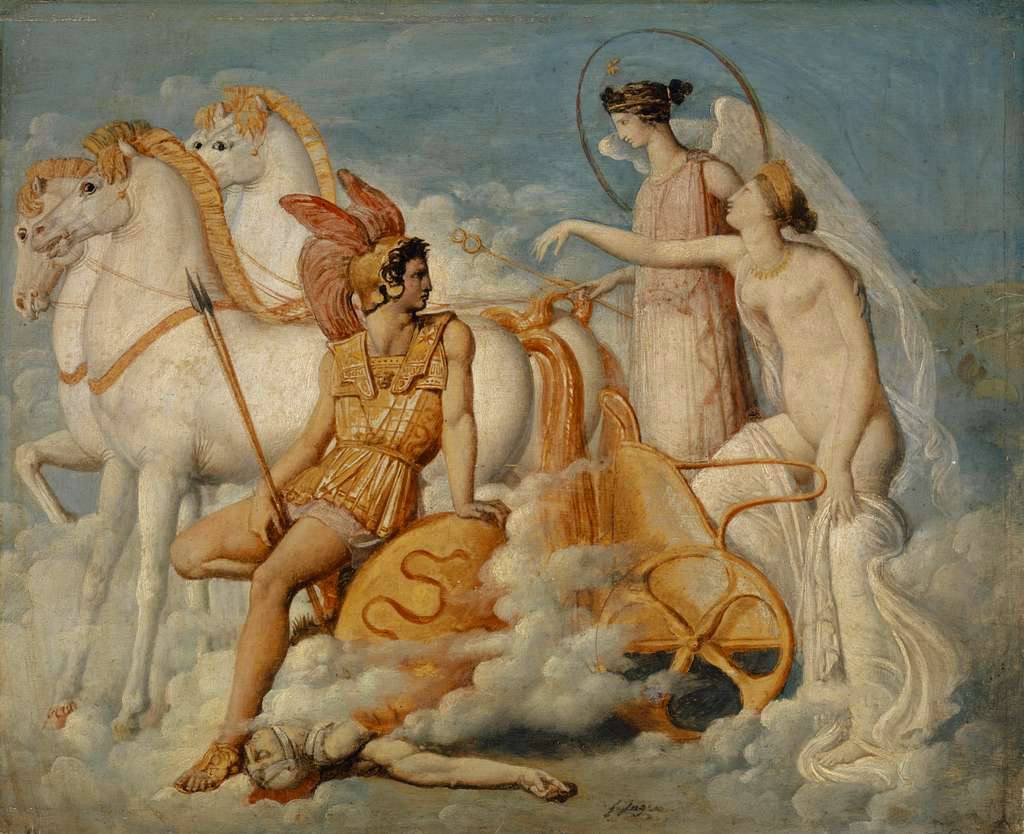
The celebrated hero of the Trojan War, Diomedes, wounded Aphrodite because she had intervened in the course of the battle to save her son Aeneas.
Inspired by Athena, the valiant Diomedes sowed panic among the Trojans and even wounded Ares. But when he attacked the Trojan hero Aeneas and wounded him, Aphrodite, the mother of Aeneas, intervened in the battle, sheltering her wounded son in the folds of her garment. Diomedes was indignant at Aphrodite's interference and cried out that she should concern herself with love affairs alone and not hinder warriors. Athena granted Diomedes the temporary ability to see the gods and not to fear them, and so he hurled his spear at Aphrodite and struck her in the wrist, from which divine blood gushed. Were the goddess of love to intervene in the battle once more, Diomedes threatened to kill her.
This mythical subject is illustrated by Jean Auguste Dominique Ingres. The painting is called The Return of Venus, Wounded by Diomedes, to Olympus. 1800-1805. Oil on paper mounted on panel. This picture from the collection of the Kunstmuseum Basel is quite small, 33 by 37 cm, and is considered a sketch for a larger work that was never realised. Ingres departs somewhat from the classical conception, showing the wounded goddess rising from the earth on a cloud in a chariot drawn by white horses, rather than by swans or doves, surrounded by cupids.