Ever wondered why Moscow has a mayor, while Saint Petersburg has a governor?
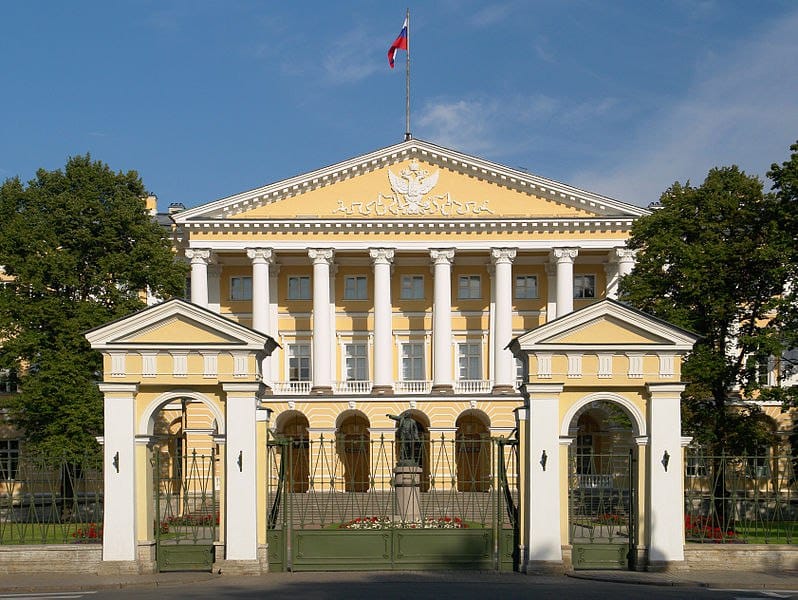
The titles of the highest officials in the constituent entities of the Russian Federation are governed by regional legislation. Both Moscow and Saint Petersburg are constituent entities of the Russian Federation, and each decides for itself what its chief executive shall be called. So does Sevastopol, where the head of the administration is likewise called a governor.
In different entities the highest office may be styled President of the Republic, Head of the Republic or Governor. Article 40, part 1, of the Charter of the City of Moscow states that "the Mayor of Moscow is the highest official of the City of Moscow". Articles 37 and 38 of the Charter of Saint Petersburg establish that the supreme executive body of Saint Petersburg is the Administration, headed by the Governor.
In Moscow, city chiefs have been called governors since the eighteenth century. But some held the title of "chief commander of Moscow": Ivan Romodanovsky in the 1720s; "first presiding member of the Moscow Senate Office" Andrey Matveyev and Ivan Musin-Pushkin. In 1727 the post of governor-general appeared, and from 1732 the commander-in-chief Semyon Saltykov took part in running the city. From the 1770s the post of commander-in-chief was introduced in place of the governorship, and in 1797 a military governor appeared. In 1812 the city acquired a city head and chairman of the municipality, Pyotr Nakhodkin; later the city was run by a military governor-general, and in 1866 the post was redefined as Governor of Moscow, which then functioned for a whole year alongside the governor-generalship. In 1905 the governor-generalship was supplemented by a city prefecture (gradonachalstvo). In 1915 Felix Yusupov was given an original post of his own: supreme commander over Moscow.
In the muddle of 1917 the city was governed by a chief commander, a city prefect, a manager of civil affairs, a commissar of the Provisional Government, the chairman of the Executive Committee of the Moscow City Soviet, the Moscow City Head, the chairman of the presidium of the executive committee of the Moscow Soviet of Workers' Deputies and the chairman of the presidium of the Moscow Soviet of Workers' and Soldiers' Deputies. And all that within a single year!
The post of chairman of the executive committee of the Moscow City Soviet of People's Deputies survived until 1991, when it was succeeded by that of mayor.
Saint Petersburg has had governors, governors-general, city heads, city prefects, first secretaries of the Leningrad City Committee of the CPSU and chairmen of the Leningrad City Executive Committee.