Deliberate curvature of lines in the architecture of the Parthenon and other Greek temples
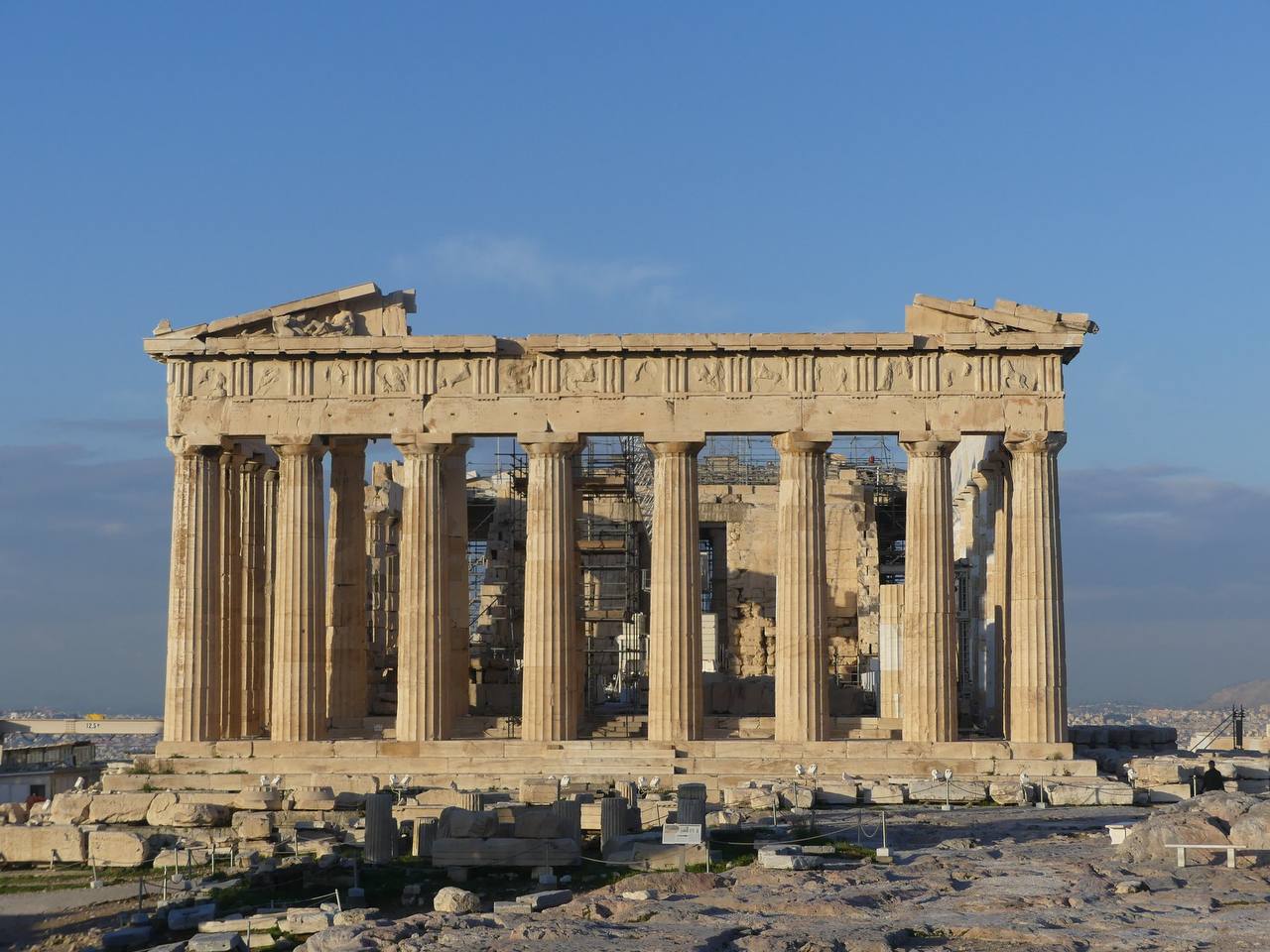
It turns out that the finest examples of classical Greek architecture, the Parthenon, the Hephaisteion, the Temple of Apollo at Corinth and the Temple of Zeus, are marked by a deliberate absence of perfectly straight lines. It is precisely the calculated curvature of the straight and the inclination of the vertical that lend its masterpieces their particular refinement.
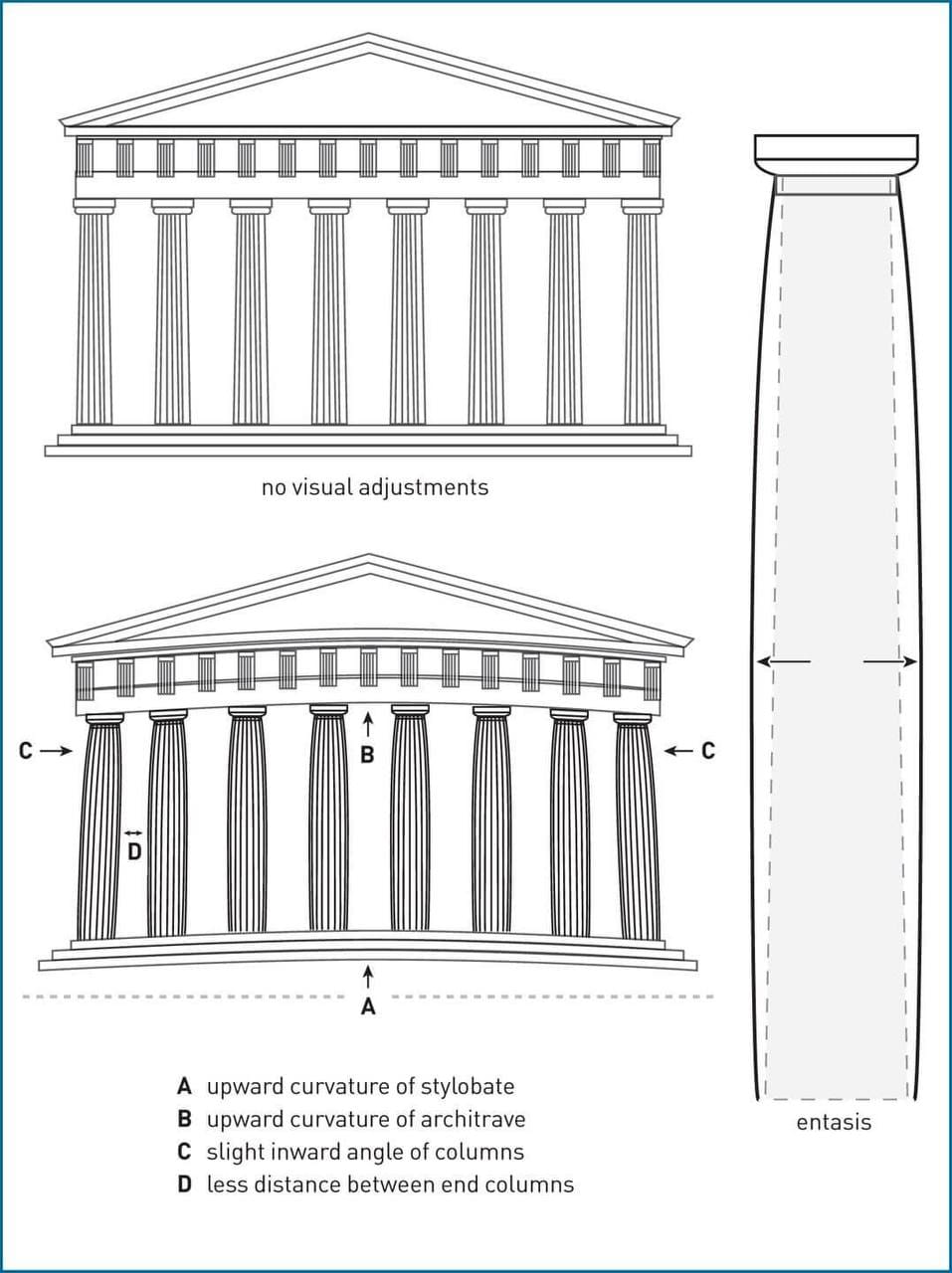
The columns of the portico of the Athenian Parthenon, for instance, are slightly potbellied in shape so as to appear perfectly straight. Nor are they spaced at equal intervals: the outermost columns stand at a somewhat smaller distance from their neighbours. The columns, moreover, lean slightly inwards. The stylobate, the three-stepped base, is curved upwards, and the architrave, the beam above the columns, likewise rises in a gentle curve.
It is these visual adjustments, made with perspective and height in mind, that give the building its ideal appearance from a distance. Had the columns been perfectly straight, they would have looked splayed outwards rather than true.
Evidently, building with a consciously introduced curvature, almost invisible to the naked eye, was far more difficult than using geometrically correct elements. Correcting for perspective demanded more complicated calculations and the making of each piece individually, its dimensions depending, besides, on its place in the overall row.
The upshot is that the Parthenon becomes an unattainable standard, although there is deliberately nothing perfectly straight in it, and the individual working of the blocks makes its construction extraordinarily expensive and, as a consequence, prestigious.