Frederick II's troops were returning home after the Battle of Prague in 1757. Young Lenore awaited her Wilhelm, but he was not among those who came back
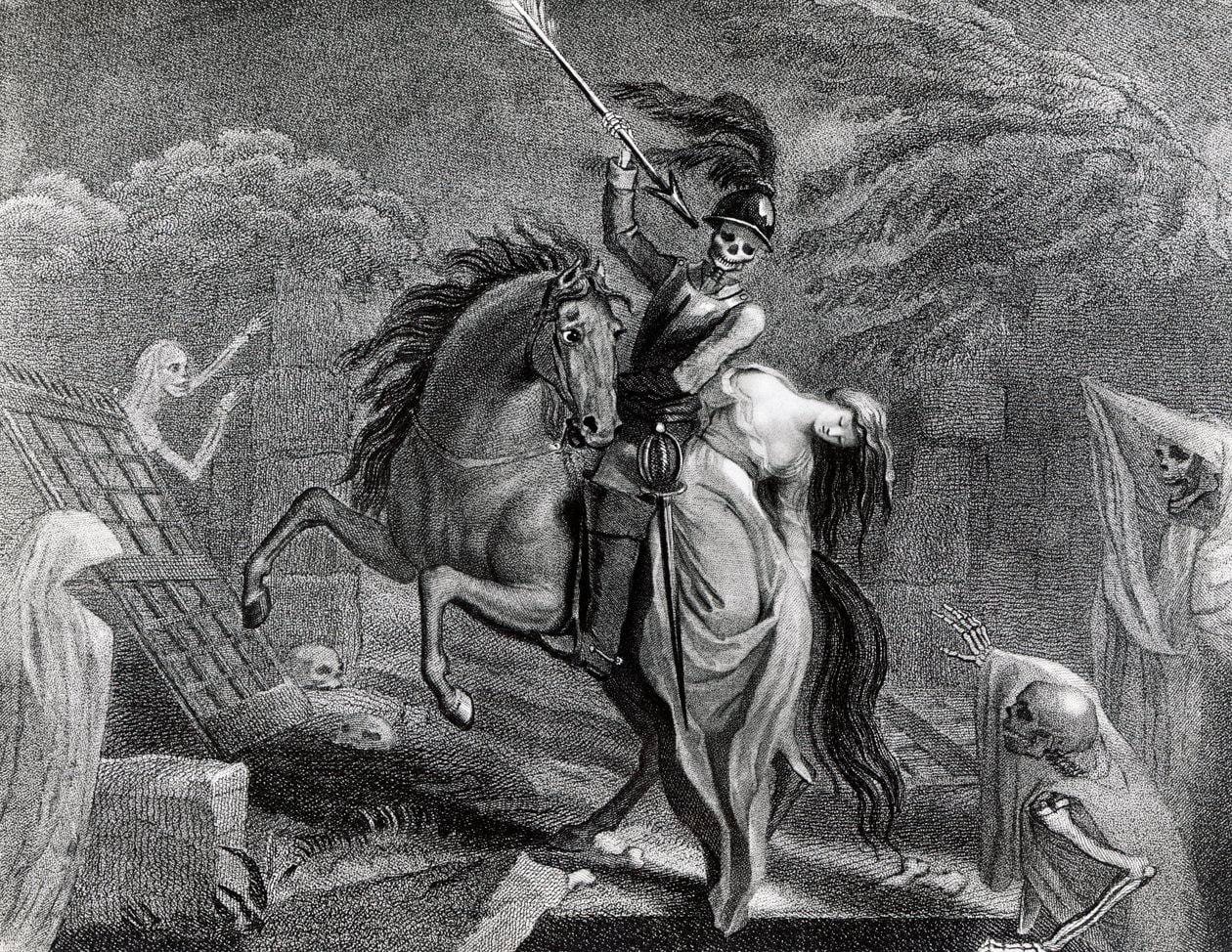
Frederick II's troops were returning home after the Battle of Prague in 1757. Young Lenore awaited her Wilhelm, but he was not among those who came back. Lenore's heart contracted with pain, and complaints against the will of God burst from her through her tears.
When the clock struck midnight, a rider drew up at the porch. He called to Lenore, and before her stood Wilhelm. The betrothed asked the girl to ride with him to his house that very night. Without hesitation, Lenore mounted the horse.
- How shall we ride so fast? - asked Lenore.
- The road is smooth for the dead, - replied Wilhelm
On the way they met a funeral procession and a swarm of flies above a hanged man.
A girl's grief collides with horror from beyond the grave, but what disturbs the reader is not the theme of a lost beloved; it is the terrible accusation hurled at the higher powers, and the punishment that followed.
In truth, Lenore mounts the horse of death at the very moment she defies fate.
Gottfried Bürger's ballad "Lenore" of 1773 is considered one of the sources of the Gothic motif of the galloping dead, including the later allusions of Bram Stoker. It was a "terrible ballad" that by the end of the eighteenth century had formed a separate genre in Britain. And the "dead" who "ride fast" are still racing through world culture.
Lenore, who embodies the tragedy of personal loss against the background of a collective catastrophe, at the same time personifies pride and the curse brought down by her own impulse.
It turns out that protest against fate can end in the ruin of a life. Thus a simple folk motif, raised to the level of a poetic legend, became one of the most significant ballads in history and what is called an eternal plot.
Lenore left her mark on Russian literature too. In Zhukovsky we find the lines
Разлука долгa, немилостив час,
Возлюбленный долго не пишет о нас.
Людмила сидит и слёзы льёт:
«Ах, где мой милый? жив ли он?»
Literal translation
The parting is long, the hour is merciless,
The beloved does not write of us for a long time.
Lyudmila sits and sheds tears:
"Ah, where is my dear one? Is he alive?"
Zhukovsky's adaptation, for he also made a translation of "Lenore", is called "Lyudmila", and his second reworking "Svetlana", though there he turns to salvation rather than to perdition. Zhukovsky begins not with war but with a girl's longing:
Так Людмила, приуныв,
К персям очи преклонив,
На распутии вздыхала.
«Возвратится ль он, — мечтала, —
Из далеких, чуждых стран
С грозной ратию славян?»
Literal translation
So Lyudmila, grown downcast,
Her eyes bowed to her bosom,
Sighed at the crossroads.
"Will he return," she dreamed,
"From distant, foreign lands
With the formidable host of the Slavs?"
Lyudmila likewise awaits her betrothed from the war and murmurs against the will of God; at night a dead man likewise comes for her.
Небо к нам неумолимо;
Царь небесный нас забыл...
Мне ль он счастья не сулил?
Где ж обетов исполненье?
Где святое провиденье?
Нет, немилостив творец;
Все прости; всему конец
Literal translation
Heaven is implacable to us;
The heavenly King has forgotten us...
Did he not promise me happiness?
Where, then, is the fulfilment of vows?
Where is holy providence?
No, the Creator is merciless;
Forgive all; everything is over
Her mother urges her not to murmur, but in vain. The ending is the same: her beloved appears on her porch, she hears his whisper, and he tells her that his house is cramped, cold, quiet and lonely, in Lithuania, a foreign land, under the sod: "A shroud, a cross, and six boards". Yet she is still astonished when she understands that her betrothed is a dead man.
But in Zhukovsky, Lyudmila is emphatically punished for her lack of faith:
Вдруг усопшие толпою
Потянулись из могил;
Тихий, страшный хор завыл:
«Смертных ропот безрассуден;
Царь всевышний правосуден;
Твой услышал стон творец;
Час твой бил, настал конец»
Literal translation
Suddenly the departed in a throng
Streamed out of their graves;
A quiet, dreadful choir began to howl:
"The murmuring of mortals is senseless;
The Tsar most high is just;
The Creator heard your groan;
Your hour has struck, the end has come"
This text is called the beginning of Russian Romanticism