At the Greek Consulate General in Chicago, an American family handed over to Greece's Minister of Culture, Lina Mendoni, a collection of antiquities purchased in the 1970s and 1980s
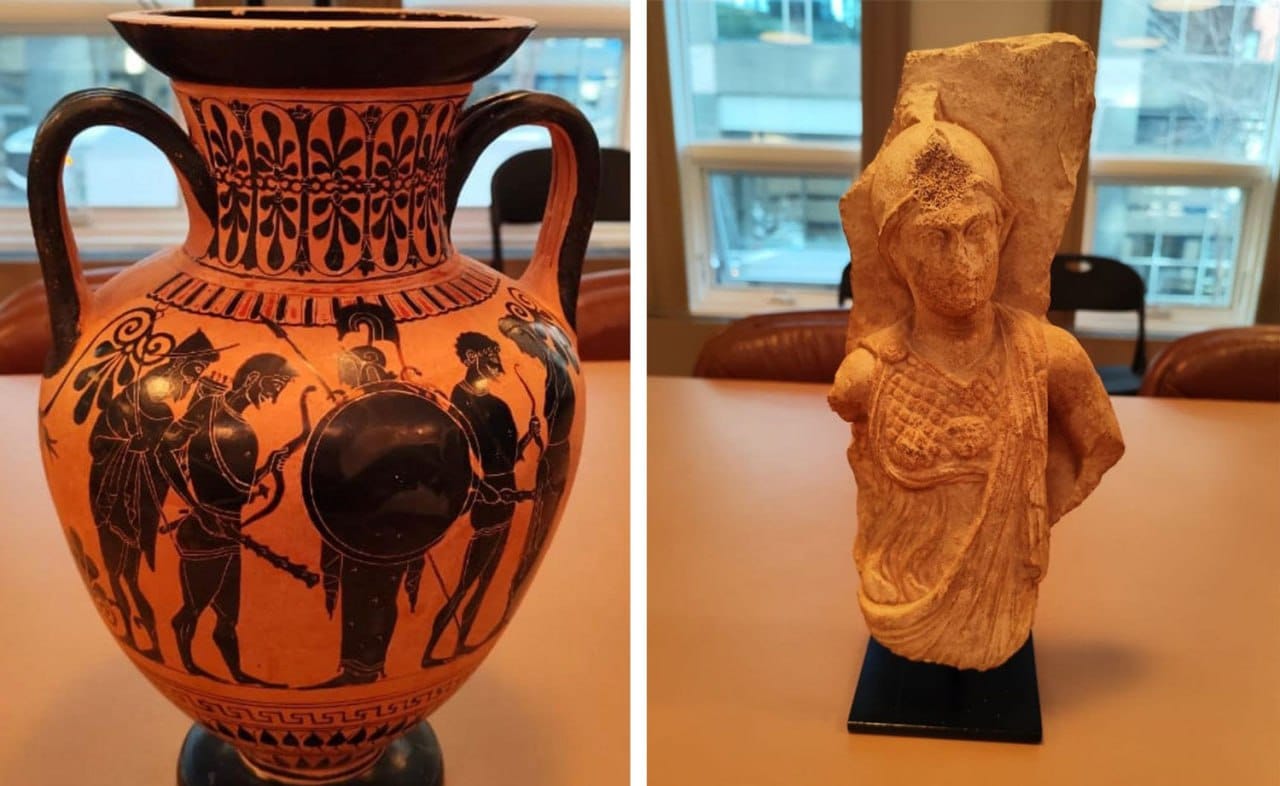
At the Greek Consulate General in Chicago, an American family handed over to Greece's Minister of Culture, Lina Mendoni, a collection of antiquities purchased in the 1970s and 1980s. Among the items returned are two black-figure Attic vases, an amphora, a jug, a bronze mirror, a headless marble statue of Hermes and a fragment of a relief showing Athena.
Mendoni noted that in recent years more than 200 objects have been voluntarily returned to Greece in the same way.
The children were clearing their parents' house after coming into the inheritance, and concluded that a headless Hermes on the mantelpiece was not quite what ought to form part of a will. Their parents had bought these objects in an era when the antiquities market was arranged rather differently.
One of the key international legal instruments in the field of cultural heritage protection is the UNESCO Convention on the Means of Prohibiting and Preventing the Illicit Import, Export and Transfer of Ownership of Cultural Property, adopted in Paris in 1970. The Convention obliges States Parties to prohibit the import of cultural property illegally exported from another State Party, to assist in its return and to establish cooperation among themselves on these matters. It introduced the notion of "illegally exported" for objects that left their country of origin without proper documentation after 1970. By that time the post-war art market had warmed up to the point where the plundering of archaeological sites in developing countries had become, to all intents and purposes, a lawful business: objects were exported in enormous quantities and sold to European and American dealers, who resold them to museums, and virtually no proof of the lawful provenance of these objects was required.
But in my view the problem today lies not only in the fact that few people are prepared to give up voluntarily what they have acquired by their own back-breaking labour, but in the subsequent fate of the artefacts: after all, you can never be certain what will become of the treasures you have handed over once they have been handed over.