At Nauwalabila I, in Kakadu National Park in the north of Australia, what may be the world's oldest evidence of the heat treatment of flint has been found
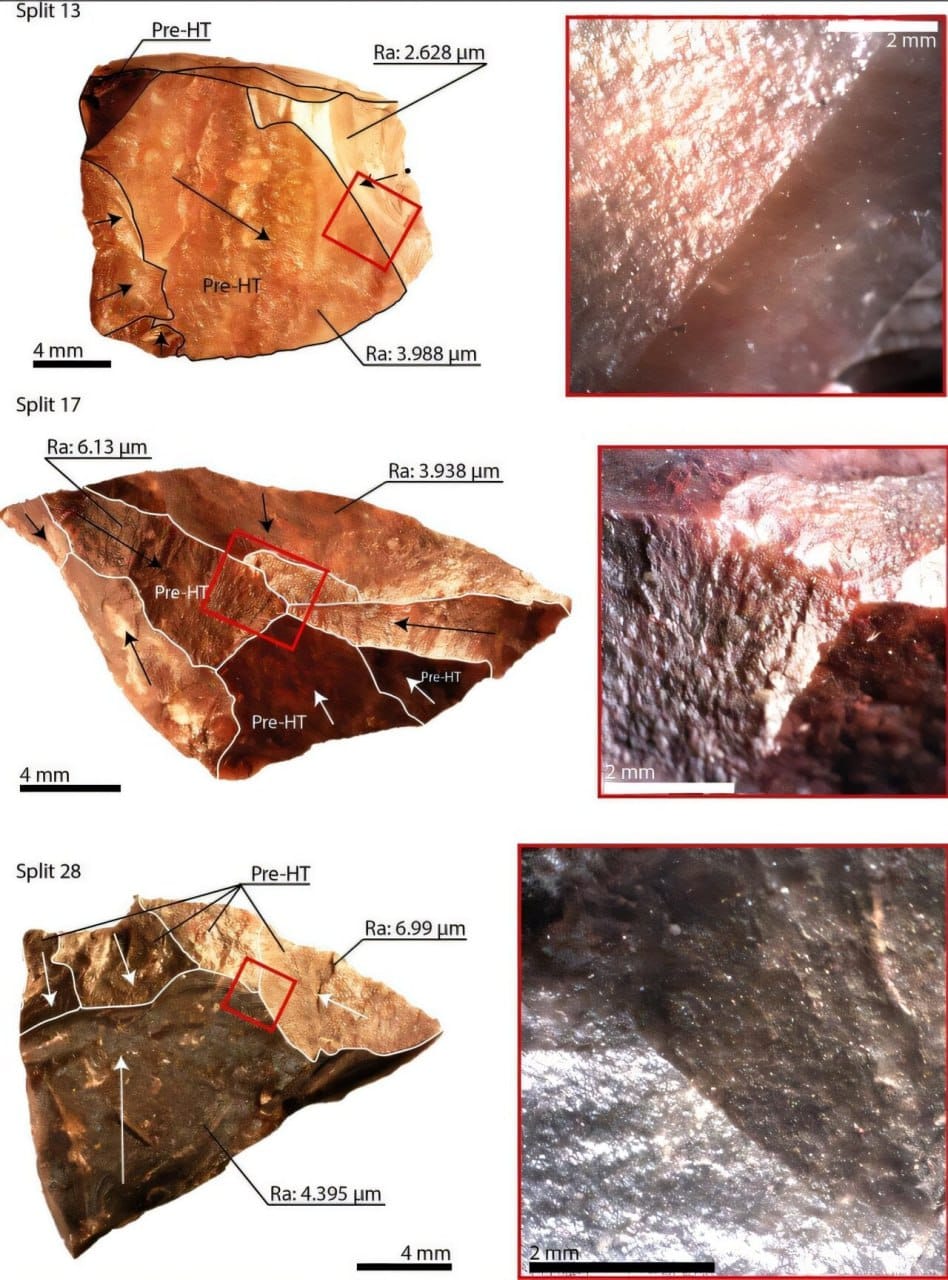
Patrick Schmidt and Peter Hiscock have re-examined flakes from the deep layers of this rock shelter and found on them traces of deliberate heating dating from 45 to 60 thousand years ago.
The technique is as follows: a piece of flint is buried in hot sand beneath a fire, or directly in the embers, slowly heated to roughly 250-350 degrees, held there, and left to cool in the ashes. The bound water leaves the stone, the microstructure is slightly rearranged, and the material becomes more pliant: it splits more readily in the desired direction and yields thin, sharp blades and neat points.
Earlier finds were more modest. The earliest known use of fire to work stone in the world comes from Africa, the site of Pinnacle Point in South Africa, around 120-160 thousand years ago. But there the material worked was silcrete, which is more tractable. As for flint, the primacy had until now belonged to the Dyuktai culture of Yakutia, with a date of about 25 thousand years, and to the Solutrean of western Europe, about 22 thousand years. Both records are more than twice as recent as the Australian date.
Two hypotheses follow from this. Either the heat treatment of flint was invented independently in Australia, which is unlikely. Or the technology left Africa with Homo sapiens along the southern dispersal route, and in Arabia, India and South-East Asia nobody has so far simply looked for it. If the second version is correct, the whole of the Upper and a considerable part of the Middle Palaeolithic of Eurasia may have to be reconsidered. It would turn out that modern man, already on leaving Africa, carried with him a fully developed pyroculture and applied it to different materials