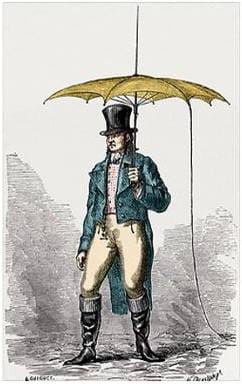
Umbrellas and hats with lightning rods in Europe after Franklin's 1752 invention
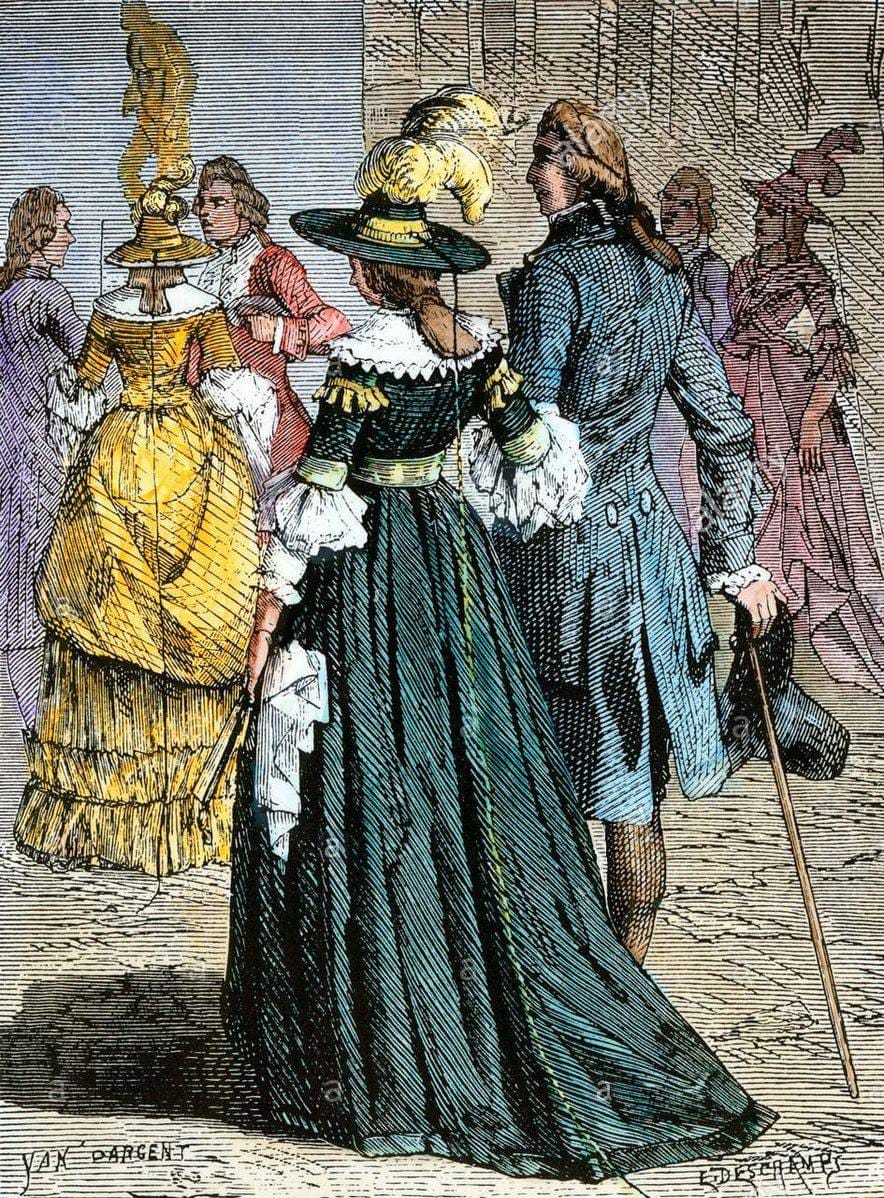
In the 1770s, Umbrellas and Hats with Lightning Conductors Came into Fashion in Europe.
The device invented in America for diverting lightning strikes from houses made a strong impression on the fashionable European public, which promptly wished to secure against atmospheric electricity its own persons as well.
Umbrellas with lightning rods had an elongated central shaft, which was meant to receive the discharge of lightning (the air terminal), while one of the ribs was fitted with a metal cord hanging down to the ground (the down conductor), so as to carry the strike into the soil through the earthing electrode in contact with it. Ladies' hats with lightning conductors worked on the same principle: a metal band around the crown was joined to a chain that hung down the back to the ground.
If one takes into account the formula for the protective effect of a lightning rod, R = 1.732*h, the umbrella was nevertheless the more effective, since even a spike of 50 to 70 cm above it protected against lightning within a radius of about a metre.
Thus the enlightened society of the Old World, soon after Franklin's invention of the lightning rod in 1752, put this newly established scientific fact to the service of its own comfort. Meanwhile, in the United States, lightning rods, for their original purpose, came into wide use only several decades later.