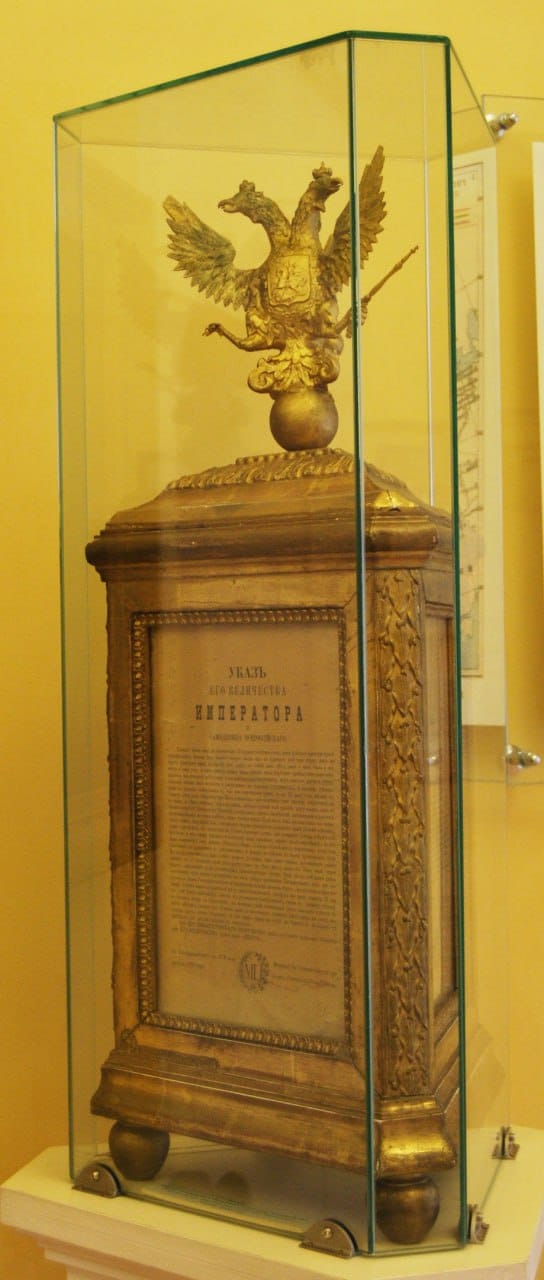
In 1722 Peter I introduced a special mass-produced form of state insignia, the Zertsalo, which remained an obligatory attribute of the institutions of the Russian Empire until 1917
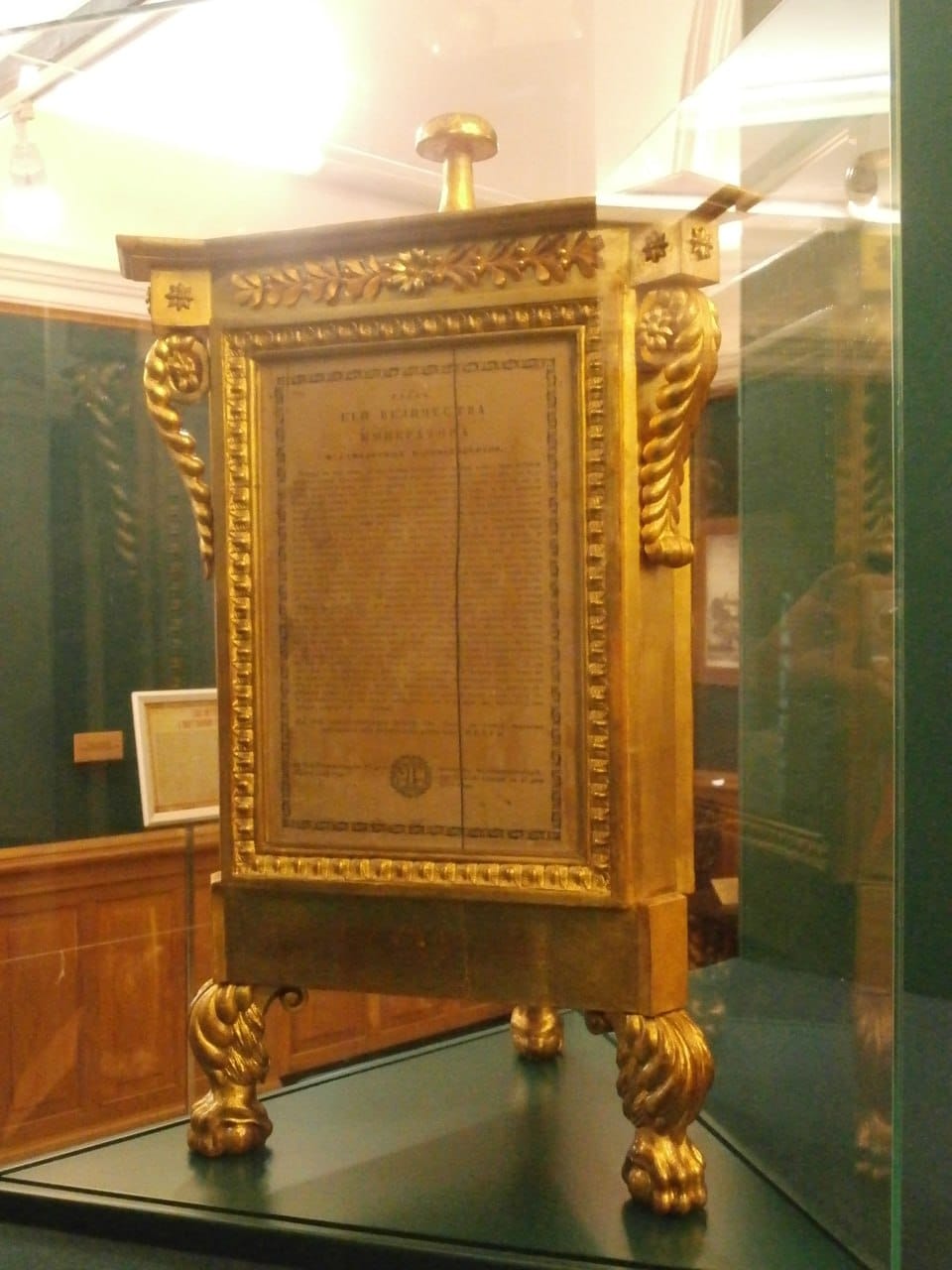
The symbol of the supremacy of law took the form of a wooden prism with three panels, crowned with the state eagle. On the panels were placed decrees on the proper conduct of business in public offices:
- the Decree on the Safeguarding of Civil Rights of 17 April 1722;
- the Decree regulating conduct in courts of law of 21 January 1724;
- the Decree on state statutes and their importance of 22 January 1724.
The Zertsalo was set up in all the public offices of the Russian Empire.
Likewise, on this pattern, in the Senate a board with a stand, on which the printed decree is to be pasted, and always in all places, beginning with the Senate and down to the lowest courts, to keep it on the table as a mirror, before the eyes of those who sit in judgement. And where such a decree shall not be on the table, for every such offence a fine of one hundred roubles to the hospital.
The Zertsalo were brought into service after being consecrated in the principal church; they were then carried in a religious procession to the house of the namestnik or governor and set up beneath the portrait of the reigning emperor, whence they were borne to the government building to the ringing of bells and the firing of cannon, after which each of the Zertsalo was dispatched to the place of its "service".
According to contemporaries, the Zertsalo of the law was established as one of three signs of supreme power, alongside "the portrait of the Tsar and the lamp-lit image of the heavenly judge".
The Zertsalo points not only to the sovereign's power but also to the concentration of the entire state order upon the figure of Peter, to which Pogodin draws attention: "rank, by the Table of Ranks of Peter the Great; nobility, established by Peter the Great; to lodge a complaint, Peter the Great determined its form; it will be received before the Zertsalo of Peter the Great".
Yet in Melnikov-Pechersky we find the fair remark that the Zertsalo was placed in public offices in lieu of the Gospel and the Holy Cross:
- In place of the cross and the Gospel they have set an idolatrous mirror in the courts!
- And in that mirror Peter the God-fighter is painted!
- The gentlemen have thrown the crosses from their necks!
- Even among the merchantry cross-fighting has begun!
- And it is all foreign enchantment, Hellenic fables!
- The Germans, all the Germans have wrought woe in Rus'!.. Lutherans!.. Calvinists!..
- There is no living for Christians because of the Germans.