In 1625, in the environs of Xi'an, the ancient capital of Tang China, Jesuit monks discovered beneath creepers and a layer of earth a stone stele almost three metres high, bearing a text in Chinese with Syriac insertions
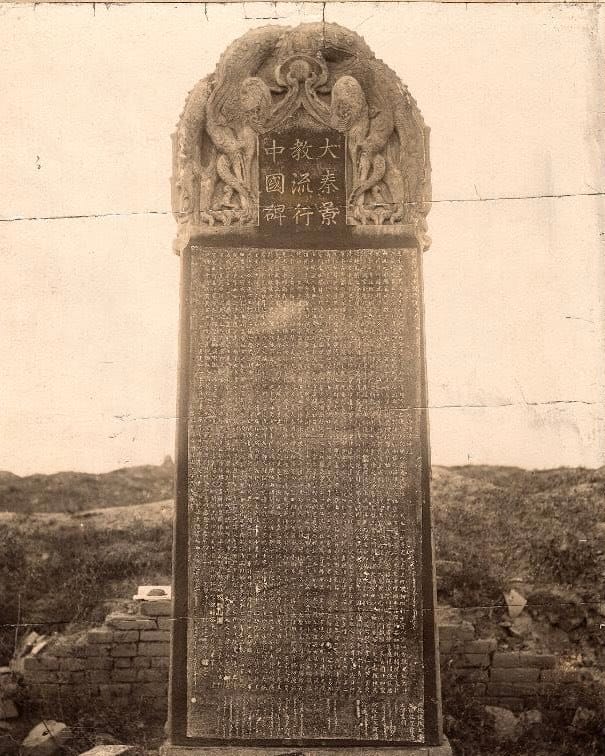
In 1625, in the environs of Xi'an, the ancient capital of Tang China, Jesuit monks discovered beneath creepers and a layer of earth a stone stele almost three metres high, bearing a text in Chinese with Syriac insertions. The stele is dated to 781.
The inscription described the "Luminous Religion", brought to China in 635 by the Nestorian monk Alopen of the Assyrian Church of the East, the very church that had separated from Byzantium after the Council of Ephesus in 431 and departed eastwards through Persia. The Tang Emperor Taizong received the missionary in person, ordered his books to be translated and a few years later confirmed an edict of patronage, declaring that this teaching was beneficial to all, and that monasteries might be built everywhere.
Nestorianism flourished in China for more than two hundred years, had monasteries in Chang'an and Luoyang, and translated Christian texts into Chinese using Buddhist terminology.
But in 845 the Emperor Wuzong began a persecution of all "foreign religions"; the Buddhists suffered first and foremost, and Nestorianism perished together with them, never to be revived in the Middle Kingdom.
The Jesuits of the seventeenth century saw in the stele confirmation of their dream: Christianity had already come to China once and been accepted, and so it could come again. Matteo Ricci and his followers used the Xi'an find as their principal argument in disputes with Confucian scholars over the compatibility of the European faith with Chinese tradition.
Today the stele stands in the Forest of Steles in Xi'an and is entered as number one in the museum's catalogue, while copies of it are held in the Vatican, in Beirut and at Yale, as a reminder that the spread of Christianity began a thousand years before the colonial empires and went not from Europe eastwards, but from the Near East through Persia to Chang'an.