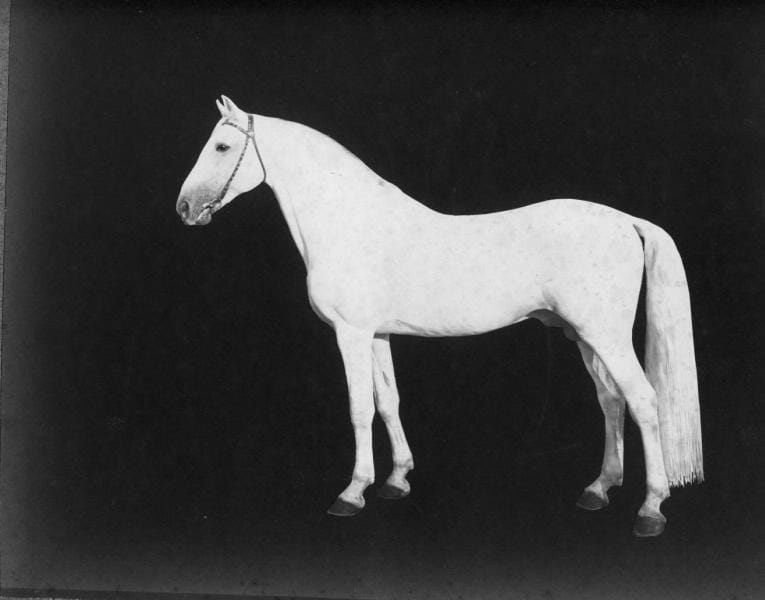
Saw this photograph of the stallion Belyi from the 1880s and became curious about the "salted paper" or "salt paper" technique in which it was made
Salted paper is the earliest method of positive photographic printing on paper, invented by William Henry Fox Talbot at the turn of the 1830s and 1840s as part of the calotype. Roughly speaking, it is the progenitor of all paper photography: the first technology in which a picture is printed as a positive from a negative on ordinary paper.
How does it work? An ordinary sheet of writing paper is taken, soaked in a solution of common salt and dried. Silver nitrate is then applied to it: the salt and the silver react, and silver chloride, a light-sensitive substance, forms right within the fibres of the paper. Next, the sheet is pressed tightly against a negative. This is contact printing without enlargement, so the print comes out exactly the size of the negative. It is set out in the sun, and the image appears of its own accord, without a developer. The silver darkens under the light wherever the light passes through the negative. The exposure is long. When the picture has emerged, it is fixed with hyposulphite and often toned with gold.
Unlike later photography, the silver lies not in a separate emulsion layer on the surface but within the fibres of the paper itself. The print is therefore matt, without gloss, with the texture of the sheet plainly visible, and the image seems to sit in the very thickness of the paper.
The technique flourished roughly in the 1840s and 1850s. By the end of the 1850s this method of printing had been displaced by albumen prints