Among the archaeological methods of which the general public seldom hears, one of the most delicate lies hidden: palynological analysis
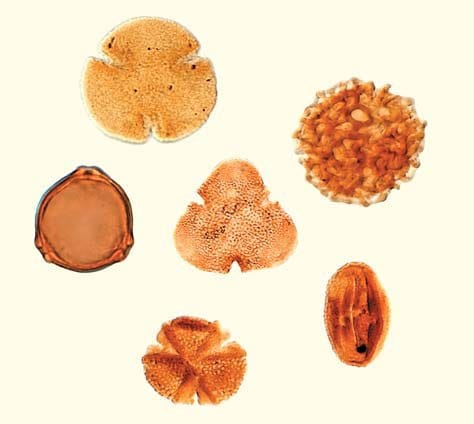
Among the archaeological methods of which the general public seldom hears, one of the most delicate lies hidden: palynological analysis. The method studies plant pollen. Microscopic grains, measuring a few thousandths of a millimetre, fall from flowering trees and grasses by the billion and settle everywhere: on the ground, in water, in animals' fur, on people's clothing, on any sticky surface. They become important witnesses to time, geography and climate. The chief merit of pollen as an archaeological source is its phenomenal preservation. The outer shell of the grain, the exine, consists of the biopolymer sporopollenin, which does not decompose for thousands and tens of thousands of years. Every genus of plant has its own recognisable surface pattern on the grain, and a trained palynologist can tell from the composition of a sample which plants grew within a radius of a few kilometres at a given moment.
The method has more applications than one might suppose. Palynology reconstructs the climate and vegetation of ancient epochs from peat cores and lake sediments. It establishes what children were fed in Neolithic settlements, from the pollen in their pots. From the pollen on the clothing of the Iceman, Ötzi, scientists determined which Alpine valleys he passed through in the last days of his life. In forensic practice palynology helps to establish whether a suspect was at the scene of a crime, since the composition of pollen on clothing is unique to every locality and every season. In archaeology it is used when one must answer the question "where", which cannot be settled by any other means. Molecular analysis says what an object is made of, isotopes say where the raw material came from, and pollen says at precisely which point in the landscape the object stood in the open air.
A fresh example is the work of the group led by Armelle Charrié of the University of Strasbourg, published in Frontiers in Materials and described in Archaeology Magazine on 27 April. The team studied a Roman vessel 2,200 years old, found off the Croatian coast. The hull had been coated with resin, partly pure pine tar, partly a mixture of tar and beeswax, which the Greeks called zopissa. Chemical analysis showed that in different parts of the ship the composition of the coating was in places identical, so that the original coating could not be told from later repairs by molecular methods alone. The researchers then extracted the pollen trapped in the hot resin at the moment it was applied. The stern and the central part yielded one pollen spectrum, while the three patches on the bow yielded three different ones, distinct from one another and from the rest of the coating. This means that in the course of its service the vessel put in for repairs at least four times, at different points on the Mediterranean and Adriatic coasts. Thus pollen that stuck to the resin twenty-two centuries ago has turned into a kind of ship's log.