Alexander I at the Tomb of Frederick the Great in Potsdam in November 1805, and the Fate of the Oath
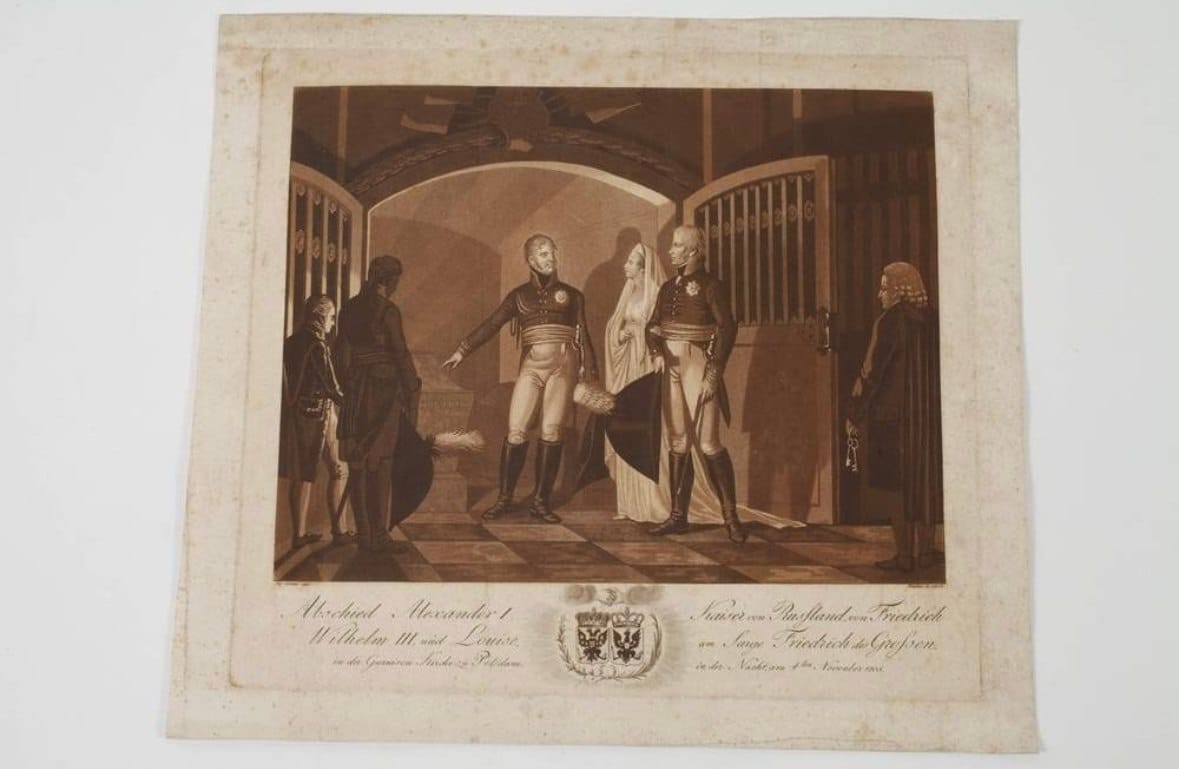
I look at Alexander I beside the tomb of Frederick the Great and once again wonder what a strange habit it is, this gadding about among the graves of strangers.
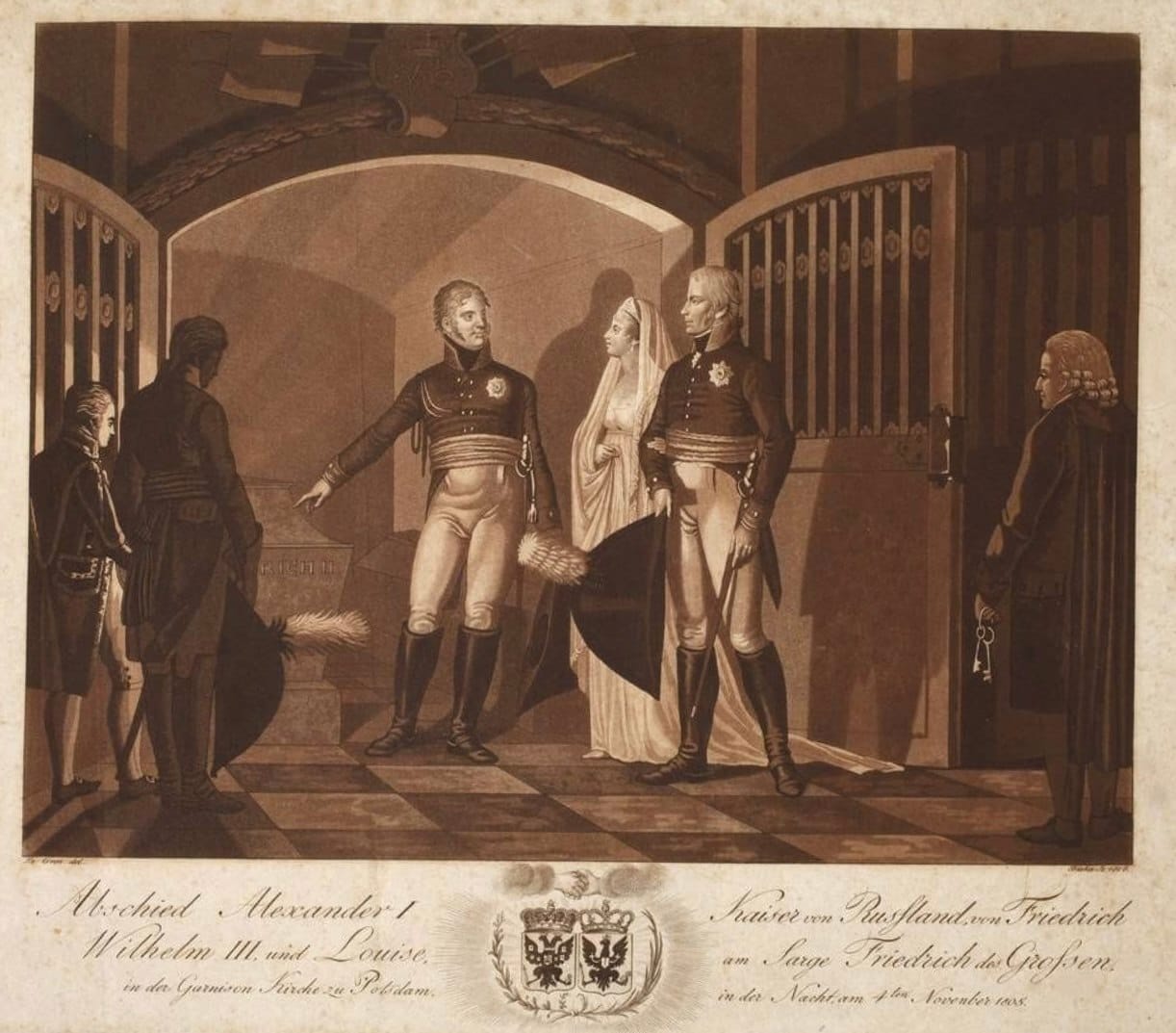
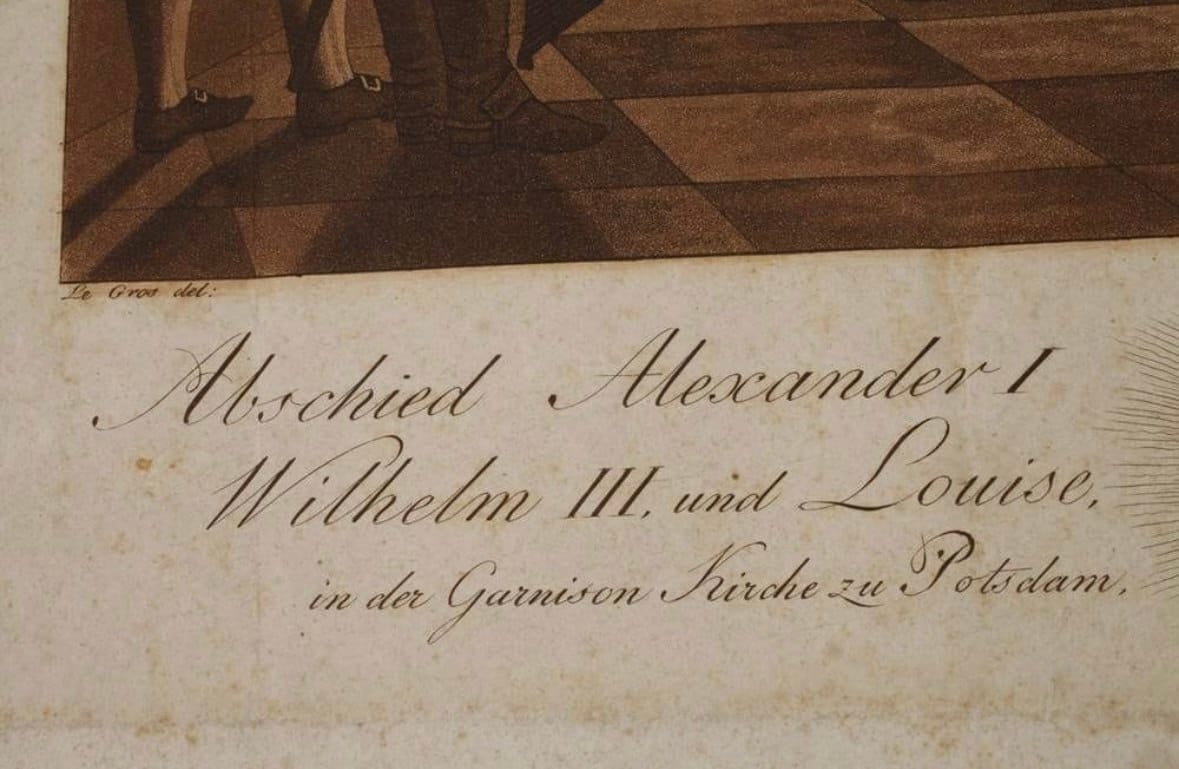
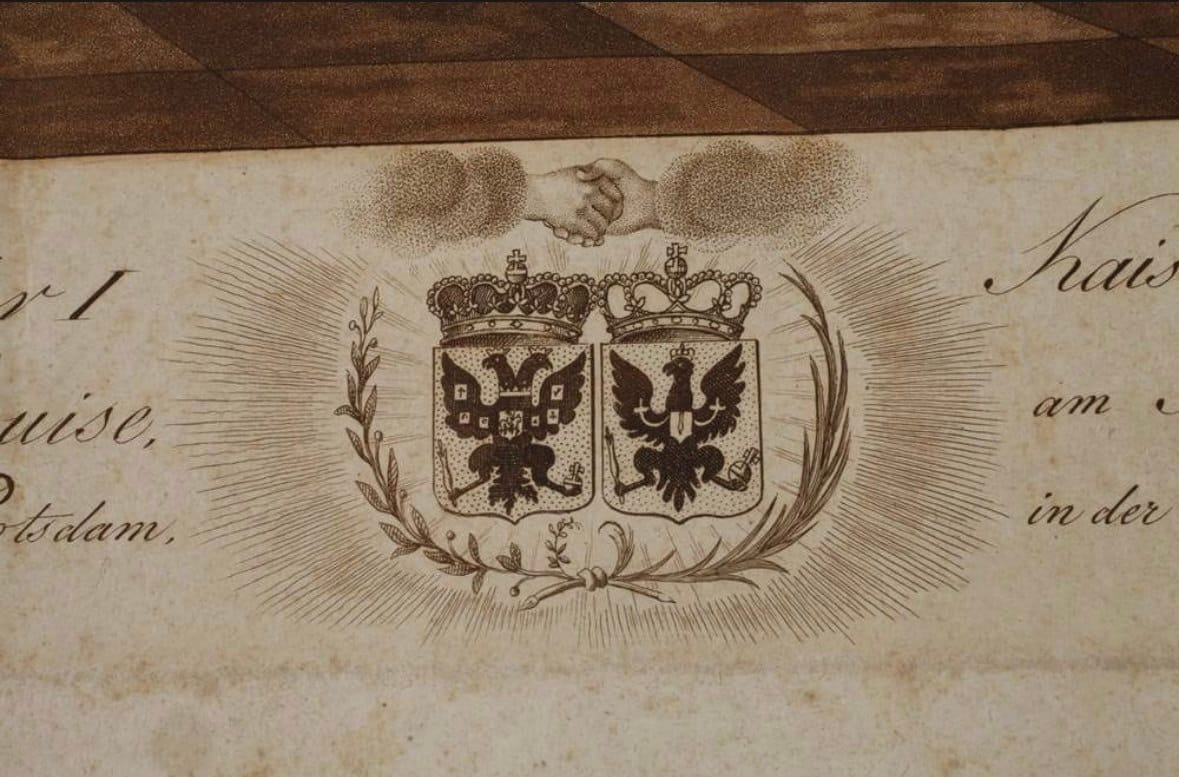
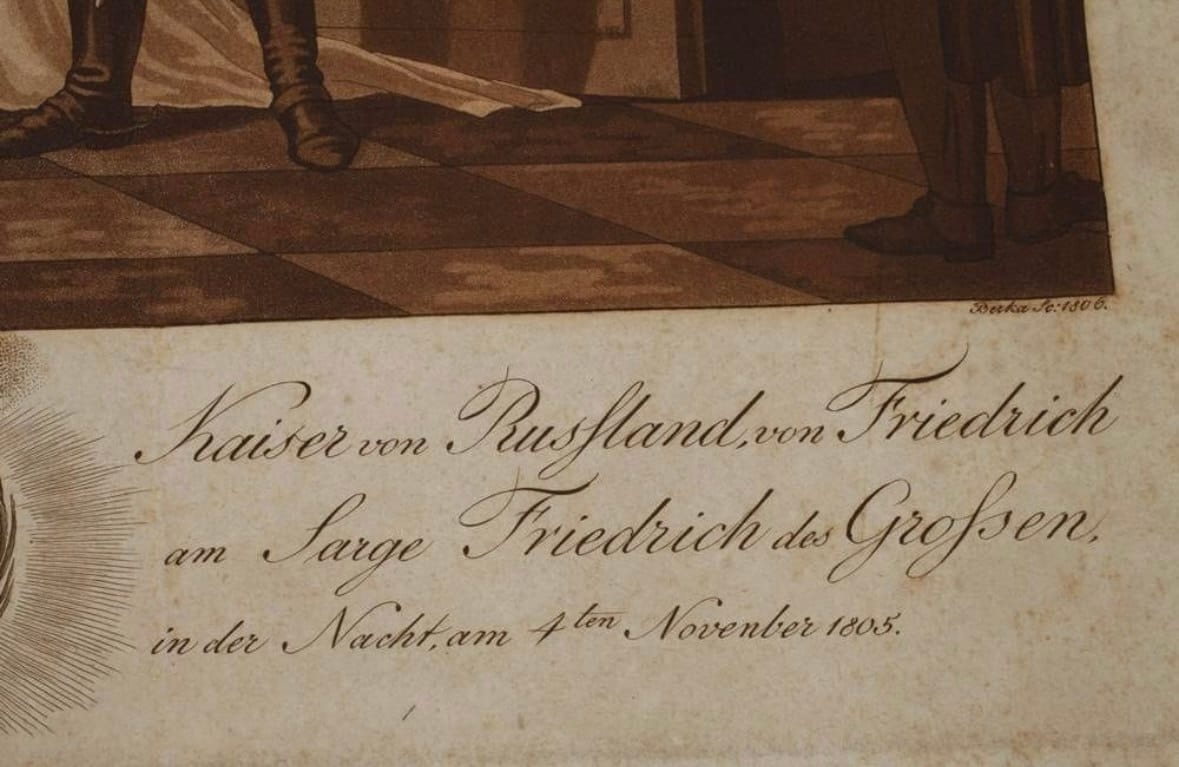
The engraving, after a drawing by Sauveur Legros, was made in 1806 by Johann Berka in aquatint. Emperor Alexander points to the sarcophagus inscribed "Friedrich II". Empress Louise, in a white veil, stands between the two monarchs. On the right an attendant waits with the keys to the vault. Below, above the arms of Russia and Prussia, a handshake is depicted.
This nocturnal ceremony in the vault made a strong impression on the Prussian public, and it was depicted many times, in all sorts of forms, as a symbol of the alliance against Napoleon.
But to my mind there is something in this visit of necromancy, an unhealthy urge to visit resting places, as if to make sure that the departed really does rest where he was laid. No, I am not saying that the dead are so indifferent that, like Diogenes, they might wish to be thrown out beyond the city wall. But would they really want all these visitors?
It is the living, rather, who need this. Which is what disconcerts. With the graves of ancestors and relatives matters are more or less clear: tending a grave helps, as it were, to strengthen kinship, to prolong the bond between generations, to feel that one belongs to one lineage and one family. A headstone bearing a familiar name seems to make the deceased present. But what bond can there be with entirely alien dead who have no connection to you whatever? What is this imposed amiability, when no general or writer ever invited you in particular to his grave? The people's path ought to be kept from overgrowing on the way to the monument not made by hands, not to a gravestone.
Here the Emperor of All the Russias arrives in Potsdam and (!) on the night of 4 November 1805 decides to descend into the vault of the Garrison Church together with the Prussian king Frederick William III and Queen Louise. What have you forgotten there, by the grace of God? A day earlier Russia and Prussia had signed the Convention of Potsdam, by which Prussia promised to enter the war against Napoleon if he did not accept her mediation. And before leaving, Alexander for some reason wants to take leave of his allies in the tomb of Frederick II. They go down into the vault: the king lies in a metal coffin, the metal coffin stands in a sarcophagus, the sarcophagus in a vault, the vault in a crypt beneath the floor of the church. And so, gazing at this burial behind an iron grille, the monarchs swear eternal friendship to one another.
Swear in order to what? To make the deceased a witness? A guarantor of the treaty? Is it really more shameful to break an oath sworn at a closed coffin than a plain oath? Is a royal vow not in itself cast in gold? And could this reciprocity not be fixed more formally in the shape of a diplomatic document? Or does Alexander I's oath of fidelity to Prussia, made in the presence of the decayed symbol of military glory lying beneath several layers of ritual trappings, lend it some special force which the autocrat's wish to keep his imperial word cannot supply? But in fact that is simply not how it works.
A month later, on 2 December 1805, Napoleon defeated the Russian and Austrian armies at Austerlitz. And Prussia never did enter the war. Six weeks after the oath Frederick William III concluded an alliance with Napoleon at Schönbrunn. So what were these promenades into the sepulchral chill for, this summoning of the dead as witnesses, these oaths rebounding off a coffin lid? If at the first opportunity the melancholic Prussian went over to the enemy against whom he had sworn to fight together with Russia?
No, not so. Why the irresolute Frederick William needed this concert is understandable. But why did our own tsar, an Orthodox one, mind you, need to be drawn into this absurd cult among foreign dead (a first cousin four times removed is not much of a relation), and heretics at that? Incidentally, Alexander, unlike the Prussians, rather kept his word. The Russian army fought for Prussia in 1807, and at Tilsit Napoleon left Frederick William half a kingdom and pointedly remarked that he did so out of respect for the Russian emperor.
By the way, Frederick himself did not want to lie in the vault at all, and bequeathed that he be buried on the terrace of Sanssouci beside his dogs. But nobody carried out his will, all for the sake of such passages