How Clay Counting Tokens in the Near East Led to the Emergence of Cuneiform
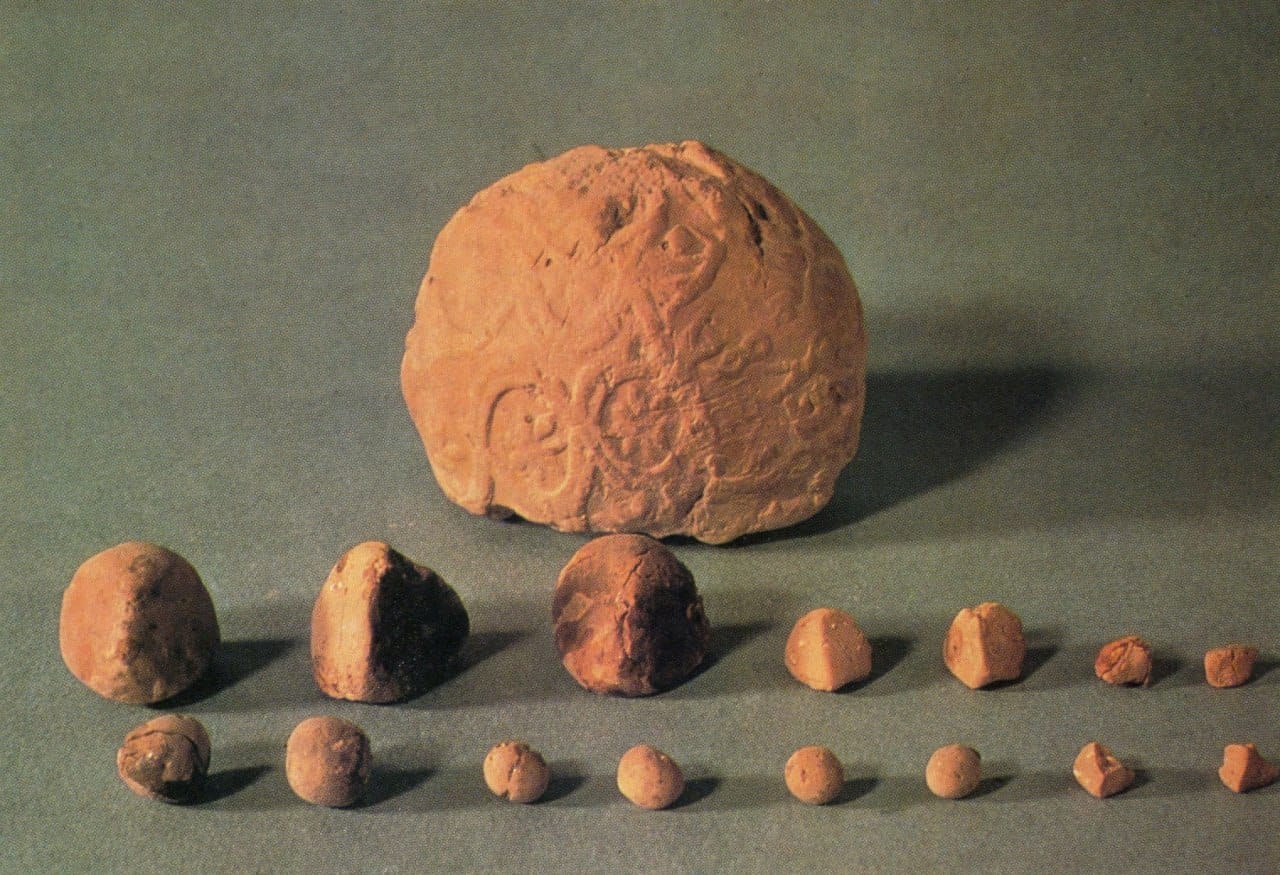
From about 8000 BC, when farming took hold across the Near East, from present-day Jordan to Iran, small clay tokens were modelled there for counting: cones, spheres, discs, cylinders. Each little figure stood for a certain quantity of goods. A cone, a sphere and a disc, for instance, corresponded to different measures of grain.
By 3300 BC the tokens had begun to be kept in hollow clay spheres. This may have been one way of formalising a debt: the tokens lay inside the sphere until the loan was repaid. To check the contents, one had to break the vessel. To avoid doing so, the accountants took to pressing the tokens into the soft clay on the outside, and only then sealing them within.
Gradually it dawned on people that the tokens inside were superfluous if their impressions were already there. Flat clay tablets bearing impressions then took the place of the clay spheres. In time, the impressions of the tokens were replaced by marks made with a stylus.
It is believed that from these signs, around 3200 BC, cuneiform arose in Mesopotamia, the first system of writing in history. For the first few centuries it served purely for bookkeeping, until people began to use it for recording inscriptions on tombstones. And after that, there was no stopping it