Marco Galli on Ancient Rome's Trade with India and China from the 1st to 3rd Century AD
I have read an interesting article by the Italian archaeologist Marco Galli of Sapienza University of Rome, "Beyond the Borders: Ancient Rome and Eurasian Trade Networks". Galli examines the Roman Empire's part in trade with India and China in the 1st, 2nd and 3rd centuries AD, and reviews the history of the study of the trade routes, how they were organised, the influence of Eastern goods on the Roman economy, and the fate of Chinese silk in the Mediterranean.
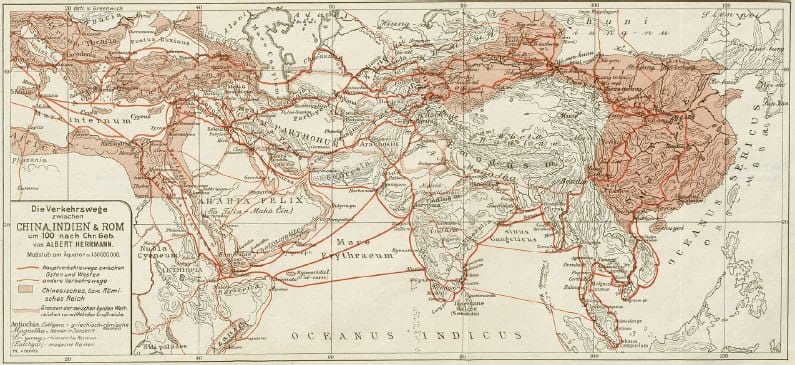
The concept of the Silk Road was introduced by the German geographer Ferdinand von Richthofen in 1877. Scholars use the term for the system of caravan and sea routes that linked China with the Mediterranean. Richthofen believed that active trade went on from 114 BC to AD 120, and wrote that the markets of the Roman Empire became for Eastern merchants a source of enormous profit. His pupil Albert Herrmann drew up detailed maps on which he joined the overland and sea routes together.
Galli stresses that there was no single road. Around AD 100 a Roman merchant of Greek origin, Maes Titianus, sent his agents east. In two years they covered more than 10,000 kilometres and reached a city that ancient geographers called Sera Metropolis. Galli identifies it with the city of Wuwei in north-western China. In AD 97 the Chinese envoy Gan Ying set out westward to reach the country of Daqin, as Chinese authors called the Roman Empire. According to the "Hou Hanshu", the official history of the Later Han dynasty, Gan Ying got as far as the Persian Gulf, but abandoned the voyage when local sailors told him that the crossing might take two years.
The Greek merchants' guide, the "Periplus of the Erythraean Sea", written around AD 70, lists 140 Eastern goods. Among them were spices, Chinese silk, Indian cotton, precious metals and stones, cosmetics and foodstuffs. Pliny the Elder wrote that Rome spent 100 million sesterces a year on Eastern luxuries, and that half of this sum went to India. The sestertius served as the basic unit of account in Roman money. The Muziris papyrus, published in 1985, records a maritime loan of the mid-2nd century secured on the cargo of the ship "Hermapollon". A maritime loan was a credit advanced to a merchant against the security of the goods he was shipping. The cargo of that one ship alone was worth 6,911,852 sesterces. Galli sets Pliny's figure beside the estimate of Roman gross domestic product at 10 billion sesterces proposed by the economist Peter Temin. The outflow of money to the East amounted to about one per cent of that sum, so the Roman economy could sustain it. Strabo reported that 120 ships sailed every year from the Egyptian port of Myos Hormos to India.
The Romans called the Chinese the Seres, and denoted silk by the word sericum. Caravans went from China across the Tarim Basin, the Pamirs and Bactria, bypassing Parthia, to the ports of northern India. From there the goods reached Egypt and Alexandria through the Red Sea, or Palmyra and the Syrian cities of Tyre, Sidon and Antioch by way of the Persian Gulf. German researchers have studied fragments of silk from the burials of Palmyra and established that finished Chinese fabrics, with their patterns and embroidered characters, were unravelled in the West and woven anew. The new cloth came out very fine, glossy and transparent, and better suited Roman taste. Galli cites the historian John Thorley, who remarked that the Chinese bought such cloth without knowing that they were buying back their own silk. The Chinese compendium on the western countries, the "Weilüe", reports that the inhabitants of Daqin unravel Chinese silk and weave their own fabrics from it.
In 2005 archaeologists excavating near Colonna, 26 kilometres south-east of Rome, uncovered a tomb of the mid-3rd century. In it they found a silk funerary cover, sapphires from Sri Lanka and a gold necklace with sapphires and pearls, which the craftsman had made in the Syrian style