Jan van Musschenbroek's magic lantern in the Boerhaave Museum and Gravesande's 1720 book
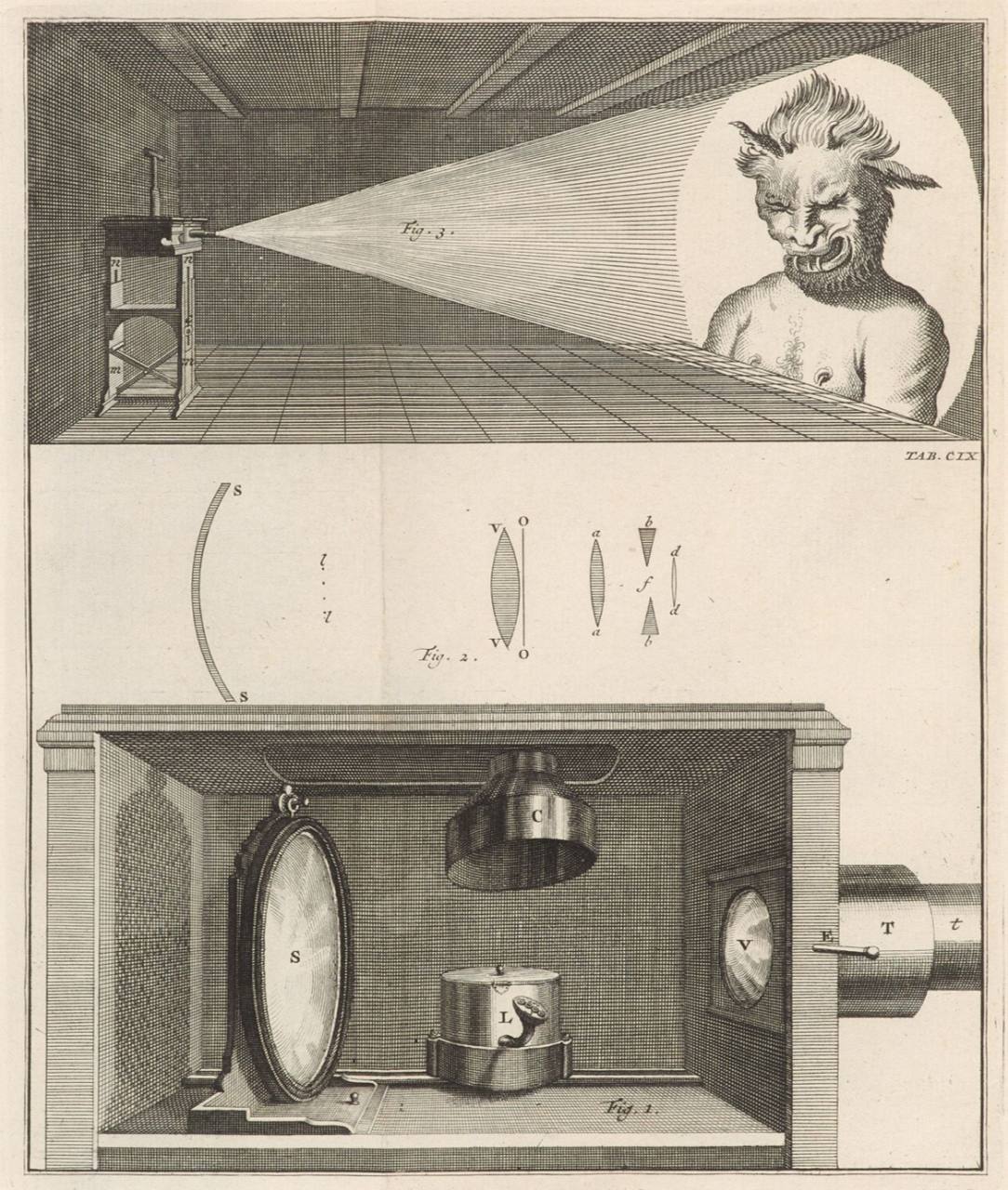
The forerunner of the television: the oldest known “magic lantern” is recorded in the Physices elementa… of the Dutch physicist Willem Jacob 's Gravesande.
's Gravesande, a former lawyer from The Hague who became a professor of mathematics at Leiden, was the first of Newton's followers outside England and is known as the European popularizer of his theories.
In his celebrated book of 1720, 's Gravesande describes the latest inventions of the age, among them the magic lantern. Today it would be called a projector. The device, made by Jan van Musschenbroek, one of the oldest instruments of its kind in the world, is in the collection of the Museum Boerhaave in Leiden.
The magic lantern uses a concave mirror behind the light source to direct light through a small rectangular sheet of glass, the lantern slide, which bears the image, and on into a lens at the front of the apparatus. The lens is adjusted to focus the plane of the slide at the distance of the projection screen, which may be no more than a white wall, and forms an enlarged image of the slide on the screen. Some lanterns, including those of Christiaan Huygens and Jan van Musschenbroek, used three lenses for the objective. Double lanterns with two objectives became commonplace in the nineteenth century and allowed images to be changed smoothly and easily. Stereopticons added more powerful light sources to optimise the projection of photographic slides.