At the centre of the photograph, in Russian costume, sits the 82-year-old Vladimir Stasov, host of the evening
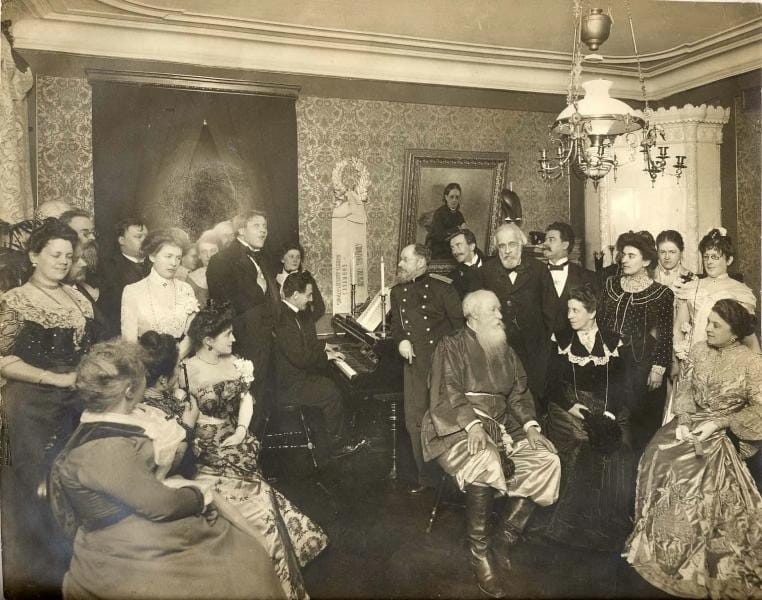
At the centre of the photograph, in Russian costume, sits the 82-year-old Vladimir Stasov, host of the evening. Behind him, to his right, is Fyodor Chaliapin; at the piano, Felix Blumenfeld; on other evenings, Cesar Cui and Rachmaninoff would occupy that place.
The eye is caught by Stasov's brilliant attire. He is dressed grotesquely, in the Russian manner, and this is part of his personal programme as the chief ideologue of the “national school” in Russian art. He presided over the “Mighty Handful” in music, promoted the Wanderers in painting, and demanded Russian subjects, Russian colouring, Russian form. And in his own drawing room he appeared in a kosovorotka, satin sharovary and morocco boots. The pose is instantly recognisable: in Repin's portrait of 1883 he sits in the very same red shirt.
Before the September evening of 1906, Stasov, according to Petelin's reconstruction, deliberately weighed the options: a red silk shirt, pale blue satin trousers and two sashes, one of gold braid with tassels, the other Oriental, with tassels and a lattice pattern, together with yellow morocco boots, embroidered on the tops with silk and precious stones. Or else a white silk shirt, embroidered by Sonya Kaverina in red on Chinese silk. With the latter, a black tailcoat, as a concession to ordinary convention. He chose, as usual, the Russian.
At the September evening of 1906 Chaliapin was in particularly fine form. Stasov wrote to his brother Dmitry on 4 September:
They sang everything that had been prepared, then Chaliapin demanded more, and together with Felix Blumenfeld performed two Schumann songs from “Dichterliebe”: “Ich grolle nicht” (“I bear no grudge”) and “Die alten, bösen Lieder” (“The old, wicked songs”). At the latter one of the guests, Selma, burst into tears and ran off to the far room behind the screens. After the singing Chaliapin read aloud Gorky's fresh sketches, “The City of the Yellow Devil”, about New York, and “Beautiful France”. The sculptor Ilya Ginzburg added humorous sketches, “Waiting for a Passport from the Gendarme” and “An Actress's Room”. They finished with the traditional toast-song “Glory”, taken up by the chorus. On other evenings of the same circle there were arias from “Boris Godunov”, “Dubinushka”, Rachmaninoff's romances, the latest compositions of Glazunov.
Stasov kept his jour fixe in the old Petersburg fashion: tea, refreshments, then supper with toasts. In one of his letters he mentioned a reception of that same year, in July, at which he fed twenty-seven people, having decked the house with bouquets of roses, in his words with a “Raphaelesque fragrance”, and recalled the lively conversations fluttering from one table to another. Alcohol was obligatory: toasts in champagne, and a separate health drunk to “Fyodor the Great” for his work. The household in the apartment was run by his niece Natalya.
Stasov's evenings were not a closed salon. Birzhevye vedomosti, Novoye vremya and Russkiye vedomosti carried chronicles of who had sung and read at Stasov's, who had arrived from abroad, who had been seen at supper. The September evening of 1906 made the chronicle also because Chaliapin had brought there for the first time Maria Valentinovna Petzold, his new beloved and future second wife. Stasov wrote of her to his brother the following day: “She decidedly pleased everyone yesterday: both her beauty, and her simplicity, and her amiability, and her affability.”
A little over a month later, on 10 October, the eminent Russian art and music critic, art historian and archivist Vladimir Vasilyevich Stasov died.