Plautilla's Veil in Christian Iconography of the Apostle Paul's Beheading
Paul called out to her:
"Greetings, Plautilla, daughter of eternal salvation! Lend me the kerchief with which you cover your head, and go yourself beyond the barrier for the people and wait there until I return to you and give back your alms. I shall bind my eyes with it in place of a cloth and, on my way to Christ, leave it as a pledge of your love for my reverence before His name."
And she hastily handed him her veil and did all that the apostle bade. But Parthenius and Pheritas laughed at her, saying:
"Why do you trust a deceiver and sorcerer? For what reason do you throw away a superb veil? You will never get it back from him."
But Paul said to her:
"See, daughter, await my coming here, and I shall bring you the tokens of my death on the kerchief, when I am alive in Christ."
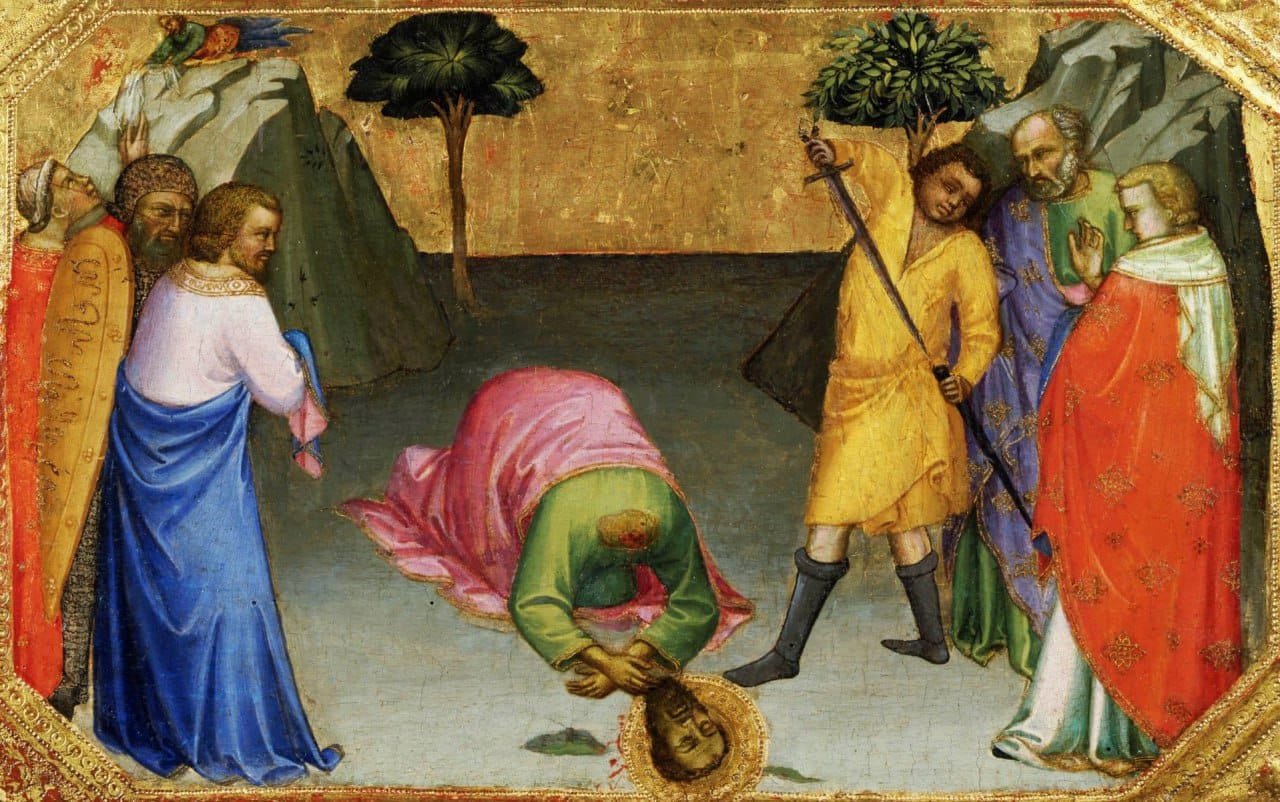
The episode of the return of the kerchief to the Roman matron Plautilla is found not only on the Vatican triptych. It occupies a peripheral position on the so-called Princeton Panel, the Beheading of Saint Paul of 1390-95, attributed to the Florentine painter Lorenzo Monaco.
It appears, moreover, in a drawing after a wall painting of the late third century for Old Saint Peter's by an anonymous Italian artist, in the album of Giacomo Grimaldi in the Vatican archive of San Pietro. And also in the early fourteenth-century fresco by Deodato Orlandi in the church of San Piero a Grado.
Plautilla is probably mentioned by Tacitus, as the wife of Aulus Plautius, tried for adherence to a "foreign superstition", who wore no garments but mourning ones. "Her soul knew no feeling but sorrow." The family name of this matron was Pomponia Graecina.
And although Plautilla's kerchief does not appear all that often in Christian iconography, its significance as a symbol is exceedingly great.
...he came to the place of execution, where, turning to the east and raising his hands to heaven, he prayed at length in Hebrew, with tears, and gave thanks to God. And when he had finished his prayer in his native tongue, he took leave of the brethren and blessed them, and, having bound his eyes with Plautilla's veil, he set his knees upon the ground and stretched out his neck. The executioner, swinging high, struck with force and severed his head. And that head, already parted from the body, glorified the name of the Lord Jesus Christ in Hebrew, in a ringing voice. And at once a stream of milk gushed from his body onto the soldier's garment, and only then did the blood begin to flow.
And when they wished to take the veil with which he had bound his eyes before the execution, it was not to be found.
The disappearance and return of Plautilla's kerchief is in essence a true miracle, and its significance is far greater than that of the execution itself, which always becomes the key theme of images in which the kerchief figures. Both the Princeton Panel and the right wing of the Stefaneschi altarpiece might more precisely be called the "Miracle of Plautilla's Kerchief", for it is in this event that the power of Christ is revealed, and that power is the true meaning of the whole narrative. And despite the modest pictorial space it occupies, the kerchief, its disappearance in the moment after the execution and its return as a precious reward to Plautilla, possible only through Christ, are the ultimate theme of the Princeton Beheading of Saint Paul and of the wing of the Stefaneschi altarpiece.
Those who had been sent to hasten his slaying, on their return came to the city gates, where they found Plautilla, praising and glorifying the Lord for all that she had heard and seen through His holy apostle. And they asked her mockingly why she had not covered her head with that veil which she had given to her Paul. But she, burning with the fervour of faith, answered with zeal:
"O vain and wretched men, unable to believe what you see with your eyes and touch with your hands! Truly, I now have that very kerchief which I gave him then. It is precious, for it is steeped in his glorious blood. For he appeared in earthly form from heaven, surrounded by a countless white host, and indeed brought it to me, and, bestowing grace for my good deed, said:
'You, Plautilla, honoured me on earth; soon I, too, shall most reverently honour you, when you come into the kingdom of heaven. And even now I have returned for your sake, to show you the glory of the Invincible King.'"
And drawing from the folds of her garment the kerchief, soaked in scarlet blood, Plautilla showed it to them.
And they, seized with terror, hastened to inform Caesar of all that they had seen and heard.