On a charter of King Philip I of France in favour of the Abbey of Saint-Crépin at Soissons, dated 1063, among Latin texts and the crosses of illiterate magnates stand two words in Cyrillic: "АНА РЪИНА"
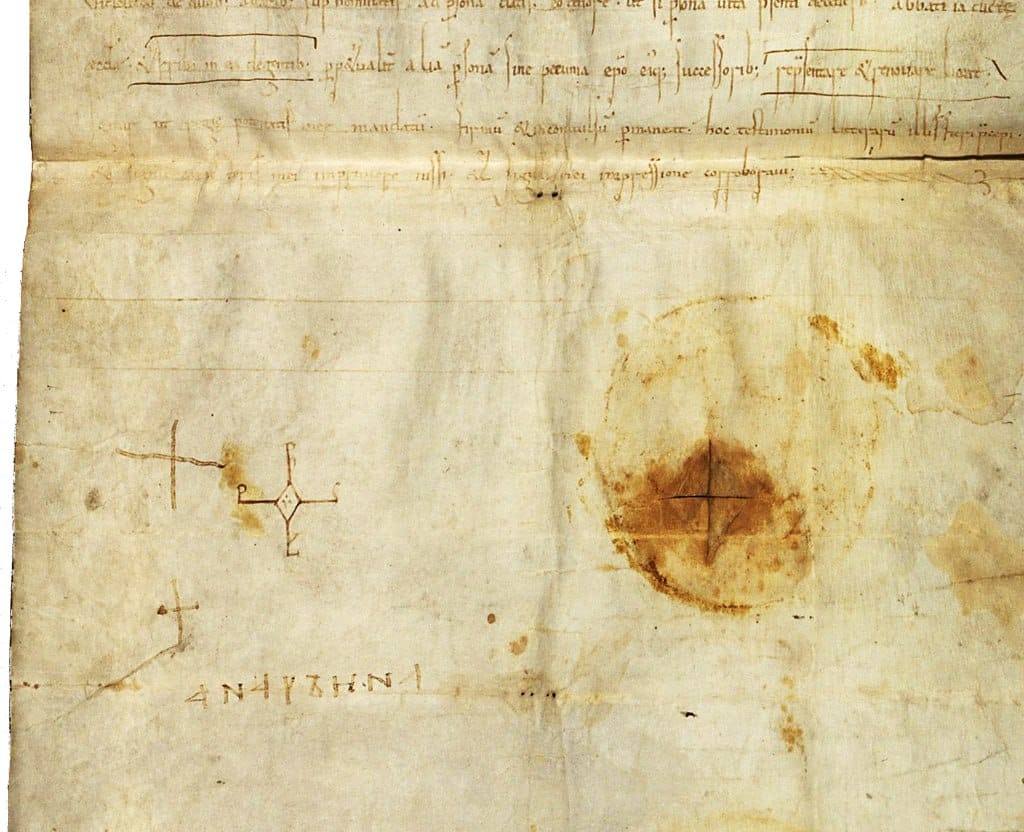
Queen Anna. This is the only surviving authentic signature of Anna Yaroslavna, daughter of Yaroslav the Wise, who became Queen of France.
The charter is kept in the French archives and was attributed by historians in the 19th century, when systematic work began on the royal documents of medieval France. In age the signature is comparable to the oldest Russian written monuments: the Ostromir Gospels were produced at about the same time.
A detail worth bearing in mind: on the marriage contract of 1051 Anna signed with her full name, while her husband, King Henry I, made a cross. Literacy did not figure in the list of knightly virtues. Anna, by contrast, knew Greek, Latin, French and Old Church Slavonic, a rarity even by the standards of the educated Europe of her day.
In state acts one can read the formulas "with the consent of my wife Anna" and "in the presence of Queen Anna": she was in effect a co-ruler, and after her husband's death she governed the country as regent for her infant son Philip.
The Russian researcher Shishkin counted 28 charters to which Anna in one way or another put her hand, as witness, co-signatory or simply person present. Of these, 6 or 7 survive in the original. During King Henry's lifetime there are three such charters; the rest belong to the period of the regency for her son Philip. The last is dated 1075, and there she is signed simply as "mother of the king", without a royal title.