Marie Antoinette in the procession to the scaffold, 16 October 1793
The Revolution's first crime was the death of the king; its most terrible crime was the death of the queen
Chateaubriand's famous phrase acquires its meaning once one truly reflects on the fate of this woman.
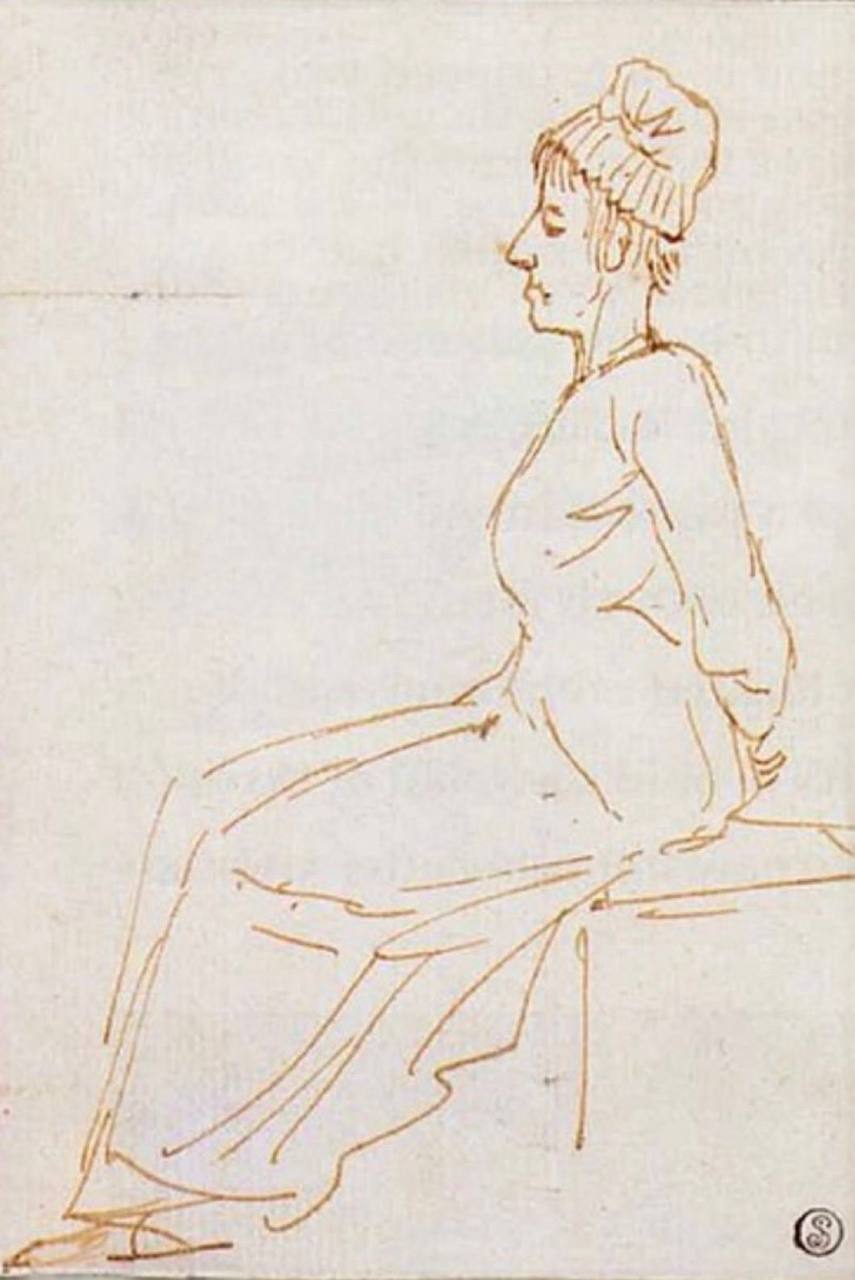
When Marie Antoinette was being taken to the scaffold, the artist Jacques-Louis David made a sketch: the queen in the cart, in plain clothes and a lace cap, her hands bound behind her back, her eyes lowered.
This moment before the execution, full of drama, was later described by Stefan Zweig. He writes that David was in the Café de la Régence on the rue Saint-Honoré and made the sketch as the cart with the royal prisoner passed by. In his biography David seems to stop time in order to show that even in humiliation she preserves her royal dignity: the shoulders are not bowed, the back is straight, the gaze is concentrated and calm, yet the eyes are lowered, as if avoiding the contemplation of this reality.
David's legendary sketch is often considered cruel. True, the artist himself took part in the Terror before entering the service of Bonaparte.
Zweig speaks of the "sinister power" of this sketch. There is an opinion that Marie Antoinette was guillotined in great haste because of a cancer she had developed; she was in effect dying, and the regime of executioners could not permit her to depart by her own death.
"Pardon me, sir, I did not do it on purpose," she said at the scaffold, having stepped on the foot of her killer.
Zweig speaks of an inner conflict between fate and personality. He shows that the tragedy of Marie Antoinette's lot is born not of her grandeur but of the fact that an ordinary person found herself in a world too large for her:
Lightly, as if in play, Marie Antoinette accepted the crown as a gift. She was still too young to know that life never gives anything for nothing, and that fate demands a price for everything. She did not think she would have to pay. She simply accepted the rights of her royal role and did not fulfil a single duty in return. She wanted to unite two desires incompatible in human experience: to rule and to enjoy herself.
How real is this scene, and how much of it is literary reconstruction? Zweig, as a biographer, does not merely retell facts; he makes of them a living spectacle, compels us to see not a queen but a woman walking to meet her fate.
There are doubts that this drawing was actually made in the circumstances described; some details, for example David's exact position, the place, the window, may have been supplied by imagination.
But perhaps, if the Marie Antoinette of the myth had known that David was drawing her at that moment, she would have smiled and said: "The main thing is that the angle should be a good one."