Speaking of the Syro-Hittite Iron Age temple of Ain Dara in Syria, it is famous first and foremost not as the closest known architectural parallel to the biblical Temple of Solomon, though that is a fact, but for the gigantic footprints in its stone
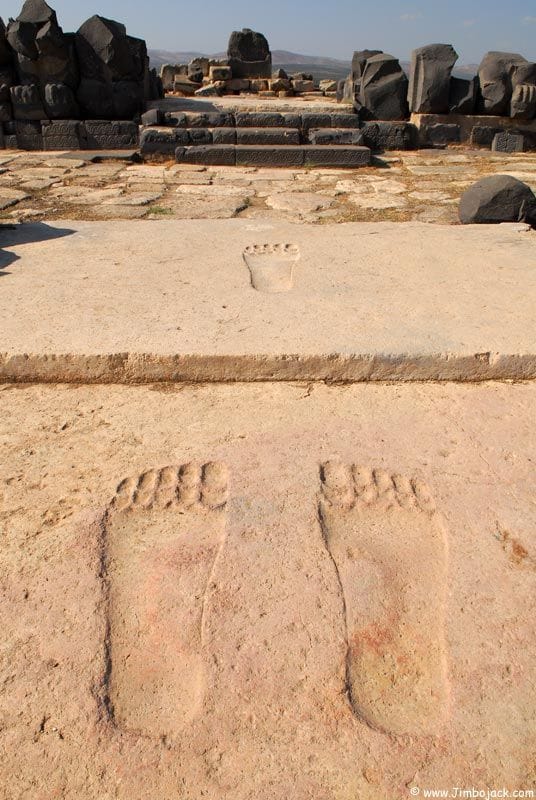
Speaking of the Syro-Hittite Iron Age temple of Ain Dara in Syria, it is famous first and foremost not as the closest known architectural parallel to the biblical Temple of Solomon, though that is a fact, but for the gigantic footprints in its stone. The prints are a little over 90 centimetres long.
But it is now hard to say what is left of the temple complex at all, apart from two craters, after the Turkish bombardments and the looting by local tribesmen.
The monument itself was discovered by chance in 1955, when a colossal basalt lion was found. The lions, by the way, are now reported to have been carted off. The first excavations, in 1956, 1962 and 1964, were conducted by Maurice Dunand and Faisal Seirafi. But it was the Syrian archaeological expedition of Ali Abu Assaf, in 1976–1985, that uncovered the temple in its entirety.
The temple is believed to have existed for about 550 years, from roughly 1300 to 740 BC.
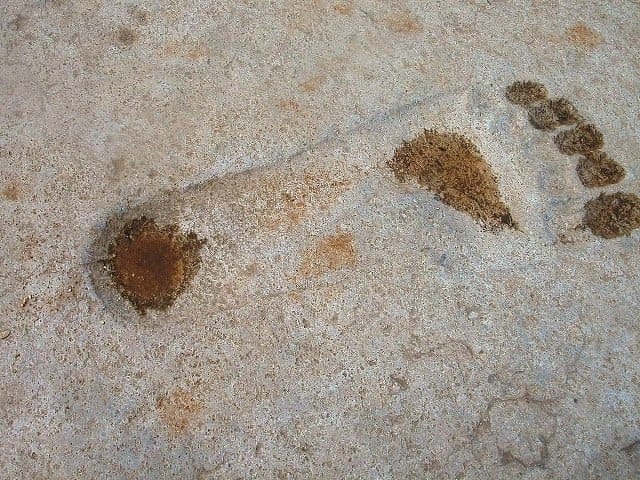
The footprints really are left in stone; this is no cement surface. The body of the temple is built of basalt blocks on a limestone foundation, and the prints are carved into the limestone slabs that form the thresholds of the doorways. As to the technique, it is said to be acceptable for the Iron Age: a chisel working limestone and basalt.
The sequence of gigantic footprints reads as the tracks of a procession. A pair of prints in the portico, then a single print further on, then another on the threshold leading inward. As though some being were entering the cella, towards the place of the cult statue.
The distance between the “steps” is about 9 metres. And if it were a literal stride, the figure that left the prints would have stood some 20 metres tall. The symbolism is described as the invisible presence and entry of the deity into the temple, a metaphor for the worshipper, on crossing the threshold, physically following in the footsteps of the god.
The attribution of the temple is disputed; it is variously ascribed to Ishtar, Astarte or the male thunder-god Hadad. No parallels to these footprints have been found in Anatolian or north Syrian art.
Yet on all the reliefs of the temple itself the deities are depicted shod, in shoes with upturned toes.