Swallowtail merlons on the walls of San Colombano al Lambro Castle and the Kremlin
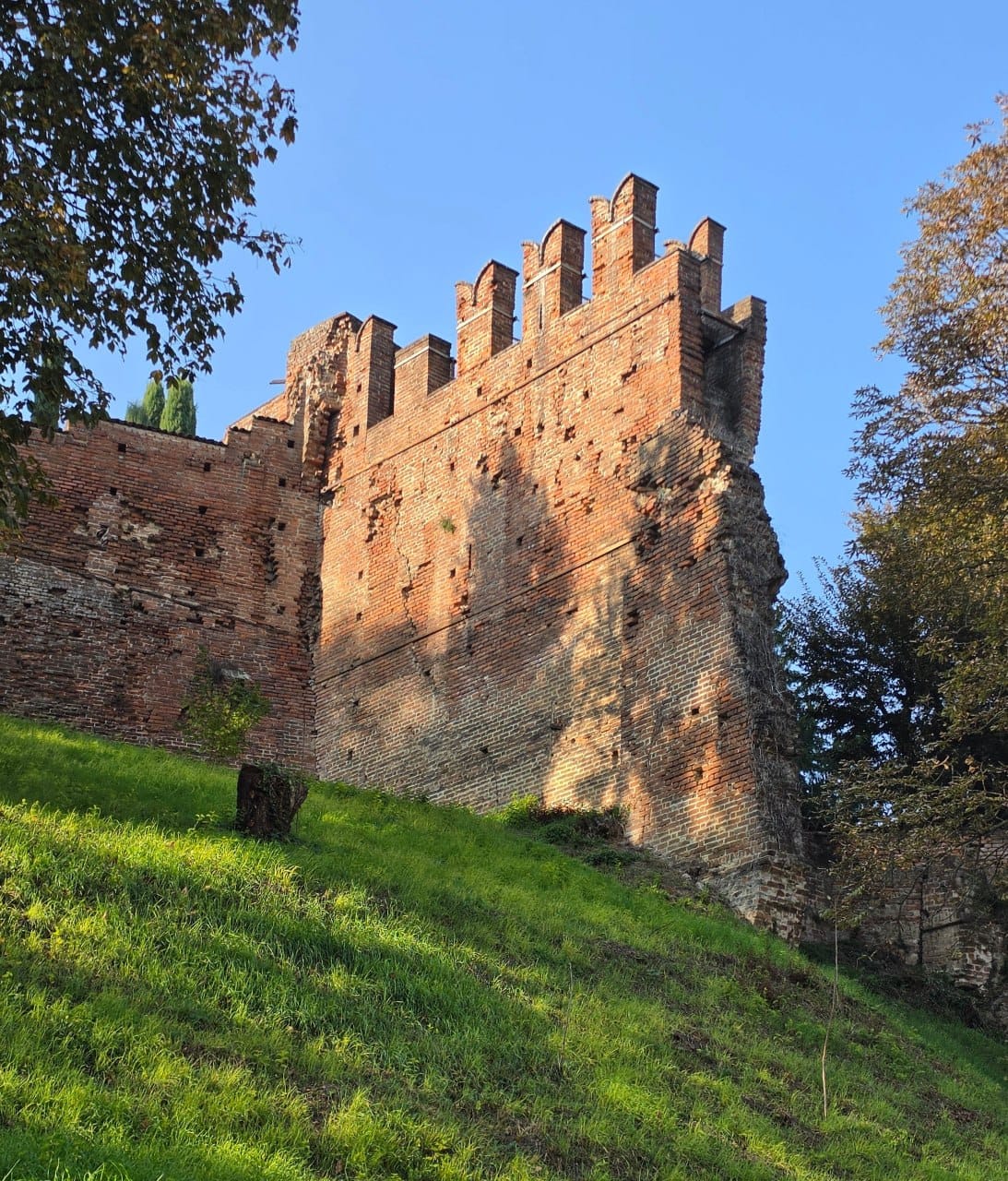
The Kremlin wall in northern Italy
In Italy, too, they are called swallowtails, and it is said that in the 12th century they served as a kind of badge of allegiance. The Guelphs, supporters of the Pope of Rome, built their walls with rectangular merlons; the Ghibellines, supporters of the Emperor of the Holy Roman Empire, with forked ones. I suspect the rule was not observed very strictly, nor by everyone, but it was possible to tell who owned a wall by its upper edge.
This section of wall belongs to the castle of San Colombano al Lambro, which stands on the only hill, 147 metres high, in the plain between Lodi and Pavia, forty kilometres from Milan. In 1164 Frederick Barbarossa took the fortress from the Milanese, razed it and built it anew, and most of those walls survive to this day.
Perhaps this lends the shape of the merlons an additional meaning: the word "Ghibellines" derives from Waiblingen, the castle of the Staufers, to whom Barbarossa himself belonged.
After that the castle passed from hand to hand: in 1299 the Viscontis took it, in 1396 it was handed over to the Certosa di Pavia monastery, which held it until 1782, and then the ownership passed to the Belgiojoso family.
For the rebuilding of the Kremlin, Ivan III needed Italians, and in 1487 Pietro Antonio Solari arrived in Moscow, having trained in Milan under his own father, one of the chief architects of Milan Cathedral. In two years Solari built most of the Kremlin walls and the Borovitskaya, Konstantino-Yeleninskaya, Spasskaya, Nikolskaya and Corner Arsenalnaya towers. In May 1493 he died in Moscow.
And the swallowtail he brought with him as an ordinary Lombard habit.