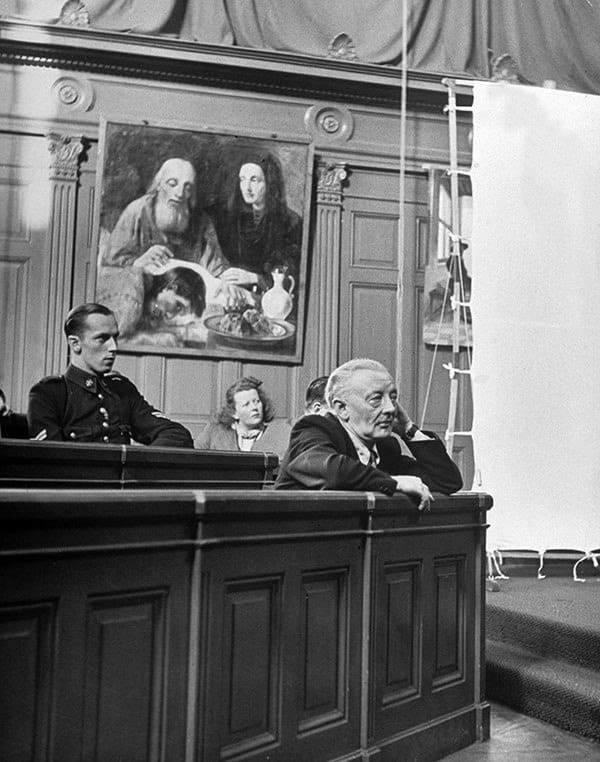
Van Meegeren sold a forged Vermeer to Göring and confessed to the forgery in 1947
Henricus Antonius van Meegeren is regarded as one of the most ingenious art forgers of the twentieth century. For a long time, van Meegeren's fakes were esteemed in the art world as very nearly the finest examples of the work of such seventeenth-century painters as Johannes Vermeer and Pieter de Hooch.
Han van Meegeren might never have been exposed at all had he not confessed himself when he was arrested for selling the canvas "Christ and the Adulteress", attributed to Vermeer and accordingly reckoned a national treasure of Holland. The sum involved was a record for an Old Master: 1,600,000 guilders. The buyer was none other than Reichsmarschall Hermann Göring.
In 1947 Han van Meegeren was charged with profiteering in the national cultural heritage and with collaboration. He then admitted that he had indeed sold the picture, but that it was a forgery made by his own hands. That the masterpiece had come from van Meegeren's brush was proved by experiment: he was shut up in a house and produced yet another "Vermeer", his last picture, "The Young Christ Teaching in the Temple", in six weeks.
He was now tried solely as a forger and sentenced to a year in prison. It emerged that van Meegeren was the author of "Christ at Emmaus", "The Last Supper", "The Girl Playing the Guitar" and "The Woman Reading Music" (all after Vermeer), "The Card Players" and "The Merry Party" in the manner of Pieter de Hooch, "The Woman with a Wine Glass" in the manner of Frans Hals, "Portrait of a Young Man" in the manner of Terborch, and a number of other canvases.
Despite the sentence, van Meegeren became a national hero of the Netherlands, as the man who had managed to cheat Göring of a fantastic sum during the Nazi occupation of the country.