How Napoleon's signature changed from Captain Bonaparte to Saint Helena
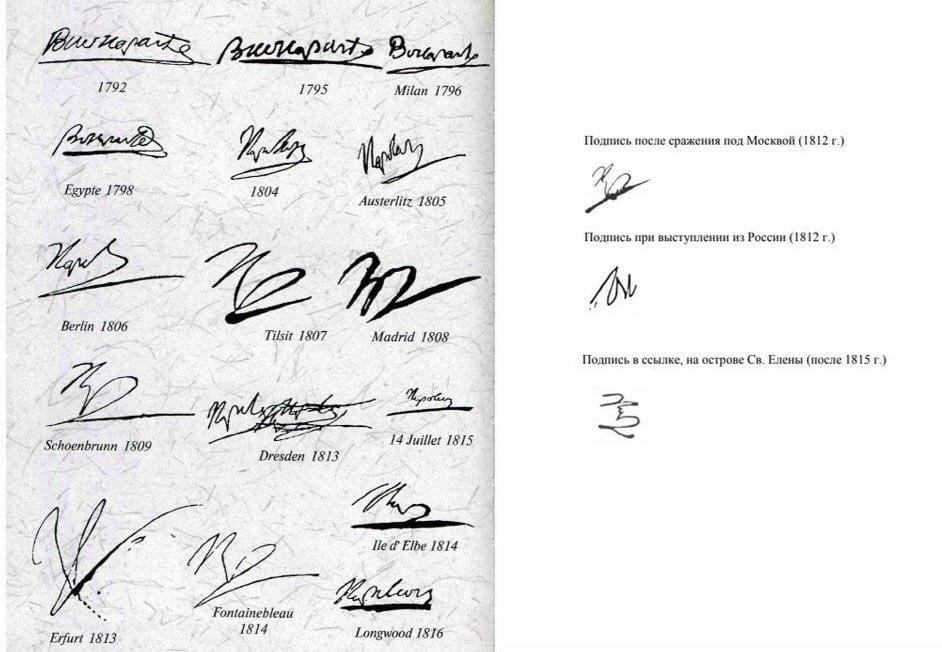
It is interesting to watch how Napoleon's signature changed: from a plain Bonaparte, when he was still an artillery captain in 1792, to a plain Napoleon with a sharp flourish in the 1800s, when he was already Emperor. As late as 1798, in Egypt, Napoleon still signed himself with his surname.
The signature beneath the proclamation of victory at Austerlitz is self-assured, abrupt, reaching ever upward. The Berlin, Tilsit and Madrid signatures carry a colossal letter N: what is that, if not the growth of vanity? A simply enormous N appears under the documents signed after the battle for Moscow: Napoleon was, as it were, at his zenith graphically too.
After the flight from Moscow, however, the signature became tangled and indistinct. The Dresden scrawl bears witness to nervousness and uncertainty. The signature after the crushing defeat at Leipzig in 1813 is jerky, jittery and unclear, in a word defeatist: the man had, after all, lost his European conquests. At Fontainebleau it is as though a quite different Napoleon is writing. On the island of Saint Helena, Napoleon leaves behind nothing more than an indistinct squiggle