The Beast of Revelation in Giusto de' Menabuoi's fresco in the Padua Baptistery
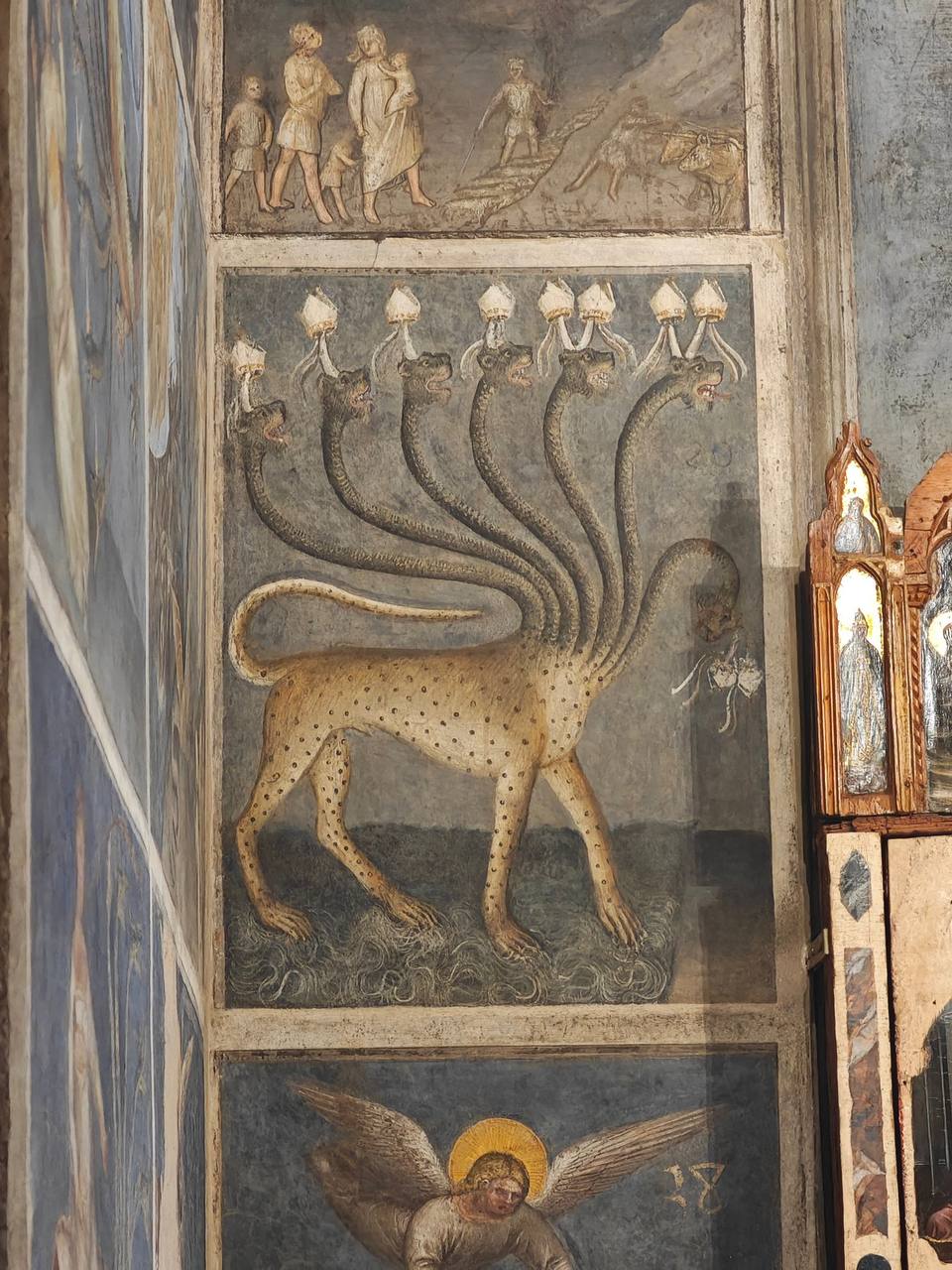
I saw a beast rising out of the sea. He has ten horns and seven heads; on his horns are ten crowns, and on his heads blasphemous names.
The beast I saw was like a leopard, but his feet are those of a bear, and his mouth a lion's. The dragon gave him his own power, his throne and great authority.
One of his heads, it seemed, had received a mortal wound, but it was healed. The whole earth marvelled and followed the beast,
and people worshipped the dragon, because he had given authority to the beast, and they worshipped the beast, saying: "Who is like this beast, and who can fight against him?"
He was given to speak haughty and blasphemous words. Authority was given to him for forty-two months.
Revelation, chapter 13. Translated by Desnitsky
A fragment of the fresco in the Padua Baptistery, whose masterpiece status is, regrettably and quite wrongly, usually eclipsed by the Scrovegni Chapel. The painter is Giusto de' Menabuoi, fourteenth century.
The Beast in Padua is composed of four animals: a bear, a leopard, a lion and one more, symbolising the enemies of God's people seen by the prophet Daniel. Together they form a seven-headed monster. Let us count, and indeed there are ten crowns, denoting rulers, apparently those of Rome. Only here, in place of crowns, we find papal mitres.