The Guardian has published a lengthy conversation with the writer Salman Rushdie, his wife Rachel Eliza Griffiths and the director Alex Gibney
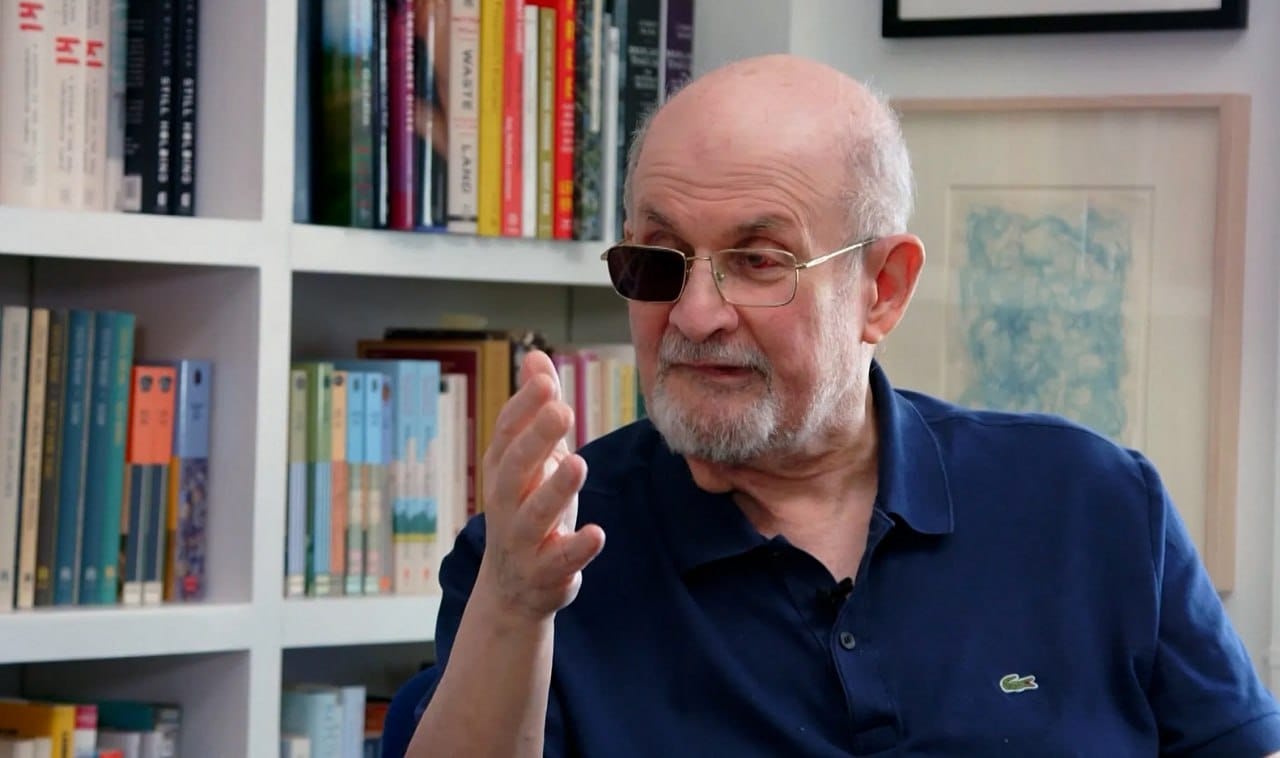
The attack on the writer took place on 12 August 2022 in Chautauqua, in upstate New York, where Rushdie was due to speak. Griffiths was at home in New York that morning and learned of what had happened by telephone from an acquaintance, the details reaching her only later through the news. She hurriedly chartered a plane, not knowing whether her husband was alive, and in the very first days at the hospital began shooting a video diary of his treatment and recovery. According to Rushdie, the idea of keeping a record was his own, but he had in mind merely a few snapshots on a phone every couple of days, whereas his wife had something else in mind. Griffiths recalls that the first thing she asked for was a proper camera, and when the box arrived she burst into tears, because it restored her to her profession as a photographer.
The film combines her footage with archival newsreel shot after 1989, when Ayatollah Khomeini issued a fatwa, that is, a religious ruling, calling for the writer to be killed for his novel. Rushdie was then forty-one, and he spent the following nine years in hiding under armed guard.
The archival part proved to be the initiative of Gibney, an Oscar winner for documentary. Rushdie himself at first objected to a return to the past and insisted that the man who attacked him, designated in both the book and the film by a single letter, had acted alone. He also speaks sharply of the fact that there was not a single security guard in the hall at Chautauqua. Gibney explains that Rushdie does not want to be defined through this attack, and admits he is right, but considers it important to show the viewer the global scale of the campaign of those days: the firebombing of a newspaper office in the USA, the deaths of six people in rioting in Pakistan, the murder of the novel's Japanese translator, the attack on its Italian translator, a march in London with an effigy of the writer. The film also cites the prediction of the historian Edward Said, who believed that the danger to Rushdie would come not from a religious fanatic but, years later, from a random stranger.
Gibney originally wanted to build the picture on the model of Dennis Potter's series «The Singing Detective», in which the hero lies in hospital, recovers physically, and meanwhile his life passes before his eyes.
Griffiths explains why the film contains so many shots of the writer's mutilated eye: the camera was at once a protective screen and a means of making sure that what was happening was real. At first she did not show her husband the footage, and they watched it together only after his return home. According to Rushdie, he saw that the injuries were far graver than he had imagined, and then he was glad, because he looks different now, and that difference shows the measure of his recovery. In the finale the couple return to the scene of the attack, and there it also emerges that the writer had been wrong to reproach himself for inaction: the recording shows that he tried to get away from his attacker