"A stout Mordvin woman in a chemise mottled at the shoulders, sleeves and hem with red wool, as though it had been inscribed in blood; her bosom weighed down with silver coins of various sizes in several rows; in her ears a ball of swan's down apiece, and
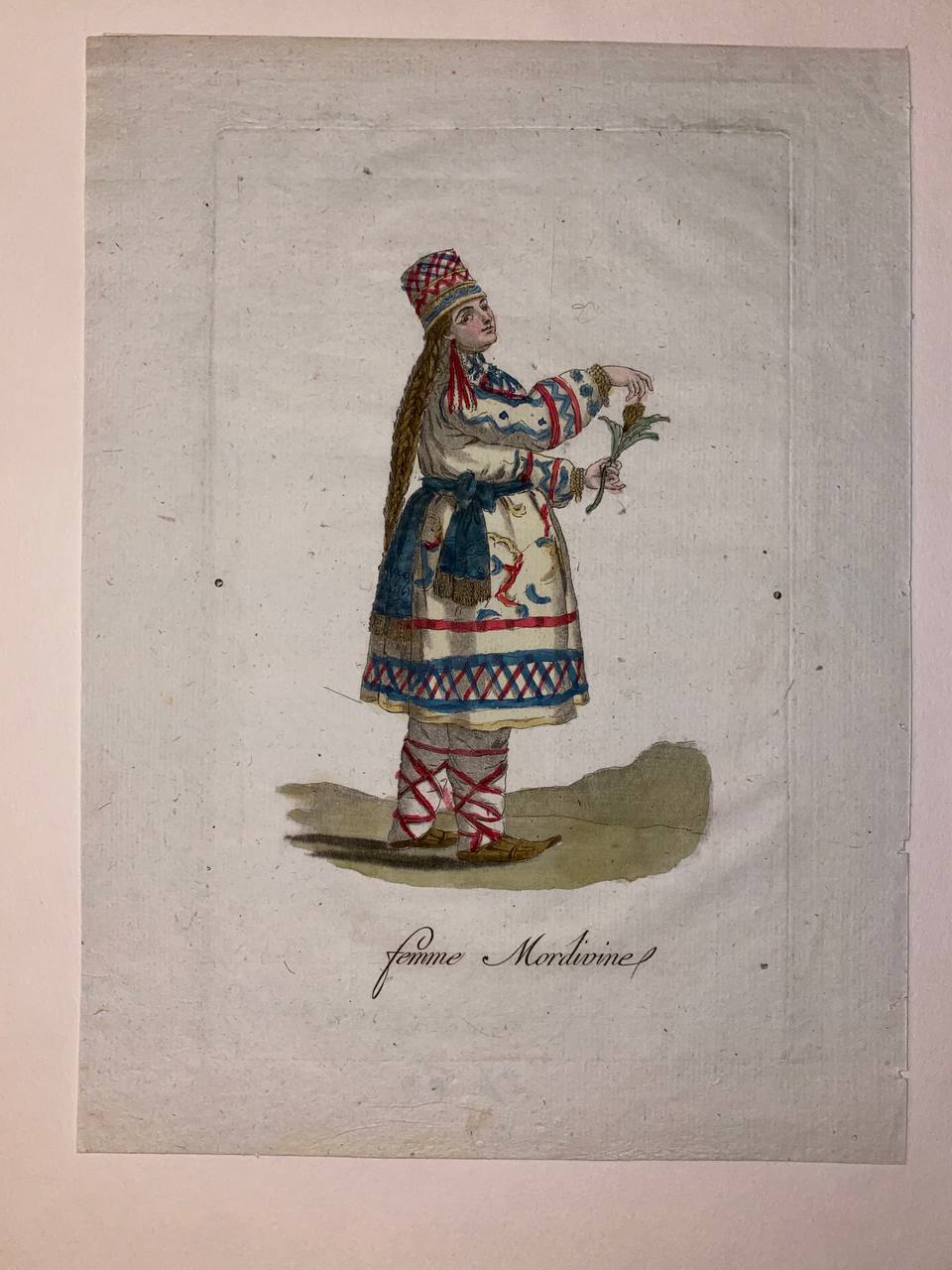
"A stout Mordvin woman in a chemise mottled at the shoulders, sleeves and hem with red wool, as though it had been inscribed in blood; her bosom weighed down with silver coins of various sizes in several rows; in her ears a ball of swan's down apiece, and beneath it the coins jingle like the studs on a horse's bridle. Here is a human countenance daubed with white lead and rouge, with brows pencilled in an arch with antimony, beneath an enormous kokoshnik in the shape of a shovel, embroidered with pearls, emeralds and rubies. This countenance is borne by a forty-bucket barrel in a brocade sarafan with gold figuring; magnificent sleeves of the finest batiste lend her wings. Blue woollen stockings reveal her plump legs, while her backless shoes on high heels betray her cautious gait. Permit me to present my countrywoman, the pastila-maker of Kolomna."
Ivan Lazhechnikov, "The Ice House"
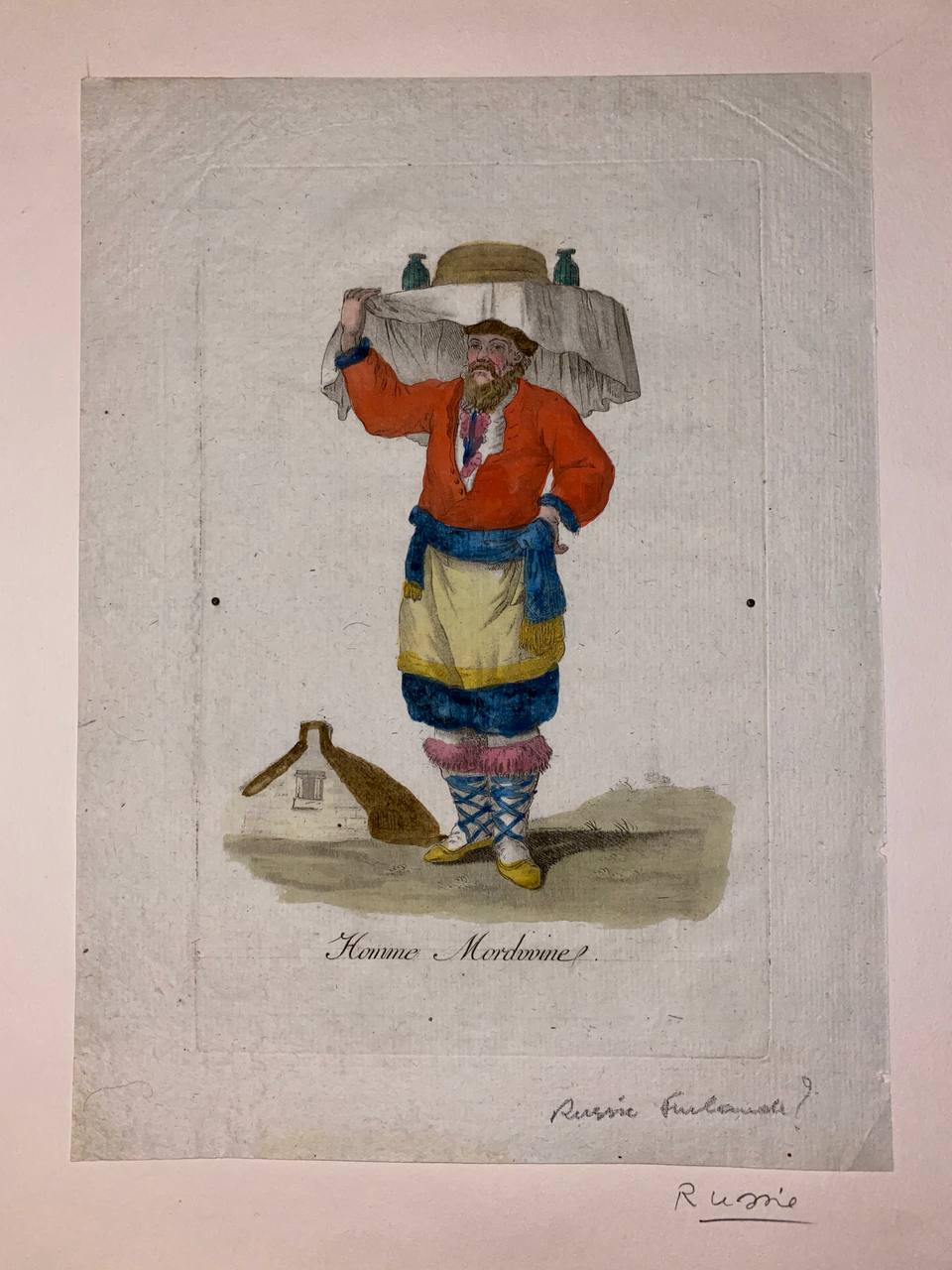
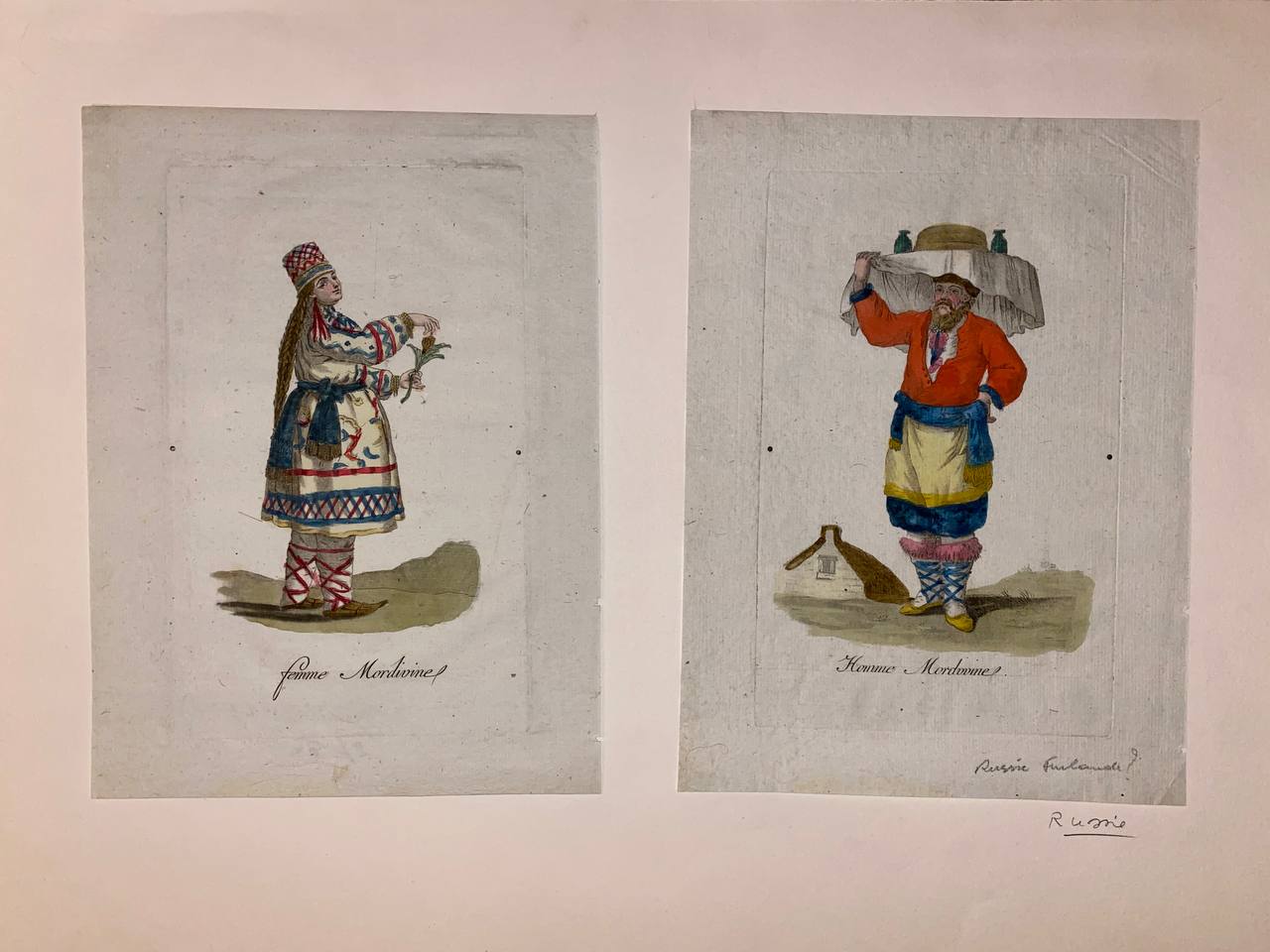
Illustration: A Mordvin woman and man, 1787-1788.
Tatishchev mentions the Mordvins in a letter of 1736, in which he calls this people descendants of the Sarmatians: "Above I mentioned that in these lands there formerly lived a Sarmatian people, whose remnants are the Finns, the Livonians or Varangians, the Lithuanians, the Kurs or Courlanders, the Chuvash, the Cheremis, the Mordvins, the Votyaks, the Ostyaks, the Lapps and others, who in ancient times were all together called Sarmatians in their own tongue. That name signifies a vast state, while by its several portions each appanage bore its own name."
In Kachenovsky's "Brief Extract on the Primeval Peoples Inhabiting Russia, and on the Newcomers Who Joined Them Before the Formation of the State", the Mordvins are counted among the primeval, that is, aboriginal, peoples of Russia: "...of the following primeval peoples (aborigenes): Chud, Merya, Muroma, Ves, Mordva, Zavolotskaya Chud, Perm, Pechera, Yam, Ugra (Yugra), Litva, Simgola, Kors, Leshgola, Lib".
The historian Lepekhin describes the division of the Mordvins: "The Mordvins are properly divided into two branches, the first of which is called the Moksha and the other the Erzya; but among the Moksha too there is some difference. Some are called native or high Moksha, while others are considered plain Moksha, and their whole difference consists in certain dialects."