The family business of Christian Dior was remarkable, and economic historians of France write of it with considerable respect
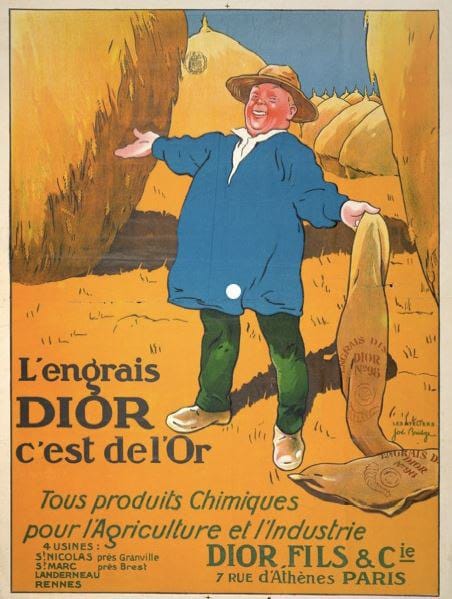
The production of quality fertilisers lent serious support to the agricultural boom of the late nineteenth and early twentieth centuries. It was precisely in these years that crop farming and animal husbandry were wholly transformed.
The zenith of French agriculture is usually placed in the period from 185+ to 1880: this was the time of growing cities and industry, of expanding non-food production and rising prices for farm produce. The period from 1880 to 1914 proved a severe trial for the country, as the market suffered fierce competition from American and Argentine producers. It was then that the decision emerged to apply synthetic fertilisers on a wide scale, which would require the growth of the chemical industry.
In the 1840s France obtained its fertilisers chiefly from England; these were natural phosphates shipped from Chile and Peru, the products of decomposed bird droppings. In those years the merchant Jean-Louis Dior (Christian's great-grandfather) began to deal in fertilisers in the district of Saint-Hilaire-du-Harcouët. Some time later he realised that such fertilisers were also being made in France, and resolved to take up their production in his native Saviigny-le-Vieux. He began to collect excrement in the town of Granville, which, after processing and fermentation, became fertiliser. The occupation brought a double profit: from the sale of the product and from the performance of a sanitary function.
In the nineteenth century a serious understanding of the importance of sanitary works in towns was taking hold, for a link had by then been established between outbreaks of diseases such as cholera and urban filth. By 1861 Dior had received from the Granville town hall a contract for the removal of excrement, and the enterprise became, quite literally, strategic for the town.
Very soon the family amassed an impressive capital, and production went from strength to strength. In the face of competition from foreign suppliers Dior decided to modernise, and built a chemical works. The coast and all the port towns became his fiefdom. He began to make chemical fertilisers in the very heart of the regions that consumed them. He mixed natural phosphates with sulphuric acid, obtained as a by-product of burning iron pyrites. The dry fertiliser was packed into sacks and sold across the whole country. In 1900 it would cover 75% of the French market.
The Dior fertiliser-making and trading enterprise, founded in 1832, passed to Jean-Louis's sons, then to his grandsons, and then to his great-grandsons. Christian's brothers modernised production and began to manufacture sulphuric acid, superphosphates and detergents. Unfortunately, after 1929 the company, which provided more than 500 jobs, contracted sharply. But the Saint-Marc detergents and Dior bleaches continued to be sold until 1988. From that time the fertilisers were made by a subsidiary, which also produced granulated chemicals. By 1996 its activity had narrowed to the packaging and bagging of products, mainly for agriculture. In 2007 this plant, too, was closed.
Nevertheless, the Dior family made a great contribution to the development of the chemical fertiliser industry and, ultimately, to the development of French agriculture.
Illustration: Dior fertiliser is gold! An advertisement for the prospering chemical fertiliser business owned by the father of Christian Dior. Who would have guessed that such a remarkable designer would spring from phosphates