Swedish filmmakers locate the Paris spot where Daguerre photographed the Boulevard du Temple in 1838
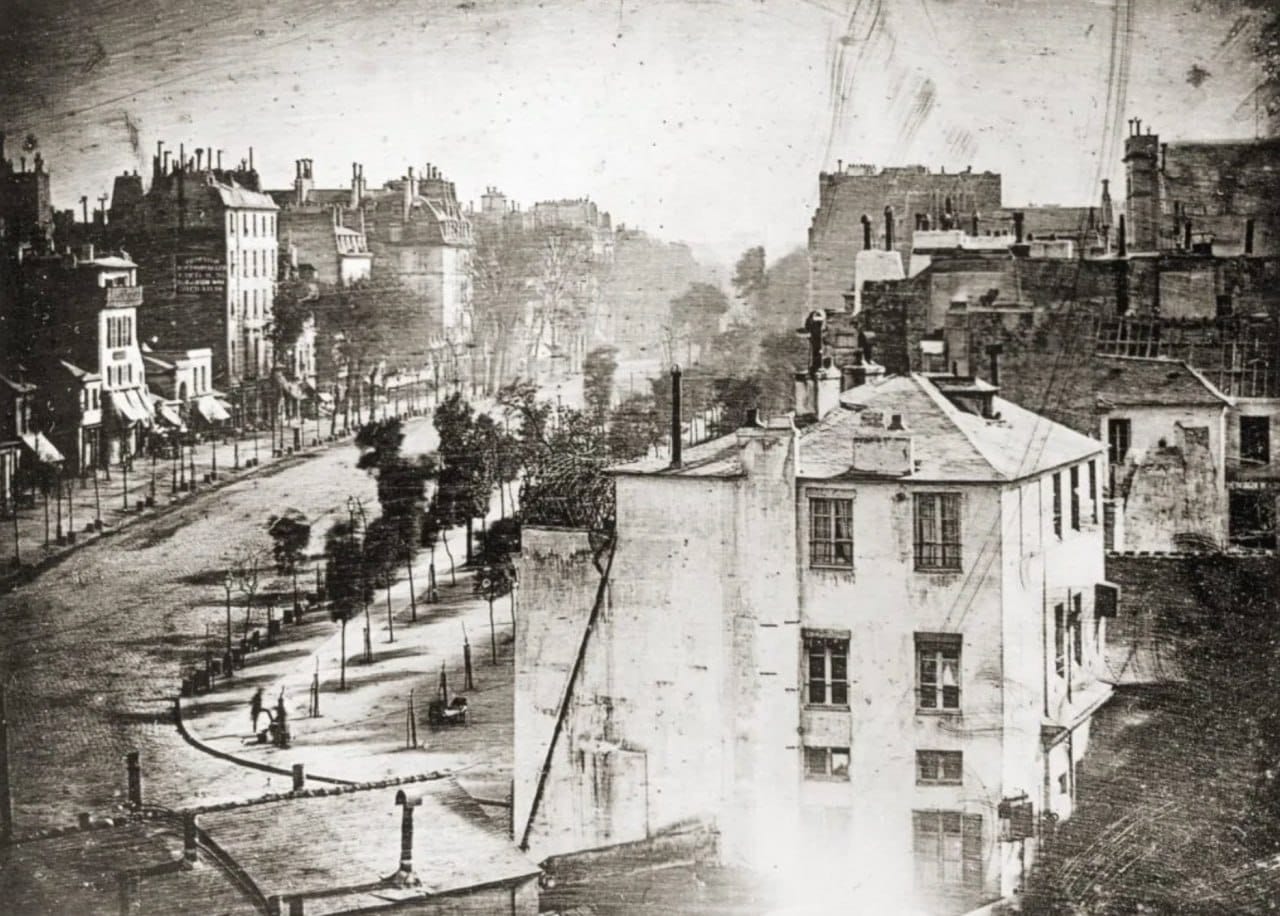
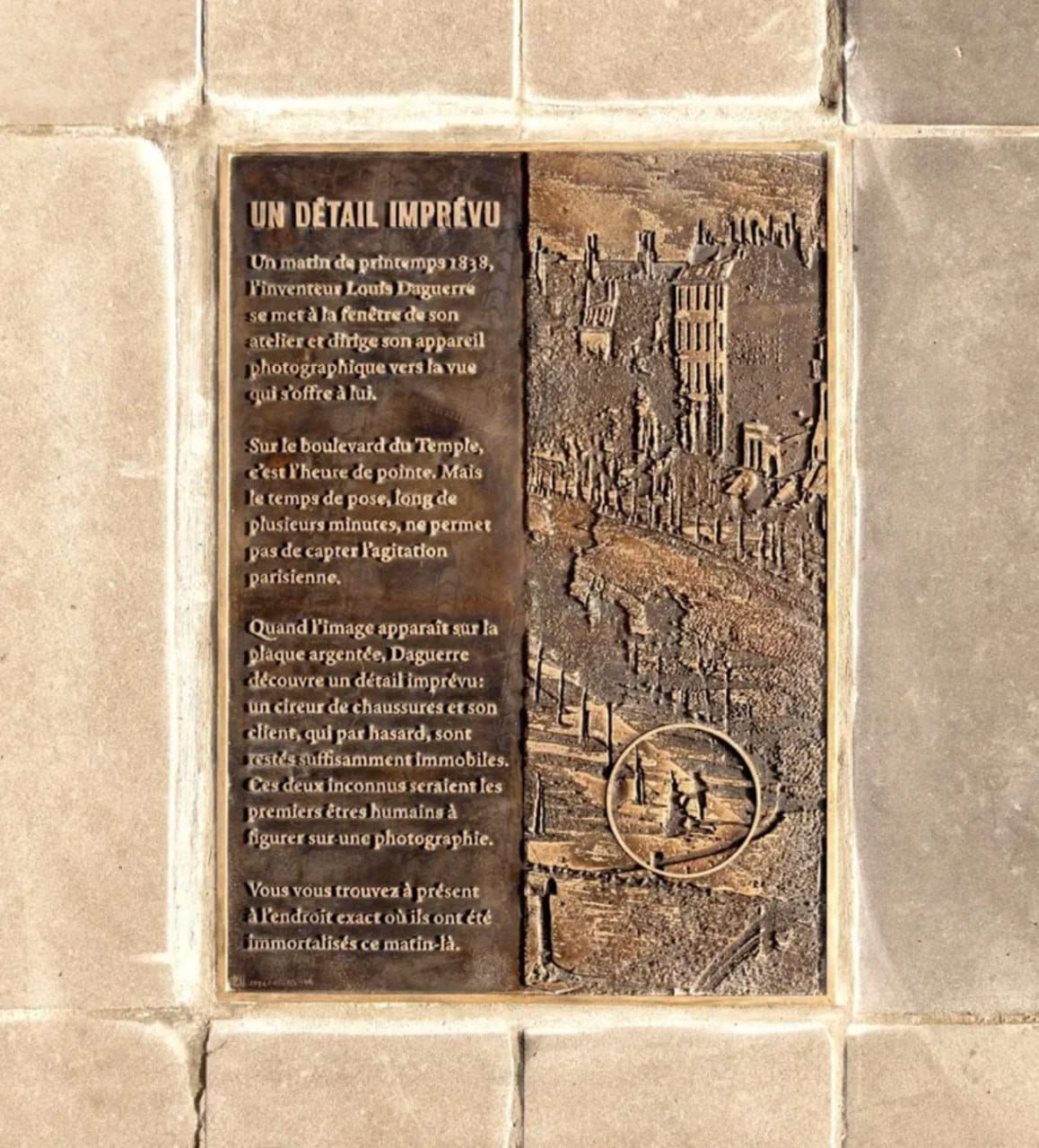
In the spring of 1838, Louis Daguerre, the French painter and inventor of the daguerreotype, was testing a camera on which he had been working for almost a year. The daguerreotype was the first practical method of photography: the image appeared on a silvered copper plate. Daguerre photographed the view from the window of his studio on the second floor in Paris. The picture is called "View of the Boulevard du Temple" and is considered the first image in which photography captured people. The exposure lasted from five to ten minutes, and for that the passers-by moved too quickly and therefore left no trace on the plate. Only a bootblack and his customer remained in the picture, standing motionless on the bend of the tree-lined boulevard.
The spot in Paris where these two men stood has been marked with a bronze plaque. Daguerre's studio and the neighbouring theatre stood on the site of today's Rue Léon-Jouhaux. Daguerre was photographing a stretch that is now occupied by the Place de la République, designed in the mid-1850s by Baron Haussmann.
The place was found by the Swedish filmmakers Maximilian Van Aertryck, Axel Danielson and Kalle Boman. They used Daguerre's picture in their documentary "And the King Said, What a Fantastic Machine", about the two-hundred-year history of images. The search began in 2024 and took about two years. The authors made a three-dimensional scan of the square and the boulevard in order to measure the distances between the buildings. They then reconstructed the appearance of the quarter in 1838 from paintings, engravings and maps in Parisian archives. Two architectural firms worked with these data independently of one another and indicated two points about two metres apart. The filmmakers chose the spot between them.
The task was complicated by the condition of the picture itself. In 1839 Daguerre sent the plate to King Ludwig I of Bavaria, and during the Allied bombing in the Second World War it was badly damaged. Most of the image is known from a copy made in 1937 by Beaumont Newhall, curator at the Museum of Modern Art in New York. The filmmakers are now looking for the negative of that copy.
In short, the map of Paris has been given a commemorated point that is, in a certain sense, connected with the beginning of a new era, as a reminder that earlier generations also lived through technological upheavals