Britain Bars Export of Bronze Nymph by Antico
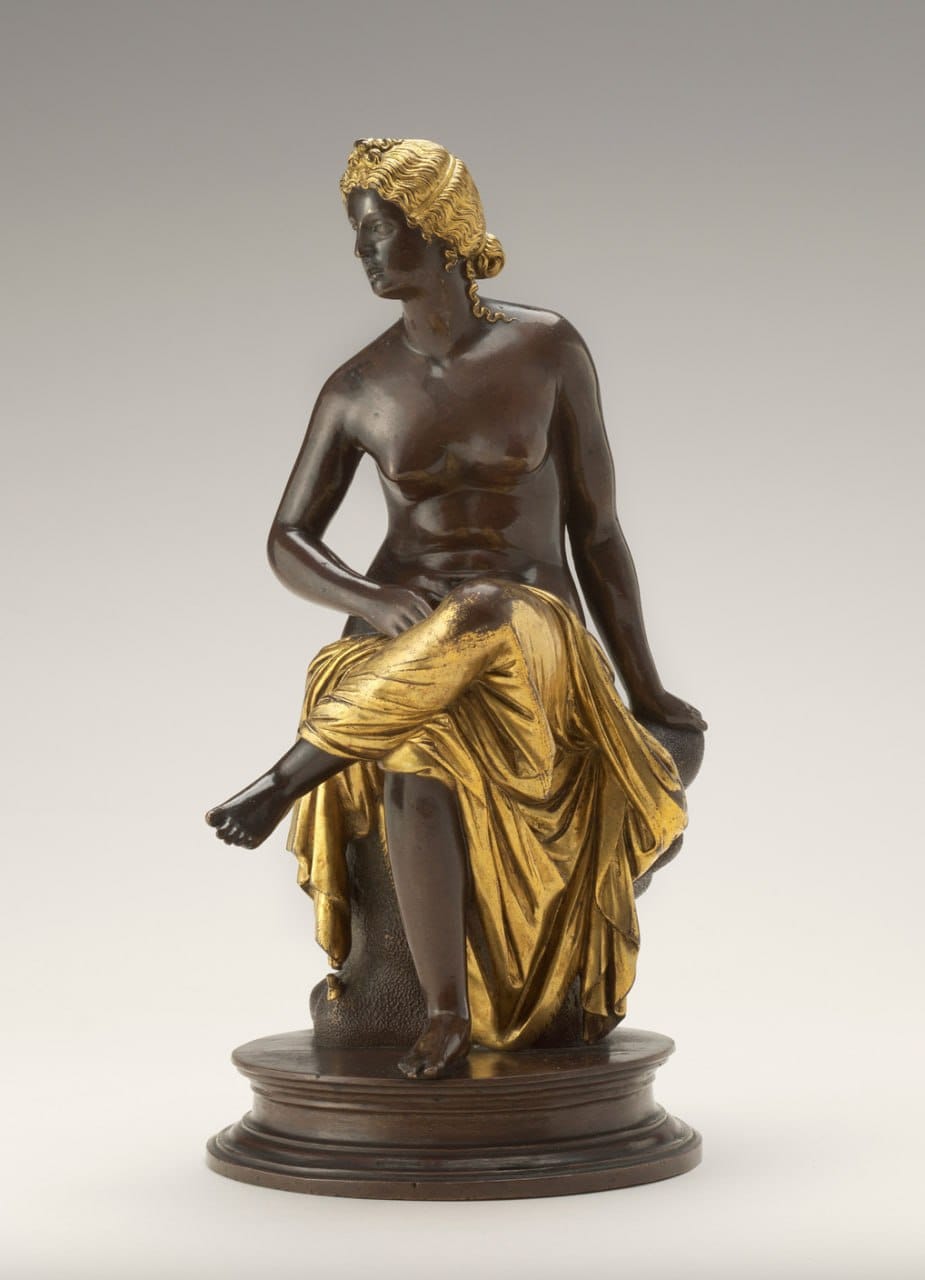
The British government has temporarily barred the export from the country of the bronze statuette "Seated Nymph" by the Italian sculptor Pier Jacopo Alari Bonacolsi, whom his contemporaries nicknamed Antico.
Experts have valued the statuette at £4.6 million. The temporary bar gives British museums and galleries time to raise the money to buy the sculpture and keep it in the country, on public view.
Antico was born around 1455 and died in 1528. He worked in Mantua, chiefly for Isabella d'Este and several generations of the ruling Gonzaga family. The sculptor earned the nickname Antico, that is, "the antique", for his skill in imitating works of antiquity. Scholars believe that the "Seated Nymph" was commissioned around 1503 by Isabella d'Este, Marchioness of Mantua. The statuette falls just short of 20 centimetres in height. The master covered the hair and the drapery of the figure with mercury gilding, and inlaid the eyes with silver. In mercury gilding, the craftsman applied a mixture of gold and mercury to the bronze and then heated the piece, whereupon the mercury evaporated, leaving a thin layer of gold on the surface. The diadem on the figure's head suggests that the sculptor portrayed a goddess, possibly Venus.
King Charles I of England probably acquired the statuette around 1628, together with the Gonzaga collections that he bought from the Dukes of Mantua. The "Seated Nymph" later passed into the collection of the Dukes of Bedford at Woburn Abbey. Staff at the estate found it in the dust near a storeroom in the private wing of the house. In 2009 Sotheby's sold the statuette at auction in London. Works by Antico very rarely come up for sale, and no other piece of his has ever fetched more than $250,000 at auction. The present owner bought the "Seated Nymph" from the London art dealer Patricia Wengraf in April 2026.
The government took its decision on the recommendation of the Reviewing Committee on the Export of Works of Art and Objects of Cultural Interest. The Committee ruled that the statuette meets the second and third Waverley criteria. British authorities introduced these criteria in 1952, following the report of Lord Waverley's committee, in order to identify national treasures. An object meets the first criterion if it is closely connected with British history and national life, the second if it is of outstanding aesthetic importance, and the third if it is of outstanding significance for the study of art, learning or history. In the case of the "Seated Nymph", the Committee noted its aesthetic importance and its significance for the study of the history of sculpture collecting in Britain.
The first deferral period expires on 17 December 2026. After that the owner will have 15 working days to consider offers to purchase at the recommended price of £4.6 million plus VAT of £166,666.67. If a buyer signs an option agreement with the owner, a second deferral period of five months will begin. Ruth Mackenzie, the Minister for Arts and Museums, expressed the hope that the bar would help keep the statuette in the country, where the public can admire it.