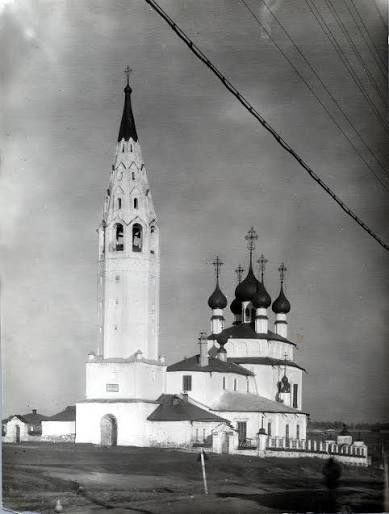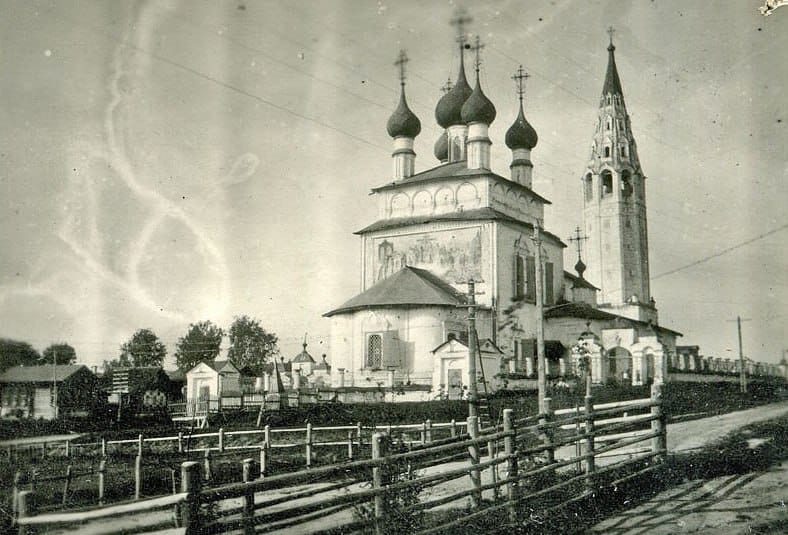
Palekh has a remarkable Church of the Exaltation of the Cross with an interesting tent-roofed bell tower
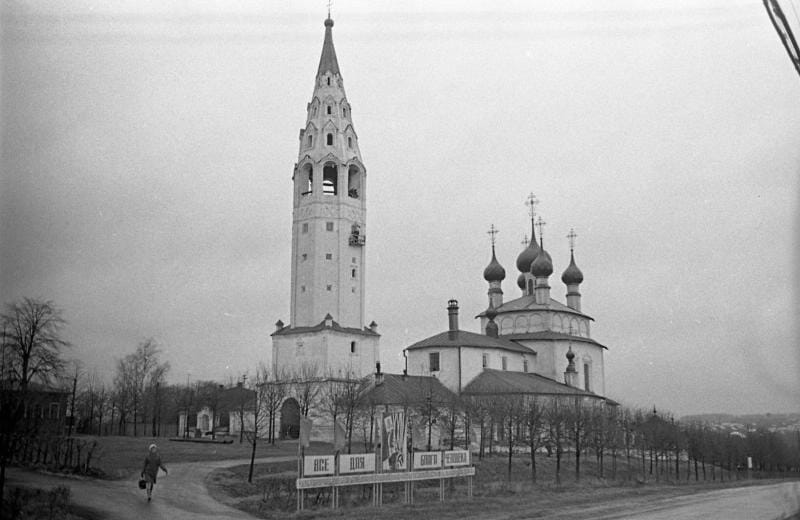
Palekh has a remarkable Church of the Exaltation of the Cross with an interesting tent-roofed bell tower. The people of Palekh built it all together, from 1762 to 1774. In Saint Petersburg at that time Rastrelli was giving way to Vallin de la Mothe, while in the Vladimir lands the master Yegor Dubov was raising above the church a bell tower modelled on pre-Petrine archaism, as though the eighteenth century had never happened.
So what of the so-called ban on tent-roofed building imposed by Patriarch Nikon in 1652? The textbook quotation from his church-building charter prescribes that churches be built "with one, with three, or with five cupolas, but tent-roofed churches are on no account to be built". It is a pity that it cannot be established from which charter exactly this quotation is taken; the historian Poloznev, for instance, asserts that Patriarch Nikon did not forbid tent-roofed churches. No one has in fact seen a single decree, although the ban itself is mentioned in the most various charters from 1655 onwards. At the very least we may be certain that the diocesan chancery truly did not look kindly on tents.
When in 1655 side chapels were being added to the tent-roofed Church of the Dormition in Veshnyaki, the patriarch ordered them to be crowned with round cupolas rather than pointed ones. Yet it was he himself who broke this written prohibition, setting above the rotunda of the Resurrection Cathedral in New Jerusalem a tent of gigantic size, in the likeness of the Church of the Holy Sepulchre.
Be that as it may, structures resembling pyramids, descended from Russian wooden architecture rather than from the Byzantine domed tradition, were driven out of church architecture. But a bell tower, after all, is not reckoned a church. And the masters of tent-building could long find use for their craft after Nikon's ban: tent-roofed bell towers were built throughout the seventeenth and eighteenth centuries, especially in the provinces. In the North, indeed, Moscow was heeded very poorly: in that same year 1774, when the church in Palekh was being completed, a wooden tent-roofed Church of the Dormition was raised in Kondopoga, which stood until it was burnt down in 2018.
The Old Believers made their contribution too. Palekh belonged to Vladimir Governorate, where a strong Old Believer presence set the general background, against which it was not European fashion but old Russian models that were held in esteem. True, the church itself belonged to a Synodal parish, but it was built by people brought up in the tradition of the local school.
Dubov combined in it the tent with the decoration of Naryshkin Baroque, and in 1807 the icon painters of Palekh covered the walls with paintings that would be called "the last great wall painting, completing the cycle of development of the ancient Russian religious pictorial tradition".
I have not found the exact dimensions of the church and bell tower; by eye I would guess 27 to 32 metres, which is far from tall next to the 93-metre tent-roofed Nikita bell tower in Poreche-Rybnoye and the 76-metre tent-roofed bell tower of the Joseph-Volokolamsk Monastery. But what proportion, and what a remarkable silhouette, and a rare one, truly!