In 2013, at the Monastery of the Protection of the Mother of God in Bussy-en-Othe, some hundred kilometres from Paris, the nun Elizabeth of Leuchtenberg peacefully departed to the Lord
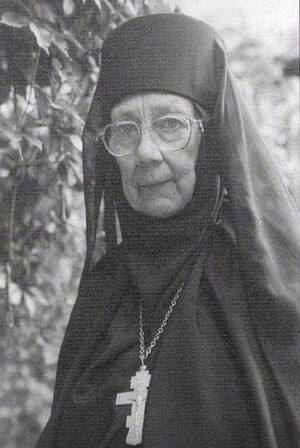
In 2013, at the Monastery of the Protection of the Mother of God in Bussy-en-Othe, some hundred kilometres from Paris, the nun Elizabeth of Leuchtenberg peacefully departed to the Lord. She was one of the last Russian nuns of the first wave of emigration and, at the same time, a great-great-granddaughter of the Emperor Napoleon I and Joséphine de Beauharnais.
The story of her family begins in 1835, when the daughter of Emperor Nicholas I, Grand Duchess Maria Nikolayevna, on her sixteenth birthday asked permission to go on living in Russia, which broke an unwritten tradition whereby every grand duchess married a European monarch and left her homeland. To underline the seriousness of her intentions, she hinted to her parents that she would sooner choose a convent than a marriage without love. Nicholas I, for all his severity, granted the wish of his beloved daughter and four years later gave her in marriage to Maximilian, Duke of Leuchtenberg, the son of Eugène de Beauharnais, Napoleon's stepson and former Viceroy of Italy.
Tradition has it that during the French advance Eugène de Beauharnais, commander of the IV Corps, occupied the town of Zvenigorod. His headquarters were set up in the Savvino-Storozhevsky Monastery. That night Eugène had a dream: before him appeared a Russian elder with a stern but noble face, who spoke impeccable French. He ordered him to protect the monastery from plunder, and promised that in that case Eugène himself would return home alive and unharmed, and his descendants would live and serve in Russia. On waking, Eugène was shaken. Later he saw on an icon in the monastery church the very same elder: it was Saint Savva of Storozhevsky. The monastery was left untouched, and Eugène did indeed return safely to France, unlike most French generals.
Maximilian of Leuchtenberg married Grand Duchess Maria Nikolayevna and took the title of Most Serene Prince Romanovsky. He was a member of the Academy of Sciences, president of the Imperial Academy of Arts, head of the Mining Institute and of the corps of mining engineers, and took part in the scientific and administrative life of the country. Together with his wife he was actively engaged in charitable work.
In the years of the revolution the descendants of the Leuchtenberg-Romanovsky line found themselves in exile. The future nun's grandfather, Georgy Nikolayevich, and his son Dmitry Georgievich served at the fronts of the First World War. Dmitry, having graduated from engineering college, joined a Guards regiment as a volunteer. After the October Revolution he was arrested and imprisoned in the Peter and Paul Fortress, escaped, joined the army of General Wrangel and soon found himself in the Crimea.
There he met Princess Ekaterina Alexandrovna Chavchavadze, a young widow with a newborn daughter, Irina. She herself had barely escaped execution, fleeing from Bolshevik captivity by a miracle. Soon they left Russia together, made their way to Rome, where they were married, and then settled in Bavaria, in the family castle of Seeon.
Elena, the future Sister Elizabeth, was born in this castle on 30 May 1922. Seeon Castle, once a Catholic monastery of the tenth century, had belonged to the Dukes of Leuchtenberg since 1852, and after the revolution became a refuge for Russian émigrés, on the initiative of her grandfather Georgy Nikolayevich.
The family lost its material comfort but remained faithful to its roots, its traditions and the Orthodox faith. In the house they kept the fasts, confessed, took communion, celebrated Easter and Christmas. At table Russian romances were heard, they sang “In the Garden, in the Kitchen Garden”, and raised their glasses: “To Russia!” Although the children had never once been to their homeland, they did not hesitate to call themselves Russian.
With this sense of belonging, with faith and with the family memory of Saint Savva of Storozhevsky, Elena came to the monastic path. At the Monastery of the Protection of the Mother of God near Paris she took the tonsure and the name Elizabeth.