In 1790 a delegation of Greek captains arrived in Saint Petersburg to meet Catherine the Great and to ask her, in the name of the Greek people, for help in their struggle against the Turks
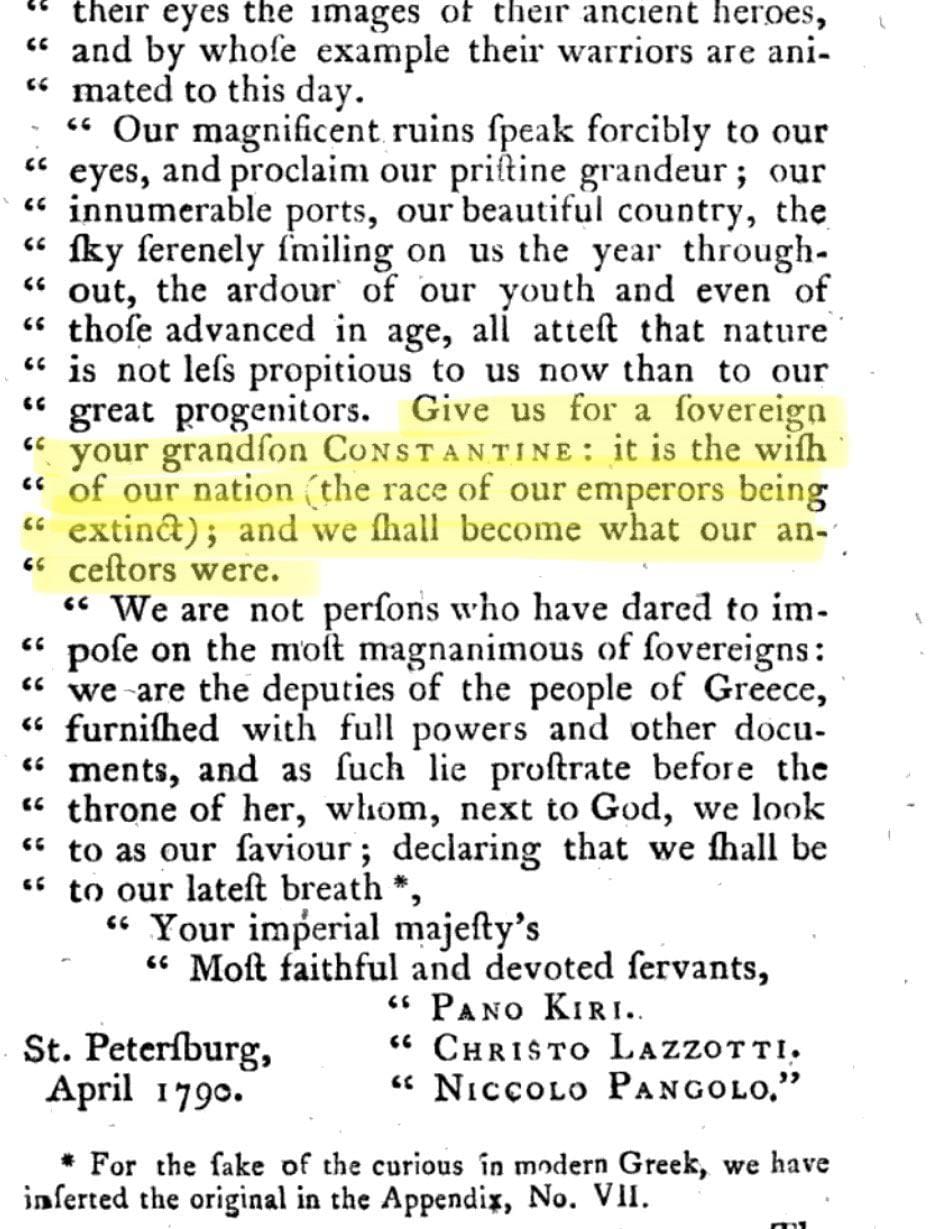
In 1790 a delegation of Greek captains arrived in Saint Petersburg to meet Catherine the Great and to ask her, in the name of the Greek people, for help in their struggle against the Turks. But the chief point of the Souliots' appeal was a request that Catherine give the Greeks her grandson Constantine as their emperor.
Earlier they had already sent letters to Saint Petersburg addressed to "His Highness, the most gentle Greek autocrat Constantine III", but Catherine did not take this seriously, remarking how amusing it was that the Greeks believed everything they could possibly imagine.
And yet her plans to set Constantine on the Greek throne are stated plainly enough in her will, drawn up in 1792, which contains her intention to raise Constantine to the throne of a Greek Eastern Empire. Though in her last years the Empress returned ever more rarely to her early idea of a grand "Greek Project".
Constantine's future was bound up with Greece from the very moment of his birth: his wet nurse was a Greek woman named Elena (as was the mother of Constantine the Great), his tutor was the Greek poet Georgios Baldani, his valet a Greek aristocrat, Dmitry Kurutа. Of course, Catherine believed in the prophecy of a Constantine who would revive the Eastern Roman Empire. It was no accident that she gave that very name to her second grandson. And the commemorative medal struck for Constantine's birth depicts the Cathedral of Hagia Sophia in Constantinople.
Alas, Constantine was not merely unprepared to become a Greek emperor: he renounced even the Russian crown, had no sympathy for the Greek anti-Turkish movement, condemned the Greeks' struggle for liberation, and even opposed a Russian war against the Turks. And how interestingly the history of Europe might have turned out...