“For three years now London has held no Russian sale, the famous auction that had existed in one form or another since the late 1980s
“For three years now London has held no Russian sale, the famous auction that had existed in one form or another since the late 1980s. It was a golden age: the descendants of Russian émigrés and celebrities such as Mstislav Rostropovich and Galina Vishnevskaya, or Prince and Princess Michael of Kent, relatives of the Romanovs, strolled about with champagne, appraising the lots,” says Joe Vickery, an expert on the Russian art market who worked at Sotheby’s for 20 years, in her article recently published in The Art Newspaper.
Points of interest from the text
Until the mid-1980s Russian art was scattered across various auctions. Paintings by Ivan Aivazovsky might be offered at sales of nineteenth-century European art, and works by Natalia Goncharova at sales of modernism and Impressionism. Only decorative art and icons were set apart in separate, specialised auction catalogues.
Today we have effectively slid back to the 1980s: the most expensive painting by a Russian artist sold in London last year appeared in Bonhams’ “19th Century and British Art” sale. To find Russian painting scattered across assorted thematic sales, one now has to sweat for it.
We are seeing a steady interest among collectors in religious art, Russian icons, traditional painting, and objects with a patriotic subtext or a particular historical value.
The boom in Russian history was especially noticeable at Sotheby’s autumn sales, where three portraits by Zinaida Serebryakova were offered: of Prince Felix Yusupov, of his wife, born Princess Irina Romanova, and of their daughter, Princess Irina Yusupova, all painted in 1925. Together these lots brought in €750,000, which considerably exceeded estimates.
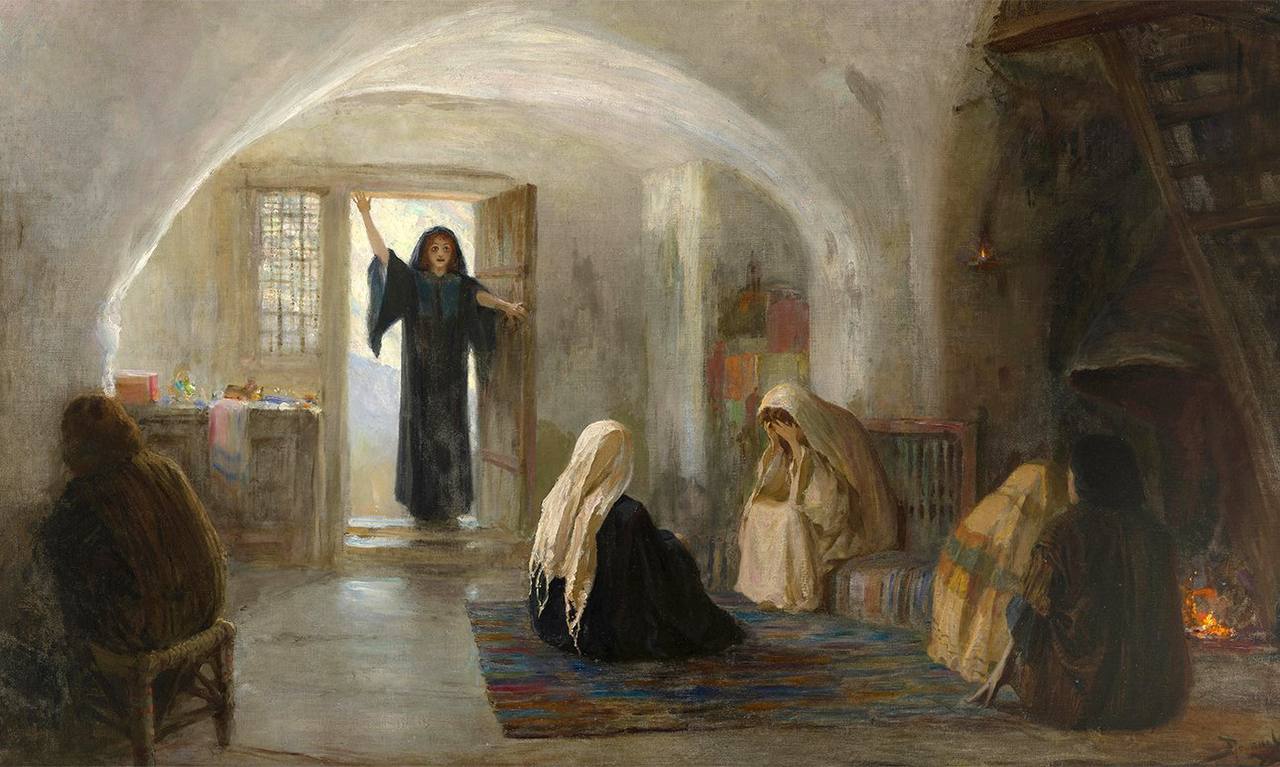
The highlight of the Bonhams sale, and the most expensive lot of the year in London, was a piece of history painting by Vasily Polenov, a canvas from the “Life of Christ” cycle, which went under the hammer for £1.4 million.
Sales of Russian applied art, Fabergé included, went very well in 2024 both at Christie’s and Sotheby’s and in New York, which traditionally remains an excellent market for the firm’s wares, partly because American collectors, too, are hunting for them.
In November works by Russian and Ukrainian artists sold successfully at Christie’s and Sotheby’s, in particular several rare works on paper by avant-garde artists from the collection of the Romanian-born American designer and philanthropist Mica Ertegun.
In November Sotheby’s put up a small but high-class collection of contemporary and avant-garde works from the private holdings of a German collector. Among the pearls was an early large-format painting by Viktor Pivovarov, which fetched €108,000, twice the preliminary estimate. There was also a contest over a work by Ivan Chuikov from his landmark “Windows” series, dedicated to Aivazovsky, which went for €72,000, and over a fantastical piece by Leonid Purygin inscribed in Russian “Democracy and glasnost, I am for Gorbachev”. Yet there were disappointments too: Ilya Kabakov’s large painting “Whose Fly Is This?”, a programmatic work for the artist recalling his famous installation “The Communal Kitchen”, found no buyer.
One of the sore points of the Russian domestic market remains the shortage of truly first-rate masterpieces at auction. The best works are usually sold privately, so that we experts can only guess at the real size and scale of the Russian art market. And when one tries to analyse the published results of sales at Moscow auctions, one concludes that there is no boom at all, since sales at public auctions are traditionally modest, and often only half of the lots find buyers.
The lack of transparency on the Russian art market means that such results often raise the question: is that a real price?