I rather feel I have failed a primary-school task from the magazine for the youngest pioneers "Yozh" (The Hedgehog), November 1933
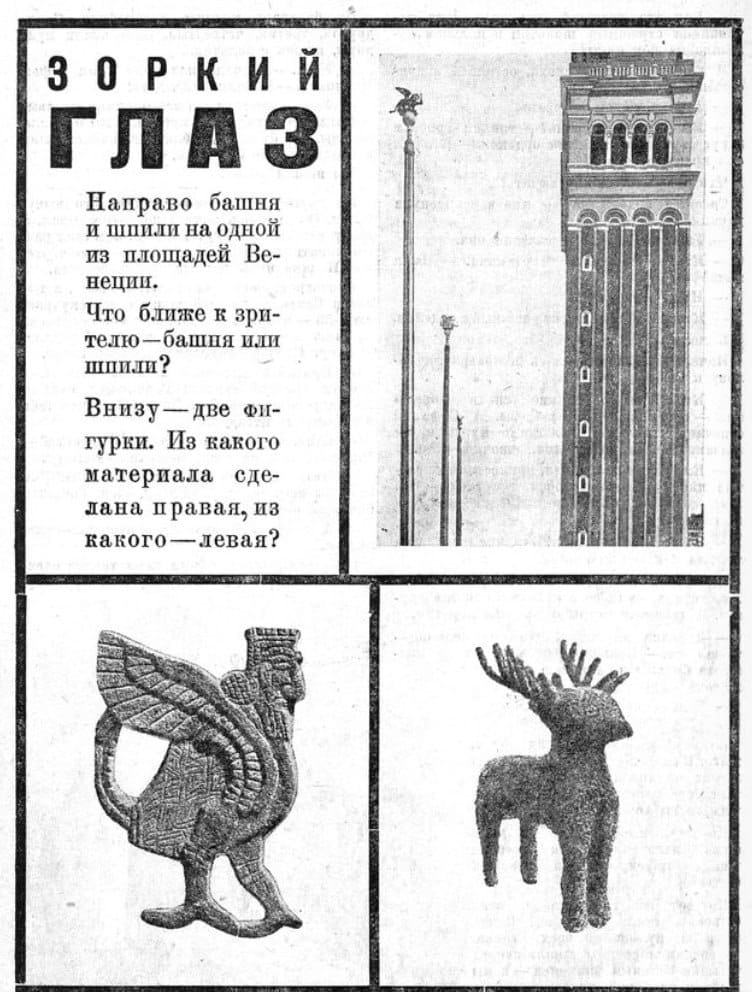
Applied art history for children, then, disguised as a training exercise for the eye. And if the spires and towers of Piazza San Marco in Venice are more or less clear, the second question, what the little figures at the bottom are made of, has proved a genuine puzzle to me.
On the one hand, the first image recalls a winged sphinx of the Iron Age in the Phoenician-Syrian manner. What might it be made of? Bronze, most likely, though the surface also has something of stone or ivory about it, like the ivories from Nimrud. Then again, it may not be an artefact of the Near Eastern cultures at all, but a specimen of Perm animal style, quite possibly a winged man-elk, cast by the flat-casting method in the 7th to 9th centuries somewhere in the Urals.
As for the second figure, it too recalls the bronze figures, or those made of some copper alloys, of the Perm animal style.
But something tells me I may very easily be mistaken. And a pioneer of 1933 would surely have dealt with it in no time at all.