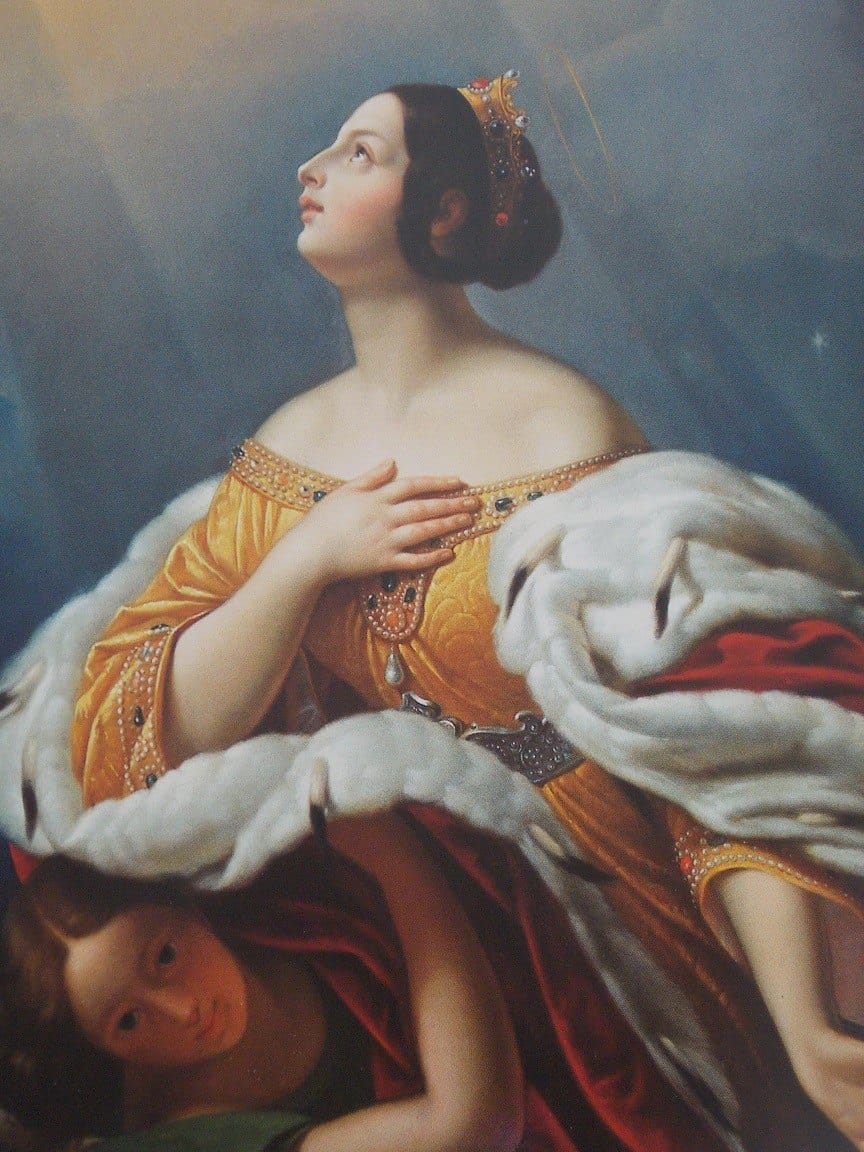
"Saint Tsaritsa Alexandra Ascending to Heaven", Karl Bryullov, 1845
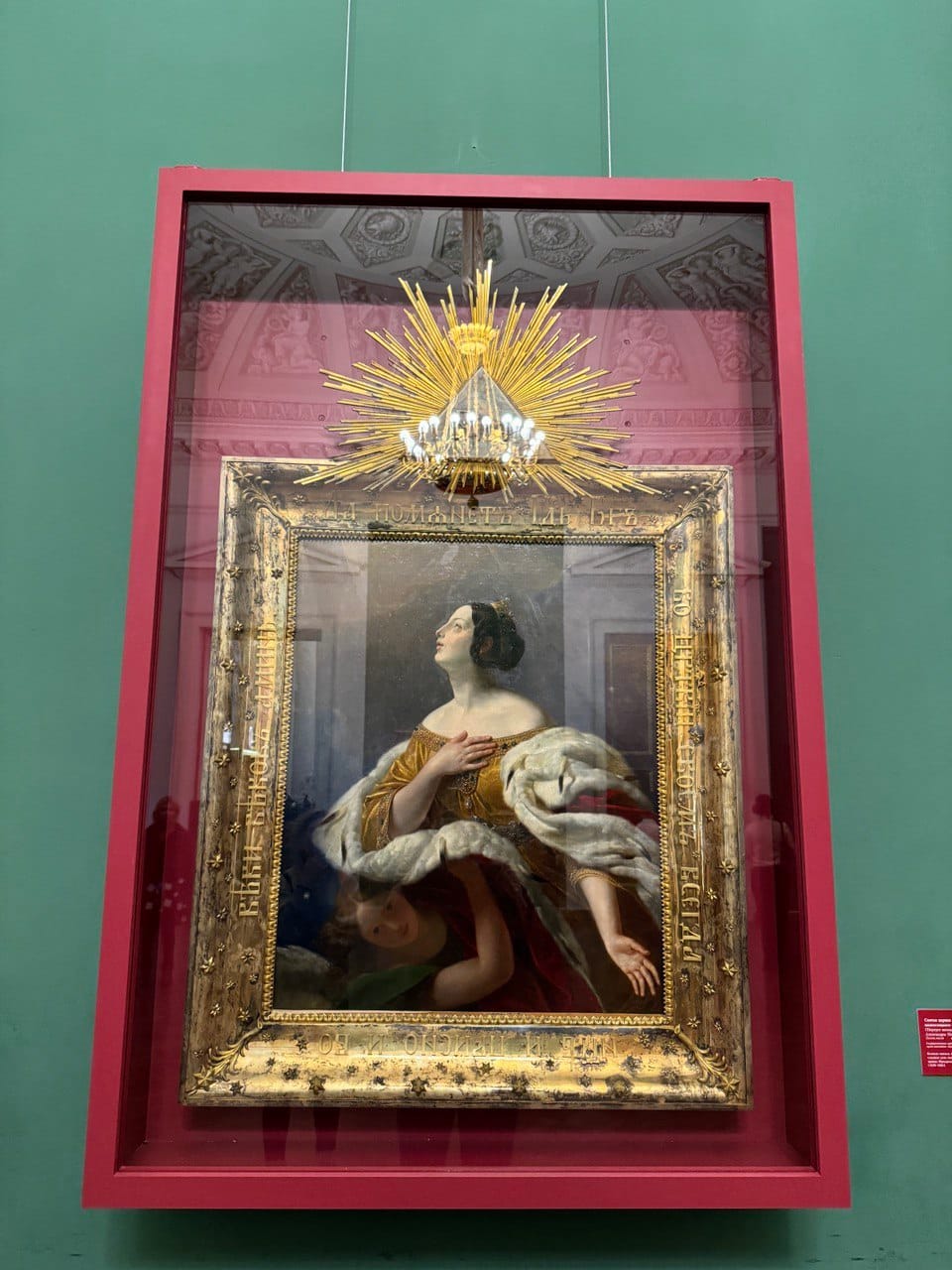
Clad in a golden silk gown and an ermine mantle, the picture shows Grand Duchess Alexandra (1825-1844), the youngest daughter of Emperor Nicholas I, a beauty and the darling of all. Alexandra Nikolayevna appears before us in an attitude of prayer, her face turned towards the divine light. This is the moment of her ascension, and an angel supports Alexandra.
Grand Duchess Alexandra Nikolayevna, whom everyone called Adini, died of tuberculosis at the age of 19, having barely had time to marry a German prince, a possible heir to the Norwegian crown, Frederick William of Hesse-Kassel. Adini was unable to carry a viable child, and her son William, born three months prematurely, died on the third day of his life.
Bryullov depicted the Grand Duchess in the guise of her heavenly patroness, Saint Alexandra, a great martyr of the 4th century, who is mentioned in the life of Saint George the Victorious, where she is called the tsaritsa and wife of the Emperor Diocletian. It is held that Saint Alexandra came to believe in Christ on witnessing the sufferings of Saint George and began to preach her faith openly, for which her husband sentenced her to be beheaded by the sword. But before she reached the place of execution she halted and died peacefully. There are certain contradictions as to whether Alexandra was the wife of Diocletian; in that case she is identified with Prisca, who may have taken the name Alexandra at baptism, or else she was the consort of an earlier emperor.
In Grand Duchess Alexandra's room at Tsarskoye Selo a prayer chamber with an iconostasis was arranged, and at its centre was placed an icon painted by Karl Bryullov, who, despite numerous refusals of commissions from the Court, painted this portrait with great zeal and without a fee.
Grand Duke Nicholas Konstantinovich bequeathed that he be buried beside his beloved sister. And so it happened that in the Cathedral of Saints Peter and Paul, on one side of his burial lay Alexandra-Adini, and on the other stood a pillar, so that it was impossible to carry out his wife's wish to be buried beside her husband. In the 20th century the grand-ducal burials were moved from the Cathedral of Saints Peter and Paul to a burial vault built nearby for the uncrowned members of the Russian imperial house.