Giorgio de Chirico's 1922 painting as an image of an emptied world and symbolic order
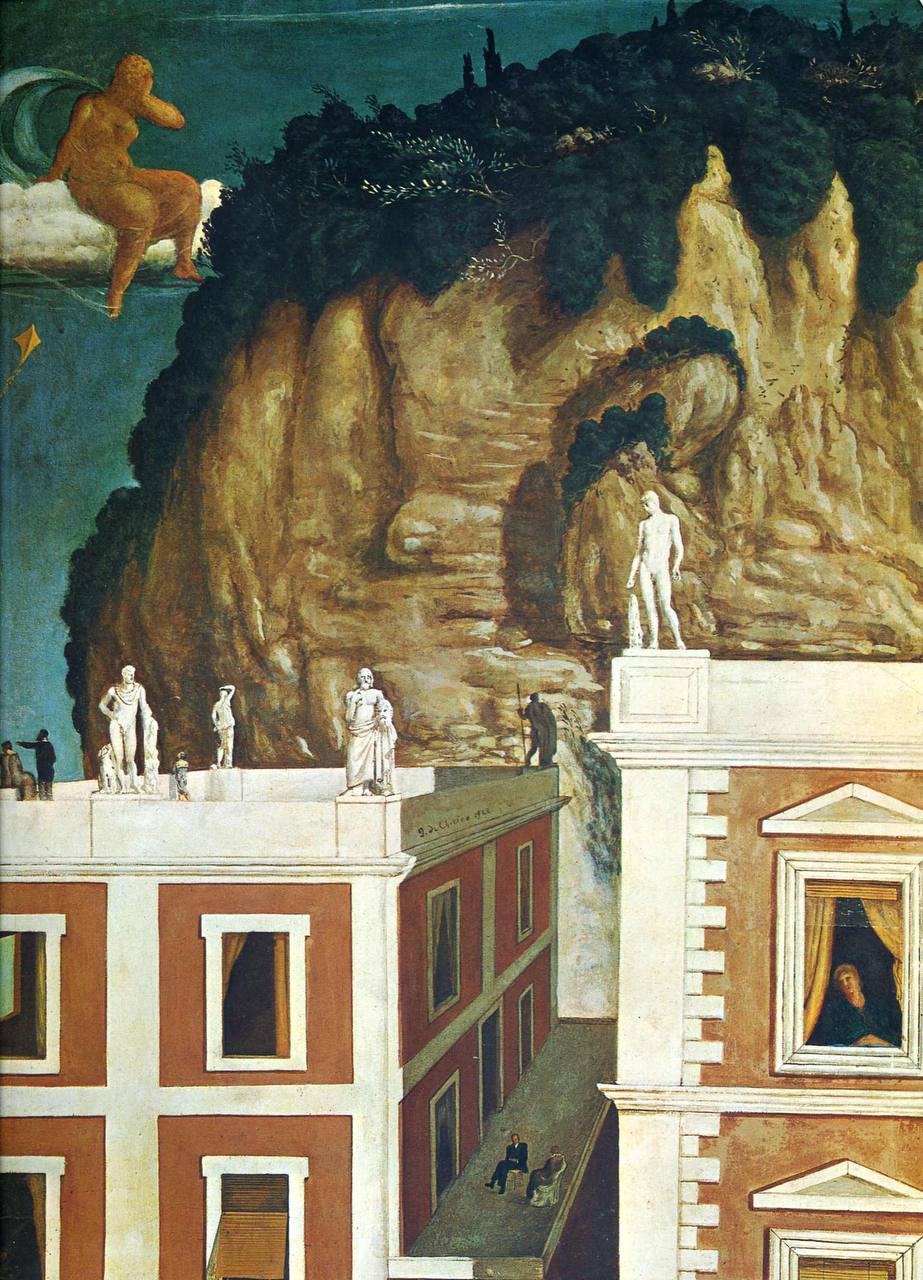
Strange Travellers, or Strange Wanderers?
Giorgio de Chirico, 1922.
A man on a cloud as a symbol of the beings flying on the "comet" Atlas.
Like no one else, de Chirico depicts mystery as the necessity of all being. You know, this painting recalls the setting of a classic disaster film, although there is, on the whole, nothing terrible in it. It is as if the world after the end of the world: some smudges in place of vanished people, or the mannequins that replaced them on the emptied stage. And somewhere within the industrial landscape one survivor of a deadly viral epidemic, or a pair of them, wanders about, themselves understanding nothing of what is happening.
The space in the shadow between the houses resembles a crack in reality, and the whole composition is rather what remains of reality when its canon collapses: buildings and squares do not stack up like a house of cards, but join together in some impossible sequence with drifting cliffs.
Who is travelling here, and where? Perhaps what we see is not wayfarers at their destination but the road itself as a structure of the symbolic order. That order, by and large, is the great stage set of our entire existence.
I keep looking at this painting, and when I am not looking at it, I remember it. I cannot catch its meaning, but perhaps there is none: there is only a matrix into which meaning can be placed and from which it can be removed.
Good morning and have a good day. Above all, don't get stuck in the textures.