A project to remodel the Acropolis by the celebrated Prussian architect Karl Friedrich Schinkel, whom Otto, the first King of the Greeks, invited to design a royal palace in Athens, a small provincial town of some 10,000 inhabitants…
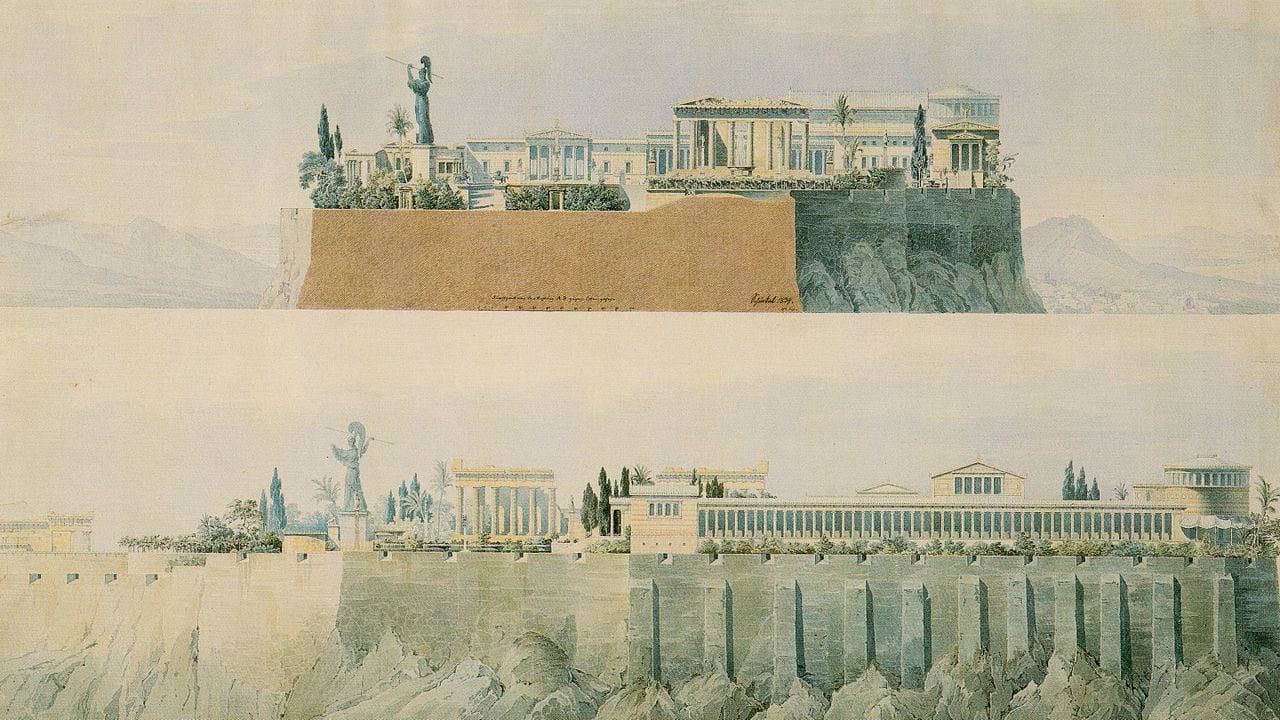
Schinkel was far ahead of his time in proposing that the palace be built literally on the site of the ancient temples, folding the ruins of the age of Pericles into a residential and administrative royal quarter. In effect, this would have meant the destruction of the Acropolis with all its monuments in favour of a pastiche, equally at home in Berlin, Warsaw or on the cliffs of the Black Sea coast.
According to the architect's conception, the ancient columns, slabs and, for instance, the Porch of the Caryatids were to be built into modern neoclassical architecture, uniting two historical epochs of Greece.
One of the sketches shows that it was planned to separate the old marble from the modern building with panes of glass. Museum display, however, was never in question: at that time the Acropolis was not yet regarded as one of the most precious possessions of all mankind. Schinkel, who had never before been to Greece or to Athens, would simply have preserved a few ancient stones in the walls of the new palace, purely for the sake of atmosphere and to keep up the spirit of romance.
Fortunately, the young Greece simply could not have afforded such a project, and the king preferred to abandon the grand scheme in favour of a more modest palace in the centre of the city, designed by another architect, von Gärtner. Today it is the palace on Syntagma Square (Constitution Square), and the Acropolis is the Acropolis, without any Schinkels