Ivan the Terrible and the boyars in Belinsky's 1836 review of Polevoy's history book
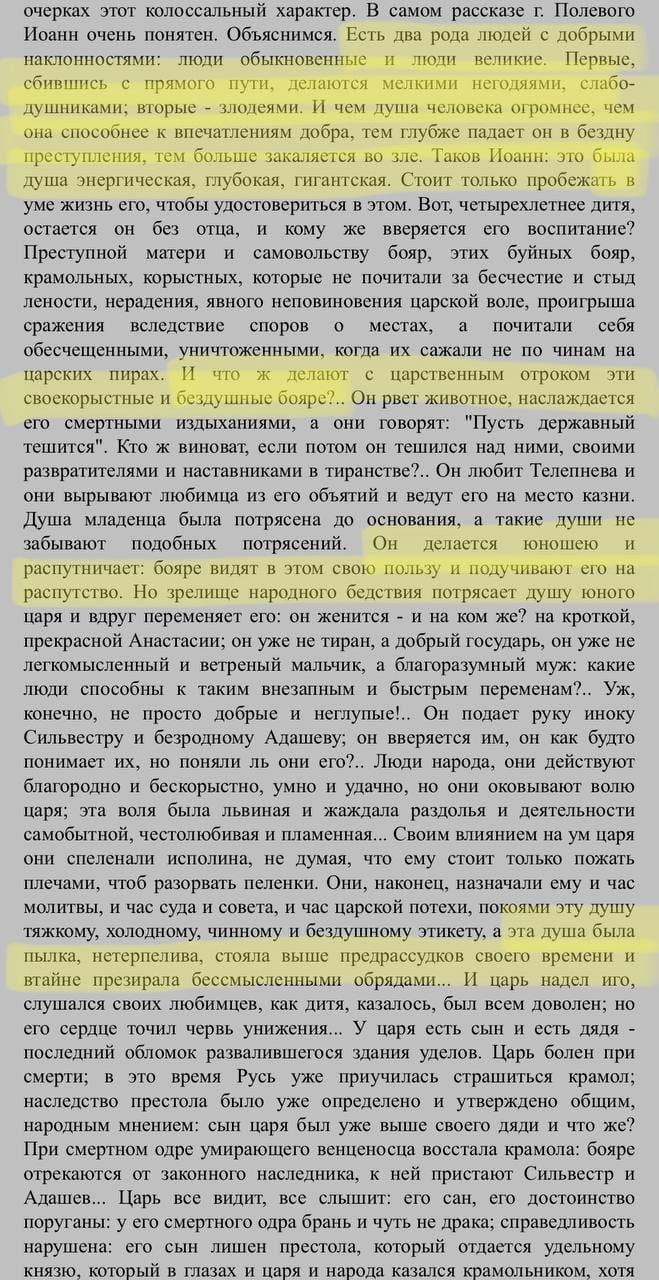
Remember how they drummed the great Vissarion Belinsky into our heads at school. Well, let us turn to his writings. Here is a review of 1836 of N. Polevoy's «Russian History for First Reading», in which Belinsky calls Ivan the Terrible a man of good inclinations, and a great one at that, with an enormous soul, capable of impressions of goodness... And the countless atrocities of this incarnate demon are, of course, the fault of the wicked, treacherous boyars, who turned this ardent, impatient soul, standing above prejudice, into a spawn of hell. John Vasilyevich himself, according to Belinsky, is a veritable angel.
I could say a great deal on the subject of the glorification of Ivan the Terrible; the tendency has long existed and has a motley historiography, but for some reason Belinsky chose the most talentless plot of all: the good, kind, sensitive tsar and the bad, wicked, heartless boyars.
And this despite the fact that Belinsky was already acquainted with what was, at that time, the most exhaustive study of sixteenth-century Rus', by Karamzin, who supplies ample information about the whole reign of Ivan the Terrible and his countless atrocities in all their colours. Instead of getting to grips with the sources and the dispassionate testimony to all the horrors of the reign of Ivan IV, Belinsky, together with Polevoy and a string of later authors, takes the path of psychological speculation, founded on personal conjecture rather than on facts.
I have a simple question: if the boyars were so bad, and the bloody Tsar John so good, then why was the only worthwhile thing in his many years of rule, namely the reforms of 1547-1556, carried out precisely by the boyars, who, in the tsar's own piteous phrase, had stripped him of all power and left him only the honour of presiding in the Duma?