Labouring for the glory of himself and his fatherland, and forever moving in society to divert his many friends with music, he fell in love with a certain lady, and the two of them took very great delight in their love
Labouring for the glory of himself and his fatherland, and forever moving in society to divert his many friends with music, he fell in love with a certain lady, and the two of them took very great delight in their love. But it so happened that in 1511 she caught the plague. Suspecting nothing and continuing to consort with her as was his wont, Giorgione caught the plague, so that in a short time he passed away at the age of thirty-four, to the infinite grief of his many friends, who loved him for his talents, and to the great loss of a world that had been deprived of him.
Vasari's life of Giorgione is rather brief. But from the information that can definitely be trusted, we learn that the artist was evidently acquainted with the works of Leonardo and was impressed by them; one of his pupils, if only for a short time, was Titian, who greatly surpassed his prematurely departed teacher. Yes, Giorgione died not in 1511 but in 1510: here Vasari was not quite accurate.
Giorgio Barbarelli was born in 1477 or 1478; the date and place of his birth have not been firmly established. He was a pupil of Giovanni Bellini and is considered one of the chief representatives of the Venetian school. He became famous in his own lifetime.
“Giorgione” is an augmentative of “Giorgio”, bestowed on him for his brilliance and the universal veneration of his talent.
Not so many paintings survive that are indisputably acknowledged as his work. Many works attributed to him are frequently regarded as doubtful. Among the master's undisputed works are: The Tempest, Venus, The Three Philosophers, the fresco from the Fondaco dei Tedeschi, The Adoration of the Shepherds, The Adoration of the Magi, Madonna with Two Saints, The Holy Family, Laura, the portrait of a knight with a page, the portrait of the poet Brocardo, a portrait of a man, Christ Carrying the Cross, The Concert, The Trial of Moses, The Judgement of Solomon. Two of Giorgione's undisputed works are held in the Hermitage: Judith and Madonna in a Landscape.
Some of Giorgione's paintings are also attributed to Titian, and some were quite certainly merely completed by Titian. Moreover, some of Titian's very earliest works were “considered so perfect” that they were attributed to Giorgione.
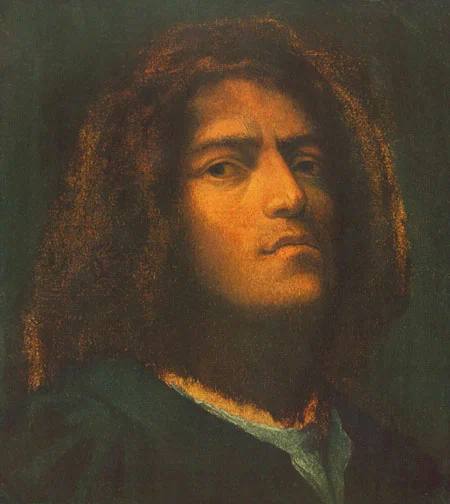
The two paintings in this post are usually called self-portraits of Giorgione, although in both cases his authorship is not beyond doubt. The second, the self-portrait of Giorgione as David in armour, of 1509-1510, is not unanimously accepted as the work of Giorgione himself, but it was used by Vasari as his portrait in the second edition of the “Lives of the Artists” in 1568. The first portrait was evidently painted on the basis of that very David, but not everyone considers it to have been painted by Giorgione himself.