A Roman prince's upbringing in Gogol's text and Gogol's monument at Villa Borghese
His early childhood passed in Rome; he was brought up as is the custom among Roman grandees who are living out their days. His teacher, tutor, nursemaid and anything else you please was an abbé, a strict classicist, an admirer of the letters of Pietro Bembo, the writings of Giovanni della Casa and five or six cantos of Dante, which he never read without loud exclamations: “Dio, che cosa divina!” — and then, two lines on: “Diavolo, che divina cosa!” — in which consisted nearly the whole of his artistic appraisal and criticism; he devoted the rest of his conversation to broccoli and artichokes, his favourite subject, knew perfectly well in which season veal is at its best and from which month one should begin eating kid, loved to chatter about all this in the street when he met a friend, another abbé, drew his plump calves very neatly into black silk stockings, having first stuffed woollen ones beneath them, purged himself regularly once a month with olio di ricino in a cup of coffee, and grew stouter with every day and hour, as all abbés do. Naturally, the young prince learned little under such a beginning. He learned only that Latin is the father of Italian, that monsignori come in three kinds — some in black stockings, others in violet, and a third kind who are almost the same thing as cardinals; he learned a few of Pietro Bembo's letters to the cardinals of his day, for the most part letters of congratulation; he came to know well the Corso, along which he walked with the abbé, and the Villa Borghese, and two or three shops before which the abbé stopped to buy paper, quills and snuff, and the apothecary's where he fetched his olio di ricino. In this lay the whole horizon of the pupil's knowledge. Of other lands and states the abbé hinted in some vague and uncertain strokes: that there is a land called France, a rich land, that the English are good merchants and fond of travelling, that the Germans are drunkards, and that in the north there is a barbarous land, Muscovy, where the frosts are so cruel that the human brain may burst.
A fragment of the tale “Rome”, published in 1842 in the journal Moskvityanin. It is an extract from Gogol's unfinished novel “Annunziata”. He lived in Rome for five years, yet in those years, oddly enough, he wrote mainly about Russia.
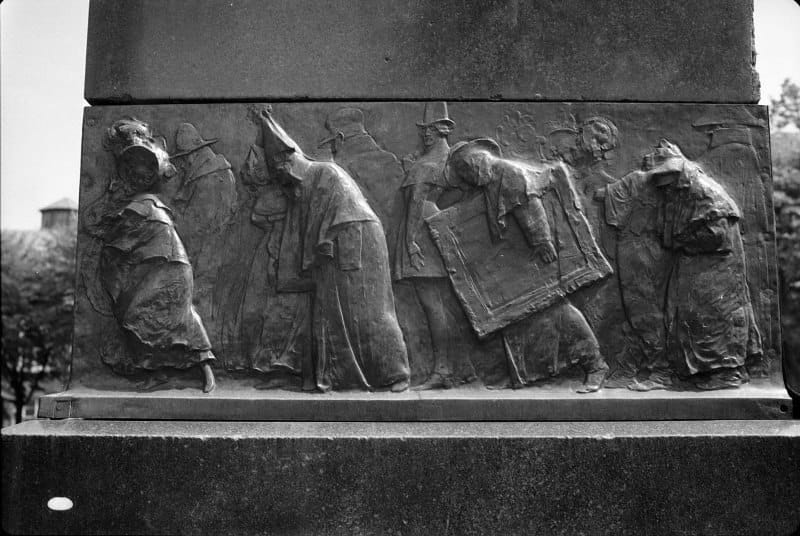
In 2002, for the 150th anniversary of Nikolai Vasilyevich's death, a monument to Gogol by Tsereteli was installed in the Garden of Poets in the Villa Borghese. Gogol dozes in a Roman [?] with his own smiling mask in his hand. Two years earlier Pushkin had appeared here.