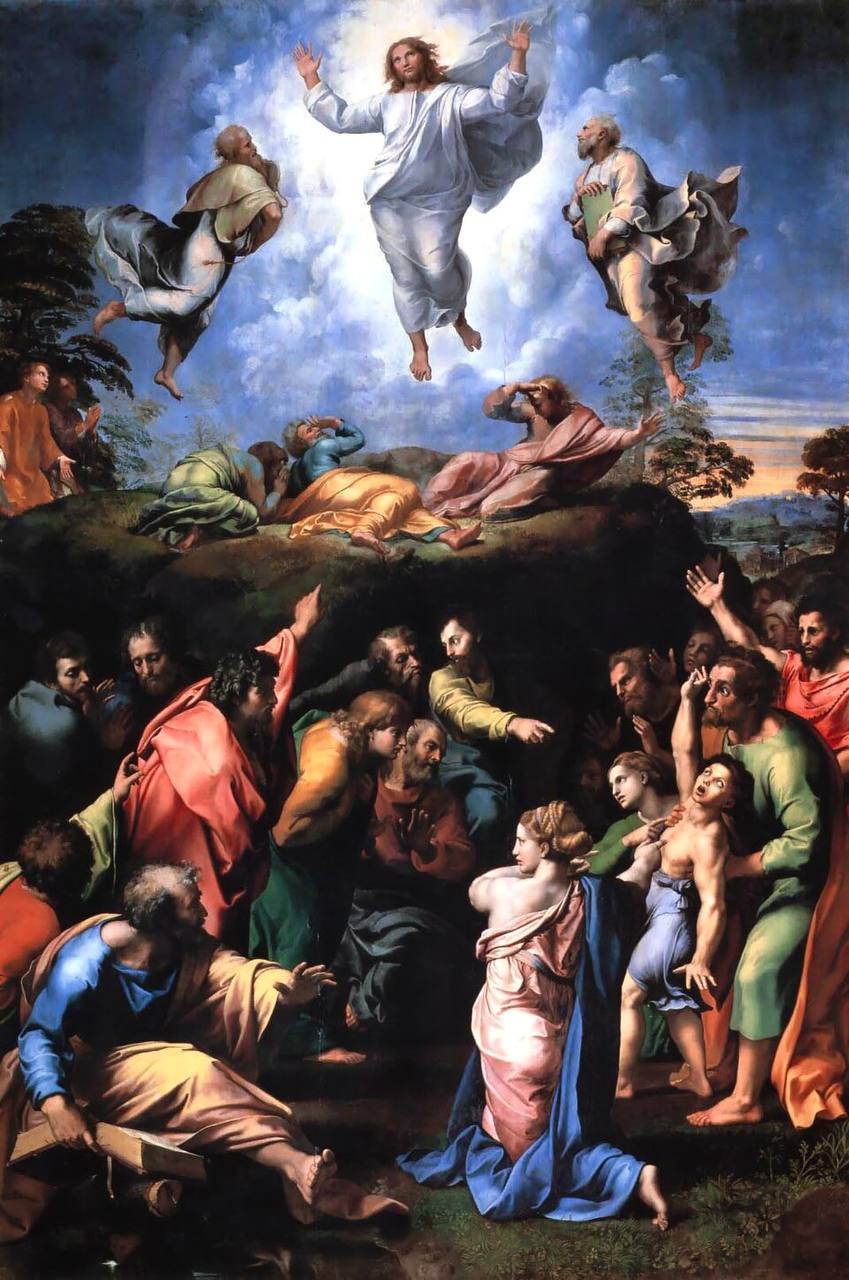
Let us begin the week before Great Lent with Raphael's Transfiguration of Christ
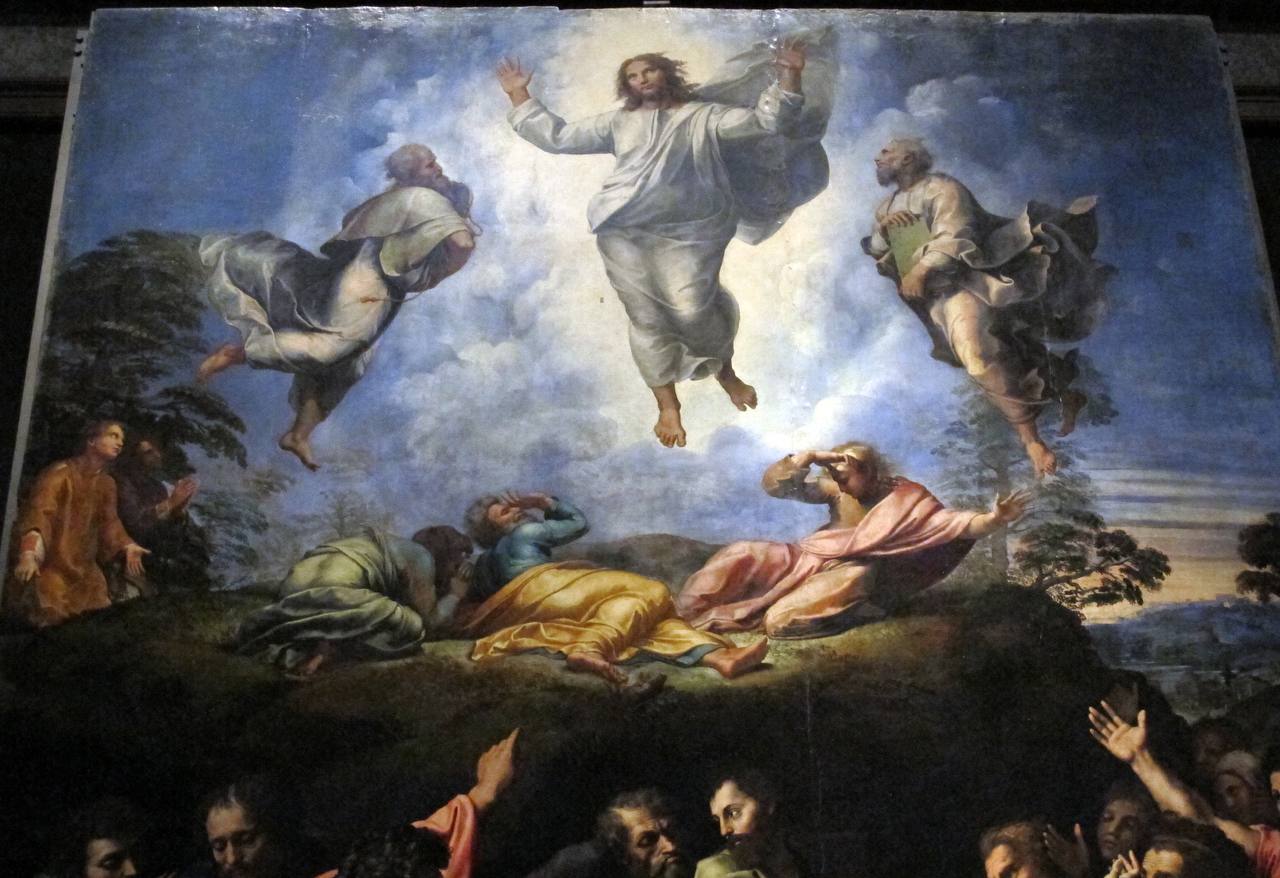
This is the last picture the artist worked on before his death in 1520. It is kept in the Vatican Pinacoteca.
A reminder that the beauty of Christ's sacrifice will save the world.
This is what Vasari writes about the work on this painting:
And for Giulio de' Medici, cardinal and vice-chancellor, he painted on panel the Transfiguration of Christ, which was intended for dispatch to France and on which he worked unceasingly with his own hand, bringing it to the utmost perfection. In this story he depicted Christ transfigured on Mount Tabor, at the foot of which the eleven disciples await him. Thither a possessed boy has been brought, so that Christ, on coming down from the mountain, might set him free. In the boy, who, his whole body convulsively stretched, cries out and rolls his eyes, we see all the torment that has penetrated deep into his flesh, into his sinews and into his blood, infected by the unclean power, and the deathly pallor of that body with its agonised and frightened movements. This figure is supported by an old man, who was not afraid to embrace him and who, his eyes wide open with glints upon the pupils, his brows raised high and his forehead wrinkled, expresses at once his strength of spirit and the fear that has seized him; and, judging by the fixed gaze he turns upon the apostles, he seems to be taking heart from his hope in them. There is also a woman among the many others who, being the principal figure in the picture, kneels in front of all the rest and, turning her head towards them, stretches out her arms to the demoniac, as though pointing to his sufferings. The apostles, some standing, some seated, and some bending the knee, show the greatest compassion for his misfortune.
And indeed Raphael painted in this work figures and heads which, to say nothing of their exceptional beauty, are so unusual, so varied and so fine that, by the unanimous opinion of artists, this is the most celebrated, the most beautiful and the most divine of all the works he ever produced. So whoever wishes to imagine and to represent in painting the divine transfiguration of Christ, let him look at this work, in which Raphael showed Christ hovering above the summit of that mountain and dissolved in the transparent air, and on either side of him Moses and Elijah, who, lit by a dazzling radiance, come to life in the light that issues from him. And on the ground beneath them lie prostrate Peter, James and John, in various and beautiful attitudes: one has bowed his head to the earth, another, shading his eyes with his hands, protects himself from the rays and the immeasurable brilliance surrounding the figure of Christ, who, clothed in snow-white garments, with arms outspread and brow raised, seems to embody the oneness of essence and the divine nature of all three persons of the Holy Trinity, gathered into one person by the great perfection of Raphael's art. And it seems that the artist so identified himself with his own mastery, revealing in the face of Christ all the daring and all the power of his art, that, having finished it as the last thing entrusted to him, he never again touched his brushes when death overtook him